
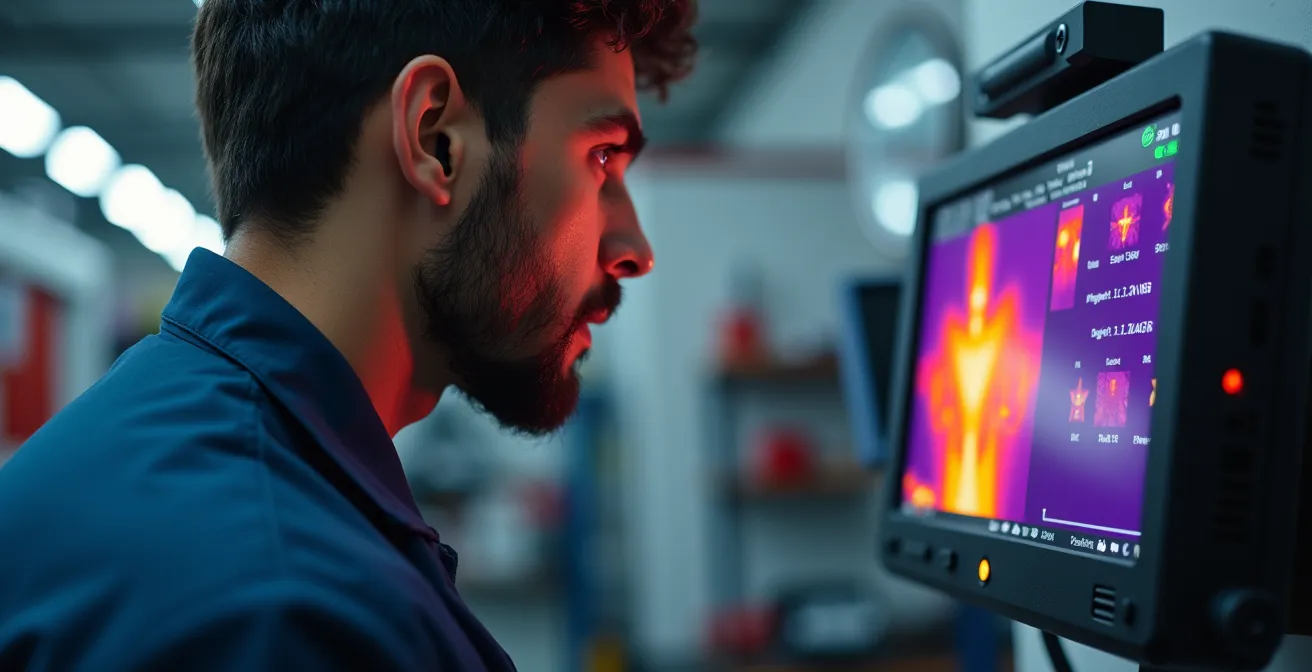
Catastrophic engine failure from heat is rarely sudden; it’s the final, predictable stage of a systemic thermal cascade that sends subtle warning signals long before total destruction.
- Standard gauge checks often miss the earliest pre-failure indicators, which manifest as unique acoustic signatures and subtle changes in fluid properties.
- The entire powertrain’s thermal system—including the engine, oil, and auxiliary coolers—must be managed as one integrated unit to prevent a chain reaction of failures.
Recommendation: Shift from a reactive repair mindset to a forensic, predictive maintenance model based on establishing baseline data, monitoring trends, and understanding the root causes of thermal stress.
For an owner-operator, the temperature gauge creeping into the red is more than an inconvenience; it’s a direct threat to your livelihood. An engine seizure on a remote highway means catastrophic repair bills, lost contracts, and potentially the end of your business. The common advice—check your coolant, look for leaks—is dangerously incomplete. It treats the symptom, not the disease. This reactive approach ignores the fact that total engine destruction is the final act in a long, predictable drama of escalating thermal stress.
The real key to asset protection lies in shifting your mindset from that of a driver to that of a forensic investigator. Catastrophic overheating is rarely a single-point failure. It is a thermal cascade failure, a chain reaction where one component’s struggle under heat compromises the next, and the next, until the entire system collapses. This guide moves beyond the dashboard gauge to teach you how to read the subtle, pre-failure diagnostics the engine provides. We will explore the acoustic signatures of impending failure, the science of oil viscosity breakdown under heat, and the interconnectedness of the entire cooling apparatus.
By learning to identify these early warnings, you can intervene before a minor issue becomes a terminal diagnosis. This forensic approach empowers you to move from costly, reactive repairs to a structured, predictive maintenance strategy that protects your most valuable asset and keeps you on the road.
For those who prefer a visual format, the following video offers a step-by-step diagnostic overview that complements the deep-dive analysis in this guide.
This article provides a structured, forensic breakdown of your engine’s thermal system. Each section is designed to build your diagnostic expertise, helping you understand not just what fails, but why, and how to detect it early.
Summary: A Forensic Breakdown of Engine Thermal Management
Identify Acoustic Warning Signs
The first sign of an impending thermal event is rarely the temperature gauge. By the time the needle hits red, critical damage may have already begun. A true diagnostician relies on a more sensitive instrument: their ears. Your engine has a baseline acoustic signature—a familiar set of sounds during normal operation. Deviations from this baseline are often the earliest indicators of stress on the cooling system.
Listen for a high-pitched whine that changes with engine RPM, which can indicate a failing water pump bearing. A sudden change in the fan’s roar could signal a faulty fan clutch that isn’t engaging correctly under load. Even a subtle squeal from the serpentine belt could be a clue; as components like the alternator or water pump begin to seize, they increase drag on the belt, causing it to slip and heat up. These are not just nuisance noises; they are data points indicating a mechanical problem that will inevitably manifest as heat.
Case Study: The Power of Baseline Monitoring
Marine technicians have perfected the art of pre-failure diagnostics by establishing detailed engine temperature baselines. Using infrared thermometers, they map and record temperatures at specific, repeatable points across the engine and cooling system during normal operation. This “temperature map” becomes a diagnostic blueprint. When a future reading deviates from the established baseline, they can pinpoint the source of a cooling system anomaly—like a partially clogged heat exchanger—long before it triggers an alarm or causes damage. This proactive methodology is directly applicable to trucking, where establishing your engine’s normal acoustic and thermal baseline is the first step in predictive maintenance.
Learning to interpret these sounds requires a disciplined ear. It means actively listening during startup, under load, and at idle. The image below shows a visual representation of sound frequencies; your brain can be trained to do the same thing, detecting subtle shifts in harmonic patterns that spell trouble.

Ultimately, treating your engine’s sound profile as a critical data stream transforms you from a passive operator into an active diagnostician. Any new or evolving sound is an immediate call for investigation, allowing you to catch a failing component before it triggers a thermal cascade failure.
Understand Oil Viscosity Under Stress
While coolant is tasked with removing heat, engine oil is the primary defense against the damage heat can cause. Overheating is not just a coolant system failure; it is a direct assault on the lubricating properties of your engine’s oil. The most critical, and often overlooked, consequence of excessive engine temperature is viscosity breakdown. Oil is engineered to maintain a specific thickness (viscosity) within a designated temperature window. For most heavy-duty trucks, this is a stable state. As the Diamond Fleet Service Technical Team notes in their maintenance guide:
When the engine temperature exceeds its designed operating range, excessive heat can lead to engine component failure, reduce lubrication effectiveness, and cause metal components to warp or break.
– Diamond Fleet Service Technical Team, Heavy Duty Truck Maintenance Guide
When temperatures climb past the optimal range, the long-chain molecules in the oil begin to break down. The oil thins out, losing its ability to maintain a protective film between moving metal parts. This is where catastrophic failure begins. The now-inadequate oil film allows for metal-on-metal contact between pistons and cylinder walls, or between bearings and the crankshaft.
This initial contact creates immense friction, which generates even more heat in a vicious, self-perpetuating cycle. The temperature spikes locally, far beyond what the gauge can read, leading to component scuffing, scoring, and eventually, seizure. A warped cylinder head or a blown head gasket is often a secondary symptom of this primary lubrication failure. Understanding this relationship is critical: an overheating engine is an engine that is actively destroying its own ability to stay lubricated, accelerating its path to total destruction.
The Mistake of Neglecting the Water Pump
If the engine is the heart of your operation, the water pump is the heart of the engine’s cooling system. Its sole function is to circulate coolant, moving heat from the engine block to the radiator to be dissipated. A failure here is not a minor issue; it’s a complete shutdown of the thermal regulation process. Yet, this critical component is often neglected until it fails catastrophically. The mistake lies in thinking a water pump works until it leaks. In reality, its failure is often a gradual process of declining efficiency.
The most common failure modes are bearing failure, seal failure, and impeller degradation. A worn bearing will often produce a high-pitched grinding or whining sound. A failed seal will result in a visible coolant leak from the “weep hole” at the bottom of the pump housing—a clear sign that replacement is imminent. The most insidious failure, however, is impeller erosion or cavitation. The impeller’s fins can be slowly eaten away by corrosive or improper coolant, or they can be damaged by air bubbles (cavitation), drastically reducing the pump’s ability to move fluid, even with no external leaks or noises.
This table, based on common diagnostic indicators, highlights the difference between a healthy pump and one that is failing internally. A forensic analysis of these symptoms is key to early detection.
| System Component | Normal Operation | Failure Symptoms |
|---|---|---|
| Coolant Flow | Steady circulation visible in radiator | No visible flow when engine revved |
| Temperature Differential | 10-20°F between inlet/outlet hoses | Minimal or no temperature difference |
| Physical Signs | No leaks, quiet operation | Coolant puddles, whining sounds |
| Temperature Gauge | Stable mid-range reading | Rapid fluctuations or steady climb |
Because water pump failure can be so devastating, proactive replacement is the only sound strategy for an owner-operator. Waiting for symptoms is a gamble you cannot afford to lose. Integrating replacement into your scheduled maintenance is a non-negotiable aspect of risk management.
Action Plan: Proactive Water Pump Replacement
- Track Hours: Use fleet management software or a logbook to track total engine operating hours.
- Set Interval: Schedule replacement based on a conservative interval, such as every 100,000 miles or 2,000 operating hours, whichever comes first.
- Monitor Fuel: Watch for unexplained drops in fuel efficiency, which can indicate increased engine strain from a struggling component.
- Inspect Seals: Perform a thorough visual inspection of the pump housing and weep hole for any signs of seepage or coolant residue at every oil change.
- Combine Services: To maximize efficiency, always replace the water pump whenever performing major front-end services like a timing belt replacement.
Optimize Auxiliary Cooling
A modern heavy-duty engine’s thermal load is not managed by the radiator alone. It is part of an integrated network of heat exchangers, including the charge air cooler (CAC), the engine oil cooler, and the transmission fluid cooler. Thinking of the radiator as the only cooling component is a critical error; these auxiliary cooling systems are intrinsically linked, and a failure in one can initiate a thermal cascade failure across the entire powertrain.
The charge air cooler, for example, is vital for engine performance and emissions. It cools the compressed air from the turbocharger before it enters the engine. If the CAC is clogged with debris or leaking, the intake air temperature rises dramatically. This forces the Engine Control Module (ECM) to inject more fuel to maintain power, which in turn generates significantly more combustion heat that the primary cooling system must now manage. A struggling CAC effectively overburdens the radiator.
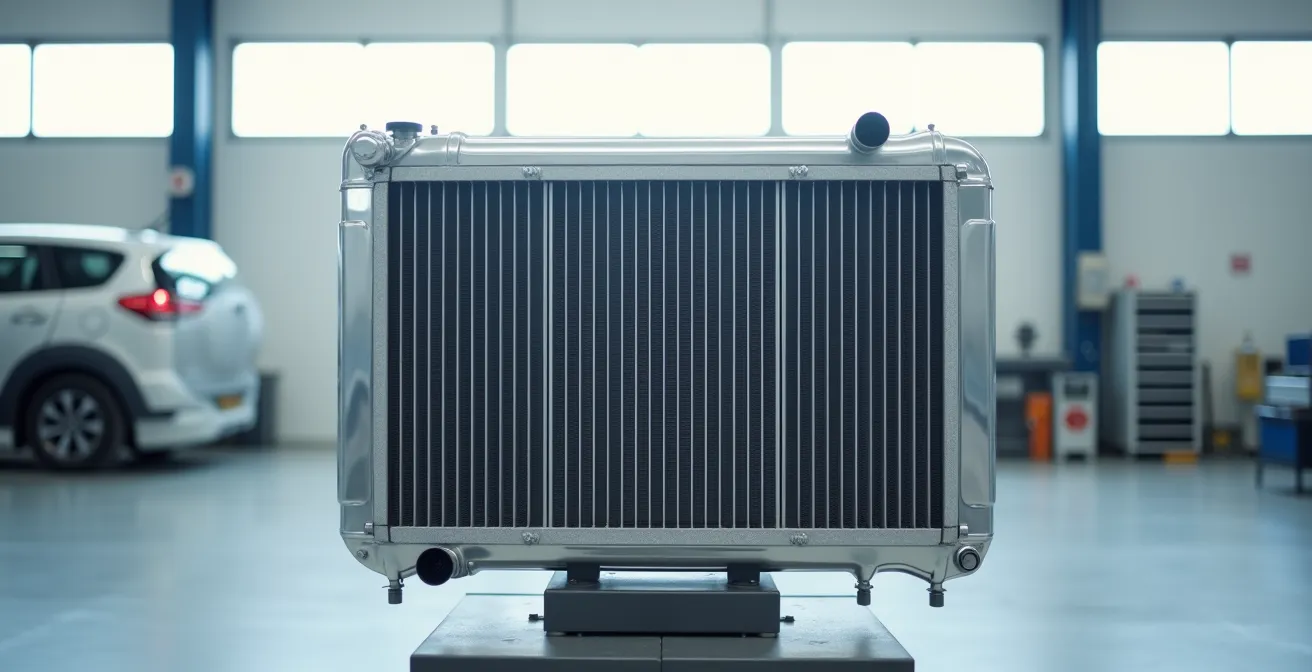
Similarly, the engine oil and transmission fluid coolers rely on the main engine coolant to dissipate their own heat. If the main system is compromised—due to low coolant, poor circulation, or a dirty radiator—these auxiliary coolers cannot function effectively. Transmission fluid temperature can spike, leading to premature wear and failure, while overheated engine oil begins its viscosity breakdown. This interconnectedness means a holistic approach is essential.
Case Study: The Domino Effect of Improper Coolant
An extensive analysis of commercial fleet cooling systems revealed how a seemingly simple mistake—using the wrong type of coolant—can trigger systemic failures. In several documented cases, improper coolant chemistry caused the formation of abrasive silicates or gels. These contaminants not only clogged radiator passages but also severely restricted flow in the narrow channels of auxiliary oil and transmission coolers. This single error led to a domino effect of overheated transmissions and accelerated engine wear, all originating from one chemical incompatibility. The study concluded that implementing strict coolant chemistry protocols and regular system flushes reduced these thermal-related cascade failures by 60%.
Plan the Emergency Response
Despite the best preventive measures, a sudden cooling system failure can still occur. A burst hose, a rock puncturing the radiator, or a sudden component seizure can send the temperature gauge climbing in seconds. In this moment, your actions will determine the difference between a manageable repair and a complete engine replacement. An emergency response must be a pre-planned, disciplined procedure, not a panicked reaction.
The absolute first rule is to resist the instinct to “just make it” to the next exit or service station. Continuing to drive a severely overheating engine for even a few minutes can cause irreversible damage. The extreme heat can warp the aluminum cylinder head, blow the head gasket, or cause pistons to expand and seize within their cylinders. The moment the gauge enters the red or a warning light appears, your only priority is to pull over safely and shut down the engine using the proper procedure.
A critical, often mishandled, part of the response is managing heat soak. When you shut down a very hot engine immediately, the coolant stops circulating, but the immense residual heat in the engine block and cylinder head has nowhere to go. This trapped heat can cause localized boiling of the coolant and oil, leading to thermal shock that can crack a cylinder head or damage turbocharger bearings. The correct procedure is to idle the engine for 3-5 minutes with the cabin heater and fan on maximum. This uses the heater core as a mini-radiator, pulling excess heat out of the engine block before the final shutdown.
Finally, personal safety is paramount. Never attempt to open the radiator or coolant reservoir cap on a hot engine. The system is under extreme pressure, and the coolant can be well over 250°F (121°C). Opening the cap will release a geyser of superheated steam and fluid, causing severe burns. You must wait at least 30-45 minutes for the system to cool before attempting any inspection.
Optimize Fluid Management
The fluids in your engine are not just lubricants or coolants; they are highly engineered chemical solutions designed for thermal management. A forensic approach to maintenance demands a deep understanding of their properties and a zero-tolerance policy for contamination or improper use. The challenge is immense, as a diesel engine is a remarkably inefficient heat machine. In fact, an analysis shows that only about 30 percent of gasoline energy converts to horsepower, with the vast majority being lost as waste heat that the fluids must manage.
The most common point of failure in fluid management is the coolant itself. Using the wrong type of coolant, or mixing different types, is a recipe for disaster. Different coolant formulations—Inorganic Acid Technology (IAT), Organic Acid Technology (OAT), and Hybrid Organic Acid Technology (HOAT)—use fundamentally different chemical inhibitors to prevent corrosion. When mixed, these chemistries can react, causing the inhibitors to “precipitate” or fall out of the solution. This creates a thick, abrasive sludge or gel that clogs radiator tubes, heater cores, and the small passages inside the engine block, leading directly to overheating.
This compatibility matrix is not a suggestion; it is a critical operational chart. Using the wrong fluid is equivalent to pouring sand into your cooling system.
| Coolant Type | Color | Service Life | Mixing Risk |
|---|---|---|---|
| IAT (Inorganic) | Green | 2 years/30,000 miles | High – forms gel with OAT |
| OAT (Organic) | Orange/Red | 5 years/150,000 miles | Critical – precipitates with IAT |
| HOAT (Hybrid) | Yellow/Gold | 5 years/150,000 miles | Moderate – reduced protection |
| Si-OAT (Silicated) | Purple/Blue | 5 years/150,000 miles | Low – compatible with most OAT |
Beyond chemistry, proper dilution is crucial. Coolant is typically sold as a concentrate that must be mixed with distilled water, usually in a 50/50 ratio. Using tap water introduces minerals like calcium and magnesium, which can form scale deposits on internal surfaces, insulating them and hindering heat transfer. Running too rich a mixture (e.g., 70% coolant) can also reduce heat transfer capability, as pure ethylene glycol is less efficient at absorbing and releasing heat than a 50/50 mix. Meticulous fluid management is the foundation of a healthy thermal system.
Optimize Engine Cooling on an Incline
Climbing a long, steep grade with a heavy load is the ultimate stress test for your truck’s cooling system. The engine is operating at maximum output for a sustained period, generating a massive amount of heat, while vehicle speed is too low for high-volume airflow through the radiator. This scenario creates a “perfect storm” for overheating. Successfully managing this thermal challenge requires more than just a healthy cooling system; it demands specific, proactive driving techniques.
The fundamental principle is to keep both the engine and the cooling system in their most efficient operating ranges. This often means resisting the urge to stay in a higher gear to save fuel. Lugging the engine in a tall gear at low RPM generates excessive heat and, critically, slows down the water pump, reducing coolant circulation at the very moment it’s needed most. The goal is to maintain sufficient engine speed to keep the water pump and fan operating effectively.
A disciplined approach to grade climbing can prevent the temperature gauge from ever starting its upward creep. The following techniques should become second nature for any mountain driving:
- Downshift Proactively: Before you even start the climb, downshift to a gear that allows the engine to run comfortably between 2200-2500 RPM. This ensures optimal water pump flow and fan speed.
- Monitor the Gauge: During a hard climb, your eyes should scan the temperature gauge every 30 seconds. The goal is to see a rise and then a stabilization, not a continuous climb.
- Pre-Cool the Engine: If your truck has a manual fan override (a “fan-on” switch), engage it a minute or two before hitting the base of the grade to give the system a head start on heat dissipation.
- Reduce A/C Load: The A/C condenser sits in front of the radiator and dumps significant heat into the airflow. Switch the A/C off or to recirculation mode to reduce this parasitic thermal load.
- Plan for Cool-Down: Use grade summits or designated pull-outs for a brief 5-minute cool-down stop. Let the engine idle to stabilize temperatures before shutting it down or starting a descent.
These techniques are not just “tips”; they are a professional-grade operational protocol. They transform you from a passenger to the active manager of your engine’s thermal state, allowing you to conquer the most demanding terrain without risking your equipment.
Key Takeaways
- Catastrophic overheating is a predictable cascade failure, not a sudden event. Early detection of acoustic and fluid changes is critical.
- Engine oil is the first victim of excess heat. Viscosity breakdown leads to friction and metal-on-metal contact, accelerating destruction.
- A holistic maintenance view is essential. The radiator, water pump, auxiliary coolers, and fluid chemistry must be managed as one integrated system.
Structure Preventive Maintenance to Reduce Downtime
The forensic mindset culminates in a structured, multi-tiered preventive maintenance (PM) program. The goal is to move beyond fixed-interval parts replacement and evolve toward a state of predictive maintenance, where data and inspection inform your service decisions. This approach minimizes downtime, prevents catastrophic failures, and ultimately lowers your total cost of operation. Instead of reacting to a breakdown, you are actively preventing it from ever occurring.
A robust thermal PM program can be broken down into three tiers of inspection, each with increasing levels of detail and frequency. This layered approach ensures that potential issues are caught at the earliest possible stage.
- Level 1 (Daily/Pre-Trip): This is the driver’s responsibility. It includes a visual check of the coolant level in the reservoir, a quick scan under the engine for any new drips or leaks, and a check of serpentine belt tension and condition.
- Level 2 (Monthly/PM Service): This is performed by a technician during regular service intervals. It involves pressure testing the cooling system and cap, cleaning debris from the radiator and CAC fins, and testing thermostat opening temperature.
- Level 3 (Quarterly/Annually): This is a deep diagnostic dive. It should include a laboratory analysis of the coolant chemistry to check for degradation of inhibitors and pH balance, and a thermal imaging scan of the entire cooling system to identify hidden hotspots or blockages.
This structured protocol generates invaluable data over time. You learn the specific wear patterns of your truck and can begin to predict failures. For instance, by tracking fan clutch engagement frequency with telematics data, you can see when a clutch is beginning to weaken and replace it before it fails on a hot day.
Case Study: The ROI of Predictive Maintenance
Thompson Truck Source, a service provider in Alabama and Florida, demonstrated the power of this approach by implementing a telematics-based predictive maintenance program. Instead of relying on fixed service intervals, they began monitoring real-time engine temperature trends, fan clutch cycles, and coolant pressure variations across their fleet. This shift to condition-based maintenance allowed them to identify and address failing components proactively. Within the first year, this data-driven strategy reduced thermal-related failures by 45% and slashed emergency roadside repairs by a staggering 60%.
For an owner-operator, this model provides the ultimate level of asset protection. It replaces guesswork with data, transforming maintenance from an expense into a strategic investment in reliability and uptime.
To implement a truly effective preventive strategy and protect your investment from the risk of thermal failure, the next logical step is to have a professional diagnostic assessment performed to establish your engine’s unique operational baseline.
Frequently Asked Questions on Engine Overheating
Should I continue driving if the temperature gauge enters the red zone?
No, pull over immediately. Continued driving can cause head gasket failure, warped cylinder heads, or complete engine seizure within minutes.
Is it safe to open the radiator cap on a hot engine?
Never open a hot radiator cap. Wait at least 30 minutes after shutdown. The pressurized coolant can reach 250°F and cause severe burns.
What’s the proper cool-down technique before shutdown?
Idle the engine with heater on maximum for 3-5 minutes to dissipate heat soak, preventing thermal shock damage to turbochargers and cylinder heads.