

In summary:
- Making the switch to an EV is less about learning new buttons and more about unlearning a lifetime of combustion engine driving habits.
- Mastering concepts like one-pedal driving and proactive battery management is key to overcoming range anxiety and maximizing efficiency.
- The EV ownership experience extends beyond the road, integrating the vehicle into your home’s energy ecosystem for charging and power.
- Understanding the core differences in motor architecture and aerodynamics explains the unique performance and feel of an electric car.
The silence is the first thing you notice. For a lifelong driver of internal combustion engine (ICE) vehicles, stepping into your first electric vehicle (EV) is a sensory reset. There’s no rumble on startup, no vibration at a standstill—just quiet readiness. This initial novelty, however, is a gateway to a much deeper transformation. The real challenge and reward of switching to electric isn’t learning to plug in a car; it’s about fundamentally rewiring your driver’s intuition. Habits honed over decades—coasting to a stop, the feel of an engine’s gear changes, the mental model of a gas tank—are no longer just irrelevant; they are inefficient.
Many guides for new EV owners focus on the basics: charging types, app features, and public station etiquette. While important, these are procedural details. They fail to address the core cognitive shift required. The transition is not simply from gas pump to wall socket, but from a passive energy consumer to an active energy manager. This article will not just list features. It will guide you through the process of unlearning old habits and cultivating a new mechanical sympathy for a machine that operates on an entirely different energy paradigm. We will explore how to master the feel, the efficiency, and the long-term ownership of your EV by focusing on the ‘why’ behind the ‘what’, turning you from a new user into a confident, expert electric driver.
This guide provides a structured path through the key adaptations required. Below is a summary of the essential milestones on your journey to mastering the electric driving experience.
Summary: Adapting Your Driving to an Electric Future
Understanding One-Pedal Driving
The most immediate and profound change to your driving muscle memory is one-pedal driving. In an ICE car, you learn to coast, lifting your foot off the accelerator to maintain momentum while using the brake pedal to slow down. One-pedal driving inverts this logic. By using regenerative braking, the car slows down assertively the moment you lift your foot off the accelerator, converting kinetic energy back into battery charge. This isn’t just a new feature; it’s the first step in unlearning a lifetime of habit and beginning the cognitive rewiring process. Initially, it can feel jerky and unnatural, requiring a new level of foot modulation.
This adjustment period is common, as drivers must learn to anticipate stops far earlier and use subtle lifts of the pedal to slow smoothly in traffic. The experience of a couple featured in The Guardian highlights this learning curve, who at first struggled with their EV’s eco-mode, only to later discover the immense power available when they understood the system. This “aha” moment is crucial; it’s when you stop fighting the car’s nature and start collaborating with it.
London EV Driver’s One-Pedal Learning Curve
A Guardian featured couple struggled initially with eco-mode, ‘laboring up a hill, accelerator flat to the floor and still only hitting 55 mph,’ then discovered that switching modes ‘pinned them against the seats by the sheer force.’ This real-world experience highlights the importance of understanding regeneration settings before attempting challenging driving conditions.
To master this technique, it’s about developing a new sensitivity in your right foot, moving from a binary on/off approach to a delicate dance of pressure and release. The illustration below shows the poised foot position required for this nuanced control.
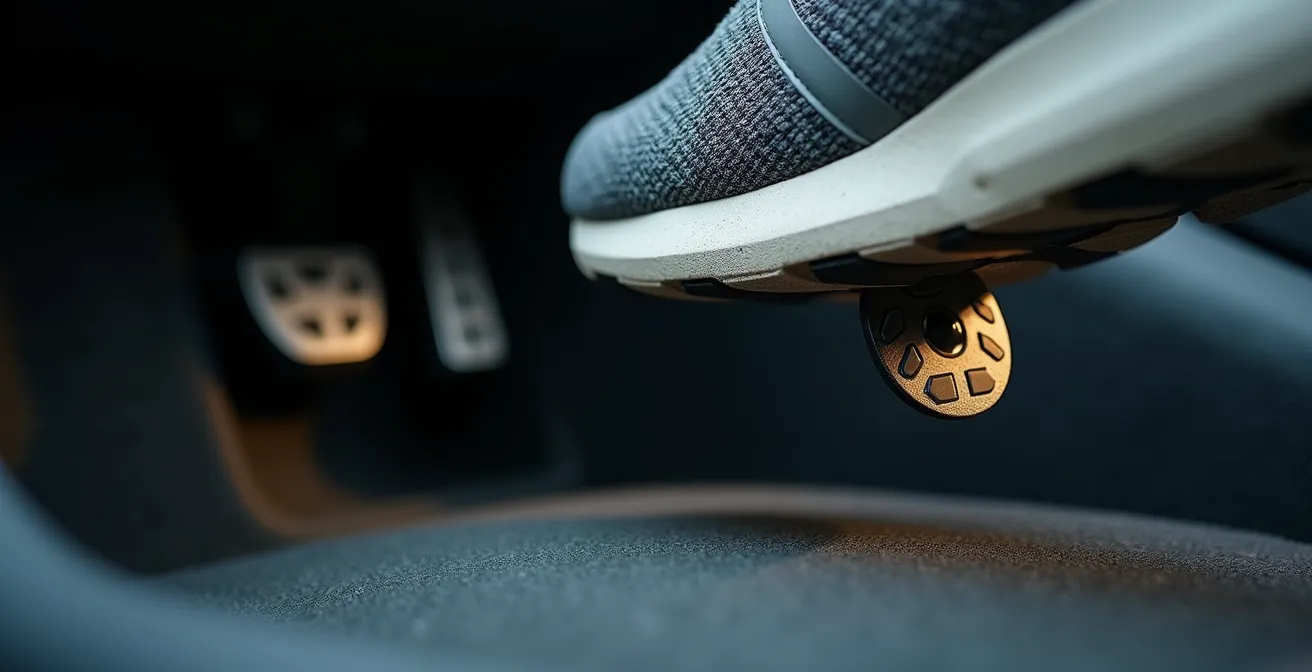
This control allows you to navigate most city driving without ever touching the brake pedal, maximizing your energy recovery and fundamentally changing your interaction with the vehicle. The following steps provide a structured plan for building this new skill.
Your Action Plan: Master One-Pedal Driving in 5 Steps
- Start in a low regeneration mode to understand the deceleration feel without sudden stops.
- Practice in empty parking lots, lifting off the accelerator at different speeds to gauge stopping distances.
- Gradually increase regeneration strength as your muscle memory develops over 2-3 weeks.
- Learn to modulate pressure for smooth traffic flow by using partial lifts for gentle slowing.
- Master anticipation by beginning to regenerate 100-150 feet before stops for maximum energy recovery.
The Range Estimation Error
The second major psychological hurdle for new EV owners is “range anxiety,” fueled by the often-inaccurate range display on the dashboard. This number, colloquially known as the “Guess-O-Meter” (GOM), is not a fixed measure like a gas gauge. It’s a dynamic estimate based on recent driving style, temperature, and terrain. An aggressive drive on a cold day can cause the estimated range to plummet, creating panic. Unlearning your trust in this single number and embracing a new energy paradigm based on efficiency (miles per kilowatt-hour or mi/kWh) is critical. Your goal is to shift focus from “how many miles are left” to “how efficiently am I using my energy.”
Real-world data consistently shows a discrepancy between a vehicle’s rated range and its actual performance. For example, a detailed analysis by CarMax shows that it is common for a vehicle to achieve 207 miles of actual range from a car with a 259-mile EPA rating when starting at an 80% charge. This isn’t a defect; it’s a reflection of variables the EPA test cycle cannot fully account for, such as highway speeds and climate control use. Trusting the GOM is like trusting a weather forecast from last week. To gain true confidence, you must learn to use more accurate tools and your own data.
The most effective way to conquer range anxiety is to understand the different methods for calculating range and their respective accuracy. The car’s display is merely a starting point, while dedicated apps and personal tracking provide a much clearer picture for daily commutes and long journeys alike.
| Method | Accuracy | Best Use Case |
|---|---|---|
| Car Display (GOM) | ±20% variance | Quick reference only |
| Personal mi/kWh tracking | ±5% after 3 months data | Daily commuting |
| Route planning apps | ±3% with weather data | Long trips |
Optimizing Battery Health
In an ICE vehicle, “mechanical sympathy” meant regular oil changes and listening for engine noises. In an EV, this concept is reborn as battery stewardship. The lithium-ion battery is the heart of your vehicle, and its long-term health depends on how you charge and use it. Unlike a gas tank, which you fill to the top, an EV battery is healthiest when kept within a specific State of Charge (SoC) range. Routinely charging to 100% or letting it drop to near 0% puts stress on the battery chemistry and can accelerate degradation over time. The golden rule for daily driving is the 20-80% rule: try to keep your battery between 20% and 80% SoC.
This requires another mental shift. Instead of waiting for the “tank” to be empty, you adopt a “grazing” charging habit—plugging in overnight to top up to 80%, rather than filling up once a week. Most modern EVs allow you to set a charging limit directly in the vehicle’s software, making this an easy habit to adopt. For long road trips, charging to 100% is perfectly acceptable, but it shouldn’t be the default for daily use.
Concerns about rapid battery failure are largely unfounded. Real-world data provides a much more optimistic picture of longevity. A long-term review of battery performance in Tesla vehicles shows the degradation curve is not a steep cliff, but a gradual slope.
Tesla Battery Performance Over 130,000 Miles
Historical Tesla data from Battery University shows capacity degradation of about 5% after 50,000 miles, with a steady range maintained up to 95,000 miles. Later software updates can also adjust the usable capacity to protect long-term health, illustrating that battery management is an ongoing, software-supported process.
By treating the battery not as a consumable but as a long-term asset to be managed, you ensure the vehicle’s performance and value for years to come. This proactive approach is the essence of modern EV ownership.
Comparing Motor Architectures
Every ICE driver has an intuitive feel for how an engine delivers power—the lag of a turbo, the high-revving peak of a naturally aspirated engine, the rumble of a V8. An EV’s powertrain feels entirely different, delivering silent, instantaneous, and seamless acceleration. This isn’t magic; it’s a direct result of the electric motor’s design. Understanding the basic motor types helps demystify this experience and explains the subtle differences in driving feel between various EV models.
As the EV Four Corners Research Team notes in their comprehensive study on the driving experience, the fundamental design of electric motors gives them an inherent performance advantage. This is a key part of the unique driving character of an EV.
EVs are more powerful than their gasoline colleagues because electric motors can deliver maximum torque at all speeds
– EV Four Corners Research Team, The Electric Vehicle Driving Experience Study
The three most common types are Permanent Magnet, Induction, and Dual Motor (AWD) setups. Permanent Magnet motors are highly efficient and provide smooth power, making them common in many modern EVs. Induction motors, famously used by Tesla in their earlier models, are known for their robustness and powerful low-end torque. Dual Motor setups combine motors on both axles, providing all-wheel-drive confidence and the ability to optimize efficiency by using only one motor during gentle cruising.
Each architecture impacts not only the “pinned to your seat” feeling but also long-term ownership factors like energy costs and maintenance. This knowledge transforms you from a mere driver to an informed owner who understands the engineering behind the experience.
| Motor Type | Driving Feel | Long-term Ownership Impact |
|---|---|---|
| Permanent Magnet | Smooth, efficient at all speeds | Lower energy costs, rare-earth dependency |
| Induction | Strong low-end torque | Robust, minimal maintenance after 10+ years |
| Dual Motor | AWD confidence, selective efficiency | Redundancy benefit, higher initial cost |
Planning for Winter Heating
Winter is the ultimate test of an EV owner’s proactive energy management skills. In an ICE car, cabin heat is a “free” byproduct of the engine’s inefficiency. In an EV, creating heat requires a significant amount of energy directly from the battery, which can reduce driving range by 30% or more in freezing conditions. This is often the biggest shock for first-time EV owners in colder climates. Learning to heat the car (and yourself) efficiently is not just a comfort tip; it’s a critical range-preservation strategy. The key is to shift from heating the entire cabin to heating the occupants directly.
The most effective strategy is preconditioning. This involves heating the cabin and battery while the car is still plugged into the charger. You get into a warm car with a warm (and therefore more efficient) battery, without having used any of the stored energy for your trip. Additionally, using heated seats and a heated steering wheel is vastly more efficient than running the main cabin heater, as they use up to 75% less energy to create a similar feeling of warmth.
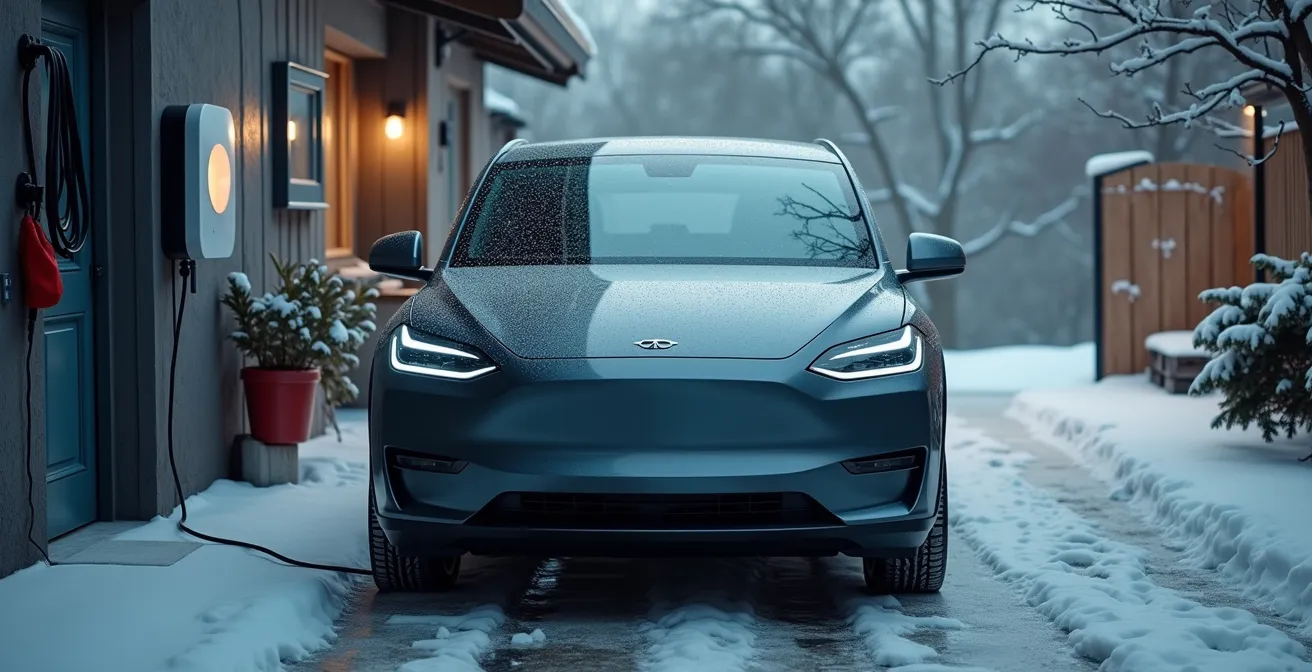
The type of heating system in your EV also plays a major role. Older EVs use simple resistive heaters, which are like giant toasters. More modern vehicles are equipped with a heat pump, a far more efficient system that functions like a reverse air conditioner, scavenging heat from the ambient air and drivetrain components. The difference in range is significant, as Hyundai’s engineering data confirms a 10-15% range preservation with a heat pump in cold weather. Planning for winter involves a combination of smart habits and understanding your vehicle’s technology:
- Pre-heat the cabin while plugged in to save 5-7% of your battery’s range.
- Prioritize heated seats and steering wheel over blasting the cabin heat.
- Park in a garage whenever possible to keep the battery from getting deeply cold-soaked overnight.
- Schedule your charging to finish just before you plan to leave, ensuring the battery is warm and at peak efficiency.
Adapting Historic Design to Aerodynamic Constraints
An EV’s design is a slave to efficiency. While ICE car design can afford the flourishes of large grilles (needed for cooling) and muscular, sharp-edged bodies, EV design is dictated by aerodynamics. The less air the car has to push out of the way, the less energy it uses, and the farther it can travel on a single charge. This is why many EVs share a similar smooth, flowing, and sometimes controversial aesthetic: flush door handles, covered wheel wells, and sloping rooflines. It’s a form that directly follows function. This represents a core part of the new energy paradigm: every element of the car is scrutinized for its impact on range.
This principle of aerodynamic efficiency is not just about maximizing range for daily driving; it directly translates to high-performance capabilities. In motorsport, where energy management is paramount, aero-first design has proven to be a race-winning strategy. The lessons learned on the track directly influence the design of the consumer cars we drive, demonstrating that a slippery shape is key to both endurance and speed.
Volkswagen ID.R Pikes Peak Aero Success
To prove the direct link between aerodynamics and performance, look no further than motorsport. As noted in the Electric Vehicle Driving Experience Report, Volkswagen’s aerodynamically optimized ID.R EV didn’t just win its class at the Pikes Peak International Hill Climb in 2018; it set a new overall record, beating highly powerful gasoline cars. This demonstrated conclusively how an aero-first design directly translates to superior cornering speed and overall performance by minimizing drag.
For a driver coming from an ICE world, where design often prioritizes aggressive aesthetics, understanding this shift is key. The “missing” grille isn’t just a style choice; it’s a statement of efficiency. The smooth, almost featureless body isn’t boring; it’s a carefully sculpted tool for cutting through the air with minimal effort. Appreciating this connection between form and function is part of developing a deeper “mechanical sympathy” for your electric vehicle.
Comparing Automatic and Manual Transmissions
One of the most profound mechanical differences between an EV and an ICE car is the near-total absence of a traditional transmission. Electric motors operate efficiently across a huge range of RPMs, so they don’t need a complex system of gears to deliver power to the wheels. This results in a drivetrain that is astonishingly simple. This mechanical simplicity is a core benefit of EV ownership, leading to lower maintenance costs and enhanced reliability. There are no transmission fluids to change, no clutches to wear out, and far fewer points of failure.
The scale of this simplification is dramatic. For instance, an analysis of Tesla’s engineering reveals a massive reduction in complexity compared to a traditional vehicle. This is not just an incremental improvement; it’s a complete reimagining of what a powertrain can be.
This is powerfully illustrated by a key finding where Tesla’s engineering analysis demonstrates the removal of nearly 2,000 moving parts from a traditional drivetrain, replacing them with just 17 in their electric motor and gearbox assembly. This leap in simplicity is a primary reason for the reduced maintenance needs of an EV.
However, for driving enthusiasts coming from manual transmission cars, this seamless simplicity can feel sterile and disconnected. The tactile feedback of a perfect gear change and the engine braking control are core parts of the driving pleasure. Automakers are now addressing this by using software to reintroduce that sense of engagement, creating a “best of both worlds” experience.
Hyundai IONIQ 5 N’s Simulated Manual Experience
High-performance EVs like the Hyundai IONIQ 5 N are bridging this experiential gap. As detailed by Hyundai, their innovative N e-Shift technology simulates the jolt and sound of an 8-speed dual-clutch transmission. It gives drivers the sensory feedback and control they crave, with virtual “gearshifts” and simulated engine braking, all while retaining the instant torque and efficiency of an electric motor. This shows that the future of engaged driving is not being lost, but redefined by software.
Key takeaways
- Mastering one-pedal driving is about harnessing regeneration, not just replacing the brake pedal.
- True range confidence comes from tracking your personal efficiency (mi/kWh), not by trusting the dashboard’s estimate.
- Long-term battery health is best maintained by keeping the daily charge level between 20% and 80%.
Integrating Electric Vehicles with the Home Energy Grid
The final and most complete step in your cognitive rewiring is to stop seeing your EV as just a vehicle. It is now a large, mobile battery that is an integrated part of your home’s energy ecosystem. For an ICE driver, the relationship with energy ends at the gas pump. For an EV owner, it continues at home. Setting up a proper home charging station is not just about convenience; it’s about taking control of your “refueling” costs and schedule in a way that was never possible before. This is the culmination of the new energy paradigm.
The standard for home charging is a Level 2 (240V) charger. While you can trickle charge with a standard Level 1 (120V) wall outlet, it’s impractically slow for daily use, adding only a few miles of range per hour. A Level 2 charger can fully replenish your battery overnight, ensuring you start every day with a “full tank” at a fraction of the cost of gasoline. Setting this up correctly involves a few key steps:
- Install a dedicated Level 2 (240V) charger in your garage or driveway for reliable overnight charging.
- Use your vehicle’s app or charger’s software to schedule charging for off-peak electricity hours (often late at night), significantly lowering your cost per mile.
- Set your daily charge limit to 80% directly through the app to automate good battery health practices.
- Monitor your monthly electricity bill to understand your new consumption pattern and optimize your charging schedule further.
This integration goes beyond simple charging. Emerging technologies like Vehicle-to-Load (V2L) and Vehicle-to-Home (V2H) are turning EVs into backup power sources. With V2L, you can use your car’s battery to run appliances during a power outage or power tools at a remote job site. This transforms the car from a simple mode of transport into a versatile energy asset, completing the shift in the owner’s mindset.
By embracing these new paradigms—from the way you use the pedals to the way you power your home—you complete the transition. You are no longer just an EV driver; you are an active participant in a smarter, more efficient energy future. The next logical step is to begin implementing these strategies, starting with the installation of a home charging solution that fits your specific needs.