
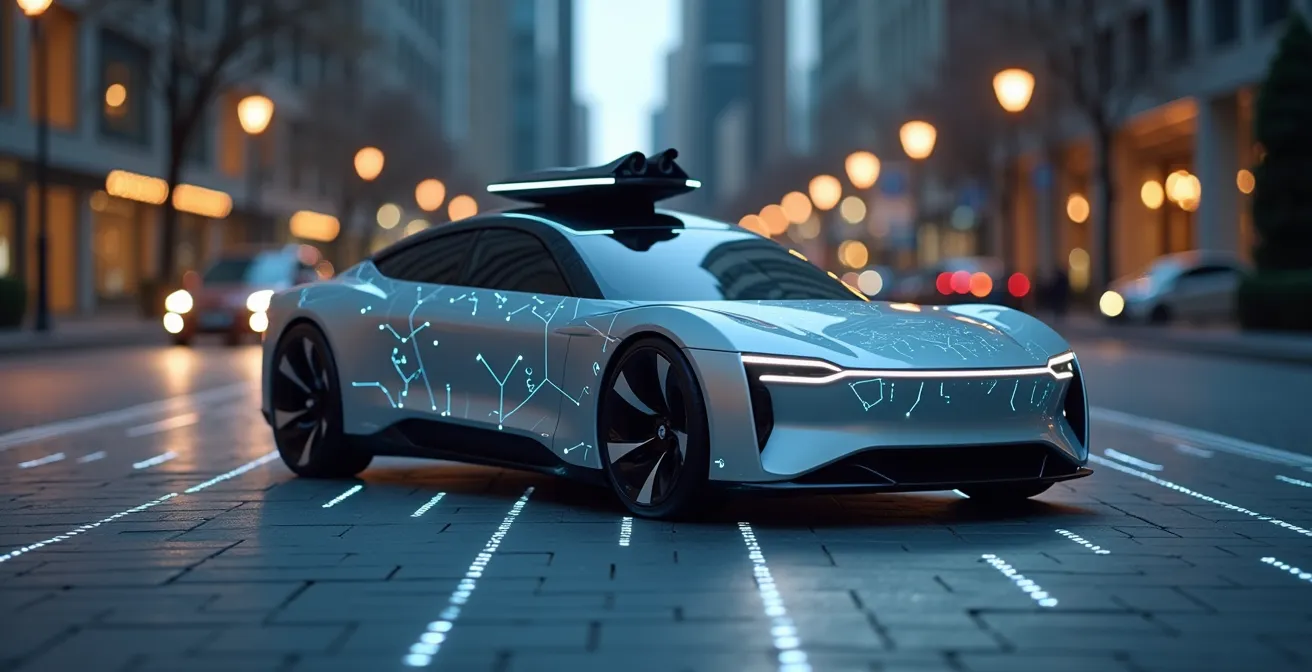
The debate over LiDAR vs. cameras is a distraction; achieving true vehicle autonomy hinges on the fundamental physics of direct measurement versus probabilistic inference.
- LiDAR provides non-negotiable spatial resolution and geometric certainty that cameras, relying on inference, cannot mathematically guarantee in all conditions.
- Cost and aesthetic barriers are rapidly diminishing due to the “chipification” of solid-state LiDAR, making the economic argument against it increasingly obsolete.
Recommendation: Evaluate autonomous systems not by the presence of a single sensor, but by the architectural robustness of their perception stack and its reliance on systemic, multi-modal redundancy.
The discourse surrounding autonomous vehicles is often dominated by a seemingly binary choice: is the path to full autonomy paved with cameras and sophisticated AI, or does it require the direct, metrological precision of LiDAR? This debate, fueled by differing corporate philosophies, frequently overlooks the core engineering and physics principles at play. While many focus on the cost or the current state of software, they miss the fundamental distinction between a system that infers reality and one that directly measures it. The former relies on algorithms to guess depth and form from 2D pixels, a process vulnerable to edge cases and environmental variables. The latter uses light to build a geometrically accurate, three-dimensional map of the world, independent of ambient light.
This article moves beyond the simplistic “vision-only vs. sensor-fusion” argument. Instead, we will reframe the discussion around a more critical axis: the architectural implications of choosing direct measurement as a foundational pillar for safety and reliability. The argument that LiDAR is a “crutch” or an unnecessary expense fails to account for the rapid miniaturization, cost reduction, and performance gains in solid-state sensor technology. According to one analysis, the automotive LiDAR market is projected to reach USD 9.59 billion by 2030, a clear indicator of its growing integration. We will deconstruct the common objections to LiDAR—cost, aesthetics, and complexity—and demonstrate why, from a first-principles perspective, it represents a more robust and ultimately scalable path to achieving the levels of reliability required for true, unsupervised autonomy.
This in-depth analysis will guide you through the key technical, economic, and strategic considerations. We will explore the physical advantages of LiDAR, the evolving cost-benefit equation, and its role in creating a truly redundant and reliable perception system.
Summary: The Physics and Economics of LiDAR in Autonomous Systems
Understanding Spatial Resolution
The fundamental advantage of LiDAR (Light Detection and Ranging) over passive camera systems is not just that it creates a “3D map,” but that it does so through direct physical measurement. A LiDAR unit is an active sensor; it emits pulses of laser light and measures the time it takes for them to reflect off objects. This time-of-flight calculation provides an immediate, geometrically precise distance measurement for millions of points per second, building a “point cloud” that is a true representation of the environment’s structure. This process works identically in broad daylight or complete darkness, as it provides its own illumination.
In contrast, a camera system is passive. It captures reflected ambient light and uses complex algorithms (inference) to interpret 2D images. While deep learning has made incredible strides, this approach is fundamentally probabilistic. It estimates depth and identifies objects based on patterns learned from vast datasets. This can fail in novel situations or when visual cues are ambiguous. The distinction is critical: LiDAR measures geometry, while a camera interprets semantics. This difference is most apparent in scenarios requiring high spatial resolution.
Case Study: NASA’s Doppler LiDAR and High-Resolution Perception
The importance of high resolution is highlighted by technology initially developed for aerospace. As explained in a NASA technology transfer report, Doppler LiDAR’s high resolution can distinguish between objects just inches apart, even from hundreds of feet away. This capability is the difference between correctly identifying a pedestrian partially obscured by a passing truck and misclassifying the entire shape as a single, large object. For an autonomous system, this isn’t an academic detail; it’s a life-or-death calculation that determines whether the vehicle brakes in time.
This high-fidelity data provides an unambiguous ground truth that perception algorithms can work with. It’s not about replacing cameras, which excel at interpreting color, signs, and traffic lights, but about providing a foundational layer of geometric certainty that cameras alone cannot guarantee.
The Integration Cost Fallacy
One of the most persistent arguments against LiDAR has been its cost. Early autonomous vehicle prototypes featured bulky, expensive mechanical LiDAR units mounted conspicuously on the roof, often costing tens of thousands of dollars. This created a perception of the technology as an impractical luxury for mass-market vehicles. However, this viewpoint ignores the relentless pace of semiconductor innovation and the shift from mechanical to solid-state LiDAR. This evolution is not just an incremental improvement; it is a paradigm shift that fundamentally dismantles the cost argument.
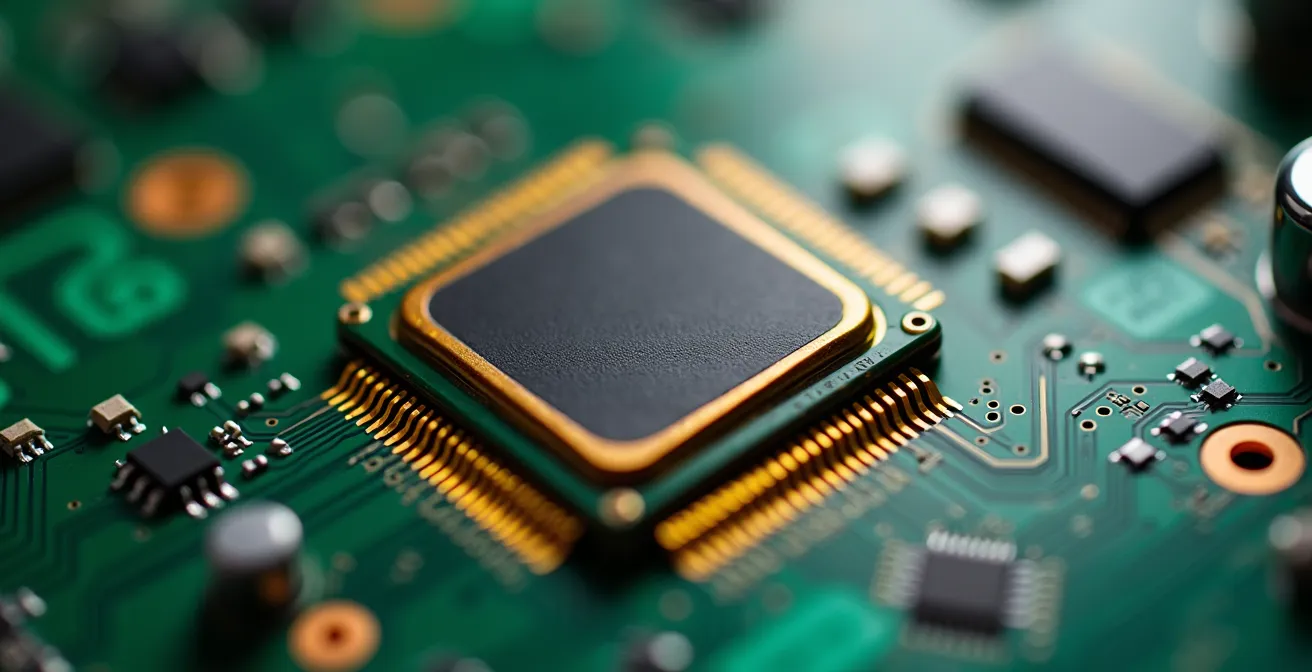
Modern LiDAR systems are undergoing “chipification”—the integration of complex optical and electronic components onto a single silicon chip. This process, akin to the evolution of computer processors, leverages semiconductor manufacturing scales to drastically reduce size, increase reliability by eliminating moving parts, and plummet production costs. As one industry report notes, this addresses key engineering demands. As stated by ResearchInChina in its Automotive LiDAR Industry Report for 2024-2025, “LiDAR chipification addresses engineering demands for streamlined form factor, compact integration, and enhanced safety redundancy by enabling finer environmental perception.”
The conversation must therefore shift from the unit cost of the sensor to the total system cost of achieving a target level of safety. If a vision-only system requires exponentially more software validation, computational power, and operational constraints to approach the same reliability as a LiDAR-inclusive system, then the “cheaper” hardware may lead to a far more expensive and time-consuming overall solution. The cost fallacy lies in comparing a component in isolation rather than its contribution to the architectural integrity of the entire safety case.
Optimizing Vehicle Aesthetics
Beyond cost, a significant hurdle for LiDAR adoption has been vehicle design and aesthetics. The initial, cumbersome roof-mounted units were anathema to automotive stylists aiming for sleek, aerodynamic profiles. The requirement for a clear, unobstructed field of view seemed fundamentally at odds with elegant design. However, just as chipification is solving the cost problem, miniaturization and new form factors are resolving the aesthetic challenge. Manufacturers no longer have to choose between advanced perception and appealing design.
Today’s solid-state LiDAR sensors are small enough to be integrated seamlessly into various parts of a vehicle’s body. They can be hidden behind the grille, incorporated into headlamp or taillight assemblies, or mounted behind the windshield without disrupting the car’s lines. This move towards discreet integration is already evident in production vehicles. Valeo, a pioneer in automotive-grade LiDAR, has been a key enabler of this trend.
Case Study: Valeo SCALA™ and Production-Ready Integration
Valeo was the first company to bring an automotive-grade laser LiDAR sensor to the mass market. Their work demonstrates that high-performance sensors can meet stringent industry standards for quality and safety. In 2021, the first vehicles in the world authorized for Level 3 autonomy were equipped with Valeo’s first and second-generation LiDAR systems. This milestone proved that LiDAR was no longer a research novelty but a viable, integrated component for production cars, paving the way for wider adoption without aesthetic compromise.
The strategic placement of multiple, smaller sensors also allows for complete 360-degree coverage without a single, large rooftop unit. This distributed approach not only improves aesthetics but also enhances redundancy, as the data from multiple viewpoints can be fused to create a more comprehensive and robust environmental model.
Checklist for Aesthetic and Functional LiDAR Integration
- Points of Contact: List all potential integration points (grille, bumper, headlamps, roofline, windshield) for a 360° field of view.
- Existing Component Audit: Inventory current vehicle components to identify opportunities for embedding sensors without altering the primary design language.
- Coherence Check: Confront potential placements with the vehicle’s core aerodynamic and stylistic values. Does the integration feel seamless or tacked-on?
- Visual Impact Assessment: Evaluate the visibility of the sensor. Is it discreetly hidden behind infrared-transparent materials or a prominent feature? Analyze the trade-off between stealth and performance.
- Integration Plan: Create a prioritized plan for a multi-sensor layout, defining which locations are essential for safety and which are complementary for redundancy.
Comparing LiDAR Types
Not all LiDAR is created equal. The term encompasses a range of technologies with different operating principles, advantages, and limitations. For an investor or enthusiast, understanding these distinctions is crucial to evaluating a company’s technology stack and its suitability for specific applications. The industry is broadly moving from mechanical units to various forms of solid-state technology, each with its own trade-offs.
Mechanical LiDAR, the earliest form, uses a rotating mirror assembly to sweep laser beams across a 360-degree field of view. While providing excellent coverage, these units are bulky, expensive, and have moving parts that are potential points of failure. Solid-state LiDAR eliminates these moving parts, leading to more compact, reliable, and cost-effective designs. Within the solid-state category, several key technologies are emerging, including MEMS, Flash, and FMCW LiDAR.
The following table provides a high-level comparison of these primary LiDAR technologies, highlighting their characteristics and ideal use cases. This data is synthesized from technical documentation, including resources from test and measurement leaders like NI, who provide deep dives into the role of laser vision in cars.
| LiDAR Type | Field of View | Key Advantages | Main Limitations | Best Use Case |
|---|---|---|---|---|
| Mechanical (Rotating) | 360° | Complete environmental coverage | Bulky, needs roof mounting | Mapping, specialized applications |
| Solid-State | Limited (multiple sensors needed) | No moving parts, compact, reliable | Requires multiple units for full coverage | Mass-market vehicles |
| Flash LiDAR | Wide view per pulse | Entire scene capture in one flash | Range limitations | Short-range urban applications |
| FMCW LiDAR | Variable | Measures velocity directly, interference-free | Complex processing requirements | High-speed highway applications |
Among these, Frequency-Modulated Continuous-Wave (FMCW) LiDAR is gaining significant attention. Unlike traditional time-of-flight LiDAR, it can measure an object’s velocity directly from a single pulse, a major advantage for predicting trajectories. It is also highly resistant to interference from sunlight or other LiDAR sensors. As a result, market analysis shows that FMCW LiDAR is projected at 49.44% CAGR and is expected to capture a significant market share before 2030, positioning it as a key technology for next-generation autonomous systems.
Planning for Mass Adoption
The transition of LiDAR from a research-grade instrument to a mass-market automotive component is no longer a future projection; it is a present-day reality. The technology is rapidly moving up the adoption S-curve, driven by falling costs, improved performance, and a growing consensus that it is a critical enabler for safe and reliable autonomous driving. The numbers clearly illustrate this momentum.
Industry data shows an exponential increase in LiDAR deployment on production vehicles. This trend signals a clear commitment from automakers who are architecting their future platforms with LiDAR as a core component of the perception stack. According to one industry report, automotive LiDAR installations exceeded 1.5 million units in 2024, representing a dramatic year-over-year increase of over 245% and pushing the technology’s penetration rate to 6.0% in the new vehicle market. This is not a trial; it is a full-scale industrial rollout.

This rapid adoption is supported by a clear regulatory and industrial push towards higher levels of autonomy. Governments and safety organizations worldwide are establishing frameworks for Level 3 and Level 4 systems, which are largely seen as unachievable without the guarantees provided by a LiDAR-inclusive sensor suite. This creates a powerful feedback loop: regulatory approval drives automaker adoption, which in turn fuels manufacturing scale and further cost reductions.
The strategic planning for this mass adoption is visible on the factory floor, where production lines are being retooled to integrate these sensors efficiently. The focus is on modularity, allowing different trim levels or regional models to be equipped with varying sensor configurations from a common vehicle platform. This industrialization is the final piece of the puzzle, transforming LiDAR from a possibility into an inevitability for advanced driver-assistance systems (ADAS) and full autonomy.
Comparing Pure Vision and Radar
To fully appreciate LiDAR’s contribution, it is essential to compare it not in isolation, but as part of a complete perception stack. The “vision-only” approach championed by some relies on cameras as the primary sensor, sometimes supplemented by radar. While this is a cost-effective solution for lower-level ADAS, it has inherent physical limitations that become critical as the demand for reliability increases towards full autonomy.
Cameras, like human eyes, are susceptible to a wide range of environmental conditions. Their performance degrades significantly in fog, heavy rain, snow, or direct sun glare. While algorithms can be trained to mitigate these issues, they cannot overcome the fundamental physics of light being obscured or scattered. Radar excels in these adverse conditions and is superb at detecting object velocity, but its low resolution makes it poor at classifying objects. It can reliably tell you something is there, but not whether it’s a car, a pedestrian, or a piece of road debris.
This creates a critical gap where a system can be blind to certain threats. A perception stack that combines cameras, radar, AND LiDAR creates a truly redundant system where the strengths of one sensor compensate for the weaknesses of another. This isn’t just additive; it’s multiplicative in its effect on safety by eliminating “common-mode failures” where multiple sensors fail for the same reason (e.g., bad weather for cameras).
Case Study: Rivian’s Demonstration of Multi-Modal Superiority
A compelling real-world demonstration highlighted these differences starkly. As documented in a test by Rivian, their vehicle’s sensor suite was evaluated in foggy conditions. The report notes that while all sensors identified objects in clear weather, the fog revealed their individual weaknesses. The camera-based system was severely limited, missing many objects, including a pedestrian crossing the street. The camera and radar combination performed slightly better but still lacked a complete picture. However, as the analysis states, “when you add in lidar, the system sees it all—again, better than a human can.” This practical example, covered by publications like InsideEVs, underscores how LiDAR provides an essential layer of perception that other sensors simply cannot match in all conditions.
Optimizing Platforms for Export
The choice of perception architecture has strategic implications that extend far beyond the vehicle itself, directly impacting a manufacturer’s ability to scale globally. A system designed and validated in one specific geographic region may not be easily exportable to others with different road infrastructures, traffic patterns, and regulatory environments. This is where a LiDAR-inclusive system offers a significant, often overlooked, advantage: geopolitical scalability.
A vision-only system is heavily dependent on its training data. An AI trained predominantly on North American roads, with their specific signage, lane markings, and vehicle types, may struggle when deployed in Europe or Asia. It would require extensive and costly re-training and re-validation for each new market. This creates a massive barrier to global expansion. In contrast, LiDAR’s output—a geometric point cloud—is a universal language. The physics of a solid object is the same in California as it is in Tokyo or Berlin. While some adaptation is still needed, the foundational data layer is far more robust and transferable across diverse environments.
A LiDAR-inclusive sensor suite is inherently more adaptable to diverse global regulatory environments and road infrastructures than a vision-only system trained primarily on one country’s data.
– IDTechEx, Lidar 2024-2034: Technologies, Players, Markets & Forecasts
This adaptability is crucial as countries enact their own specific regulations for automated vehicles, such as the EU’s Regulation 2019/2144. An architecture based on the verifiable, physical measurements of LiDAR is easier to certify with different national safety agencies than one based on the “black box” nature of a complex neural network. Therefore, automakers planning for global leadership are increasingly designing modular vehicle platforms that treat LiDAR not as an option, but as a scalable feature that can be adapted to meet the performance and regulatory requirements of any given market, ensuring a faster and more cost-effective path to worldwide deployment.
Key takeaways
- True autonomy is a physics problem first, a software problem second. LiDAR provides direct measurement, while cameras provide inference, a fundamental architectural difference.
- The arguments against LiDAR based on cost and aesthetics are being systematically dismantled by the progress in solid-state “chipification” and advanced integration techniques.
- A multi-modal sensor suite including LiDAR, cameras, and radar is not just about “fusion,” but about creating systemic triple redundancy to eliminate common-mode failures and achieve verifiable safety.
Decoding the Reliability of Machine Perception Systems
Ultimately, the entire debate about sensors boils down to a single, non-negotiable metric: reliability. For an autonomous vehicle to be commercially viable and socially accepted, its perception system must perform with a level of reliability that is orders of magnitude better than a human driver. This is not something that can be achieved by simply improving one type of sensor; it requires a systemic approach to safety rooted in the principle of redundancy.
The aerospace industry, a benchmark for safety-critical systems, has long relied on this principle. The goal is to ensure that no single point of failure can lead to a catastrophic outcome. In automotive perception, this translates to using multiple, dissimilar sensor types. By combining the strengths of cameras (for semantics), radar (for velocity and weather penetration), and LiDAR (for geometric precision), the system creates a robust safety net. An error or limitation in one sensor’s data stream can be cross-referenced and corrected by the others.
This approach is often referred to as triple redundancy, a standard being adopted by leaders in the automotive safety space. The core idea is that every critical piece of information must be confirmed by at least two different types of sensors. As explained by industry leader Valeo, their safety architecture mandates that every sensor information must be confirmed by two other sensors of different types to guarantee safety. This is the only way to build a system that is resilient to the “unknown unknowns”—the unpredictable edge cases that have proven to be the biggest challenge for vision-only systems.
The continuous improvement in hardware, such as the development of more compact and robust chip-based LiDAR, further strengthens this architectural foundation. Research at institutions like the University of Washington has led to breakthroughs in solid-state beam-steering devices that are not only smaller and cheaper but also far more resilient to vibration and shock than their mechanical predecessors. As one researcher noted, this work has the potential to shrink the entire scanning LiDAR system from the size of a large coffee mug to that of a small matchbox. This relentless hardware progress makes the architectural choice for maximum redundancy both technologically and economically inevitable.
Therefore, when evaluating the future of autonomy, the most telling question is not whether a car has LiDAR, but whether its perception architecture is built on a foundation of systemic, multi-modal redundancy. For any investor or technologist aiming to look beyond the hype, analyzing a company’s commitment to this core principle of safety engineering is the most reliable way to gauge its long-term viability.