
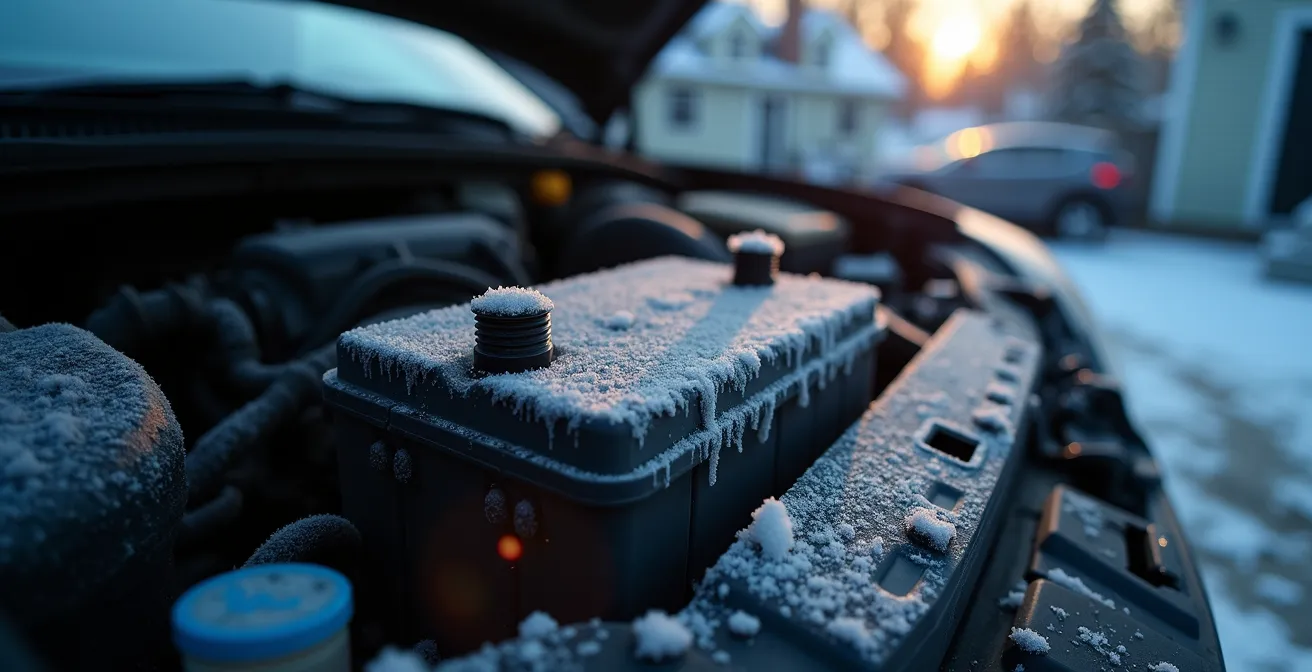
The key to a guaranteed Midwest winter start isn’t just a new battery, but systematically eliminating the hidden energy deficits caused by extreme cold.
- Cold drastically reduces a battery’s chemical ability to deliver power, losing up to 60% of its strength at 0°F, creating a massive energy deficit.
- Absorbent Glass Mat (AGM) batteries offer vastly superior cold-cranking performance and are the recommended upgrade for modern vehicles in the Upper Midwest.
Recommendation: Before the first deep freeze, perform a professional State of Health (SoH) test on your battery and plan to upgrade to an AGM with a Cold Cranking Amp (CCA) rating appropriate for your vehicle and climate.
There’s a sound every resident of the Dakotas or Minnesota knows and dreads on a January morning: the slow, gut-wrenching *click-click-click* of a starter solenoid that isn’t getting enough power. Your vehicle is a frozen brick, and you’re already late. The usual advice gets thrown around—use a block heater, keep the tank full, maybe buy a new battery. While not wrong, these tips often treat the symptoms, not the underlying disease. They fail to address the core reality: in a polar vortex, your vehicle is an electrical system under siege, and winning the battle for a reliable start requires more than just hope and a set of jumper cables.
The problem is rarely a single, catastrophic failure. It’s a war of attrition fought on a chemical and electrical level. The brutal cold wages a direct assault on your battery’s chemistry, while modern vehicle electronics silently bleed it dry. A weak alternator, struggling to recharge in these conditions, completes the trifecta of failure. Surviving a Midwest winter isn’t about luck; it’s about systematically de-risking these failure points. Forget the generic advice. What if the key wasn’t just *having* power, but understanding and preserving every single milliamp your vehicle has?
This guide moves beyond the basics to deliver a pro-level diagnostic and preventative strategy. We will dissect the chemical reasons for failure, expose common misdiagnoses, and provide a clear roadmap to building a vehicle with true winter resilience. We’ll compare the hardware built for this fight and equip you with the knowledge to manage both your vehicle and the hazardous journeys it must undertake. By the end, you won’t just be hoping your car starts; you’ll have engineered it to do so.
To build this fortress of winter reliability, we will systematically address each critical component and scenario. This structured approach ensures no weak link is left unexamined, from the battery’s internal chemistry to the emergency kit in your trunk.
Table of Contents: A Systematic Guide to Winter Starting Reliability
Understanding Chemical Degradation
The fundamental reason your car fails to start in extreme cold is a simple, brutal law of chemistry. A car battery is a chemical plant in a box, relying on a liquid electrolyte solution to facilitate the flow of electrons. As the temperature plummets, this chemical reaction slows down dramatically. The electrons simply can’t move as fast, crippling your battery’s ability to deliver the massive burst of energy—the Cold Cranking Amps (CCA)—needed to turn over a thick, cold engine. It’s not that the energy is gone; it’s just locked away, inaccessible. This creates a severe energy deficit at the worst possible moment.
The numbers are stark. A battery that is fully functional at 80°F is a shadow of its former self when the temperature drops. Research shows a battery loses about 35% of its starting power at 32°F. At 0°F, that loss escalates to a staggering 60% power loss. Simultaneously, a cold engine requires more than twice the power to start as a warm one due to thickened oil and increased friction. You’re demanding double the work from a component with half its strength. This is the recipe for a no-start situation.
Case Study: Midwest Winter Battery Performance
A study of service data from Minnesota reveals the direct impact of these conditions. Vehicles parked outside during sub-zero nights show drastically higher battery failure rates. The data provides clear minimums for winter survival: a compact car needs at least 400-500 CCA to start reliably, while the larger engines in trucks and SUVs demand 700+ CCA to overcome the intense cold of a typical Midwest winter.
Understanding this chemical reality is the first step. Your battery isn’t necessarily “bad” or “dead” in the conventional sense; it’s chemically incapacitated by the cold. This is why testing is so crucial. A simple voltage test (State of Charge) doesn’t tell the whole story. You need a load test to determine the battery’s true State of Health (SoH)—its actual ability to perform under pressure.
Your Action Plan: State of Health vs. State of Charge Testing
- Check open circuit voltage with a multimeter to determine State of Charge (SoC); a healthy, fully charged battery should read around 12.6V.
- Perform a load test using a dedicated CCA tester at the battery’s actual ambient temperature to assess its real-world capability.
- Compare the actual CCA reading from the test to the manufacturer’s rating printed on the battery to assess its State of Health (SoH).
- Test your battery annually before winter, especially if it is three or more years old, to proactively identify degradation.
- Plan to replace the battery if its actual tested CCA falls below 70% of its original rated capacity, as it will likely fail during the first deep freeze.
The Alternator Misdiagnosis Trap
After a frustrating no-start and a jump, the immediate suspect is always the battery. It’s the component that failed, so it must be the problem. This is a common and often costly misdiagnosis. While the battery was the component that couldn’t deliver the power, it may only be a symptom of a larger issue: a weak or failing alternator. The alternator’s job is to recharge the battery and power the vehicle’s electronics while the engine is running. In the extreme cold, this job becomes exponentially harder.
A winter-stressed alternator faces a double challenge. First, it must work harder to recharge a battery that is chemically resistant to accepting a charge due to the cold. Second, it has to supply power to a host of high-draw winter accessories like the heater fan, defrosters, heated seats, and wipers. If the alternator is already marginal, it can’t keep up. The battery never gets fully recharged between trips, especially short ones. Each time you start the car, you create an energy deficit that the alternator fails to replenish, and over a few days, the battery is drained to the point of failure. You replace the battery, and the new one works for a while—until the weak alternator drains it, too.
Physical stress is also a factor. The intense cold makes rubber and plastic components brittle. According to automotive service experts, extreme cold conditions can cause alternator belts to crack and fail. A whining noise that correlates with engine RPM is a classic sign of a failing alternator bearing, another victim of the cold.
Before you spend hundreds on a new battery, a simple five-minute test with a multimeter can help you determine if the alternator is the true culprit. This diagnostic step is crucial for preventative resilience and avoids a cycle of repeated failures.
To test the system yourself, follow this sequence:
- With the engine off, test the battery voltage. A healthy, charged battery should read about 12.6 volts.
- Start the engine. The voltage should immediately jump to between 13.5 and 14.5 volts. This indicates the alternator is producing a charge.
- Turn on all high-draw accessories: headlights, heater fan on high, rear defroster. The voltage should remain steady, staying above 13 volts. If it drops significantly, the alternator is struggling under load.
- Listen for a high-pitched whining or grinding sound that changes with engine speed, a clear sign of a failing alternator bearing.
Optimizing Parasitic Drain
Even when your car is turned off and parked in a frozen driveway, it is never truly “off.” Dozens of microcomputers, the clock, the security system, and the keyless entry receiver are all drawing a small but constant amount of power from the battery. This is known as parasitic drain or key-off load. In normal conditions, this tiny draw is insignificant. But on a vehicle that has been “cold-soaked” for 12 hours at -20°F, with a battery that has already lost 60% of its power, this slow, silent bleed can be the final nail in the coffin.
The problem is compounded in modern vehicles, which are packed with more electronics than ever before. A faulty door switch, a glove box light that stays on, or a malfunctioning aftermarket remote starter can dramatically increase this drain, turning a small trickle into a significant flow. A drain that might take weeks to kill a battery in the summer can do it overnight in the dead of winter. Identifying and minimizing this drain is a critical part of building a resilient winter vehicle.
A mechanic can test for parasitic drain using an ammeter, but you can take preventative steps. Ensure all aftermarket electronics are professionally installed. If your vehicle will be sitting for an extended period, the single most effective strategy is using a smart battery maintainer or “tender.” Unlike a trickle charger, a maintainer monitors the battery’s voltage and delivers a charge only when needed, preventing overcharging while ensuring the battery remains at peak capacity, ready to fight the cold.
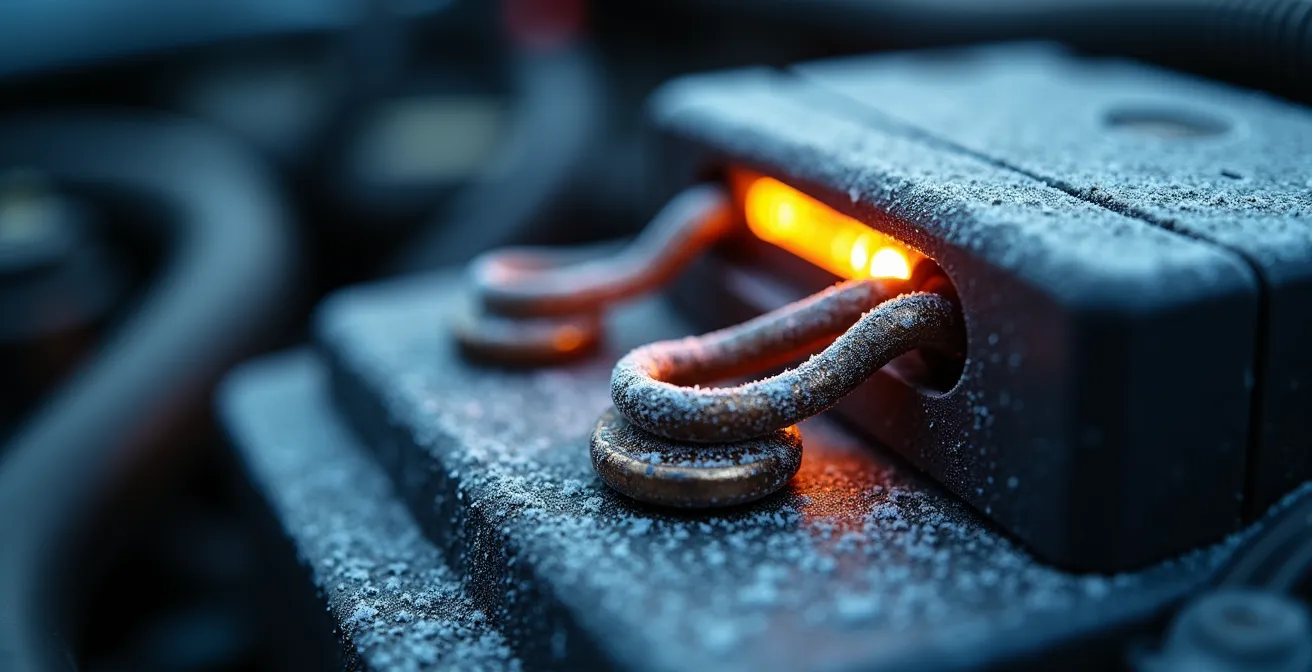
The image below shows a typical setup, providing a constant, optimized charge that counteracts both parasitic drain and the battery’s own self-discharge, ensuring it’s at 100% capacity for that critical morning start.
Understanding what constitutes an acceptable level of drain is key. While a professional diagnosis is best, the following table provides a general guideline for the expected key-off load for different vehicle types. A reading significantly above these levels indicates a problem that needs to be hunted down.
| Vehicle Type | Acceptable Draw | Warning Level | Critical Level |
|---|---|---|---|
| Compact Sedan | Under 30mA | 30-50mA | Over 50mA |
| Mid-size SUV | Under 50mA | 50-75mA | Over 75mA |
| Full-size Truck | Under 75mA | 75-100mA | Over 100mA |
| Luxury Vehicle | Under 85mA | 85-120mA | Over 120mA |
Comparing Battery Chemistries
Not all car batteries are created equal, especially when facing a Midwest winter. The standard “wet cell” or flooded lead-acid battery that comes in most vehicles is a proven, cost-effective technology, but it is also the most vulnerable to the chemical slowdown caused by extreme cold. For drivers in the Upper Midwest, investing in a battery with a more resilient chemistry isn’t a luxury; it’s a strategic necessity. The primary upgrade to consider is the Absorbent Glass Mat (AGM) battery.
AGM batteries differ from standard batteries in a crucial way. Instead of having free-flowing liquid electrolyte, the electrolyte is absorbed into fiberglass mats packed tightly between the lead plates. This design has several key advantages for cold weather performance. It has lower internal resistance, meaning it can discharge power and accept a charge much faster in the cold. This makes it more tolerant of short trips and better able to be replenished by the alternator in freezing temperatures. Most importantly, this construction allows for a higher packing density of energy-producing material, resulting in a significantly higher CCA rating for a battery of the same physical size.
As the experts at Batteries Plus note, the performance difference is not subtle. The technical team confirms that “AGM batteries perform much better in low temperature environments than flooded lead acid batteries do… AGM batteries typically have higher CCA ratings than a flooded lead acid battery.” This makes them the definitive choice for vehicles with high electronic loads (common in modern cars) and those operating in sub-zero climates.
While AGM batteries come at a higher initial cost, their superior performance, better tolerance for deep discharge, and longer average lifespan often make them a more economical choice over time, especially when factoring in the cost and inconvenience of a no-start situation. The table below provides a clear comparison for a Midwest driver.
| Battery Type | Performance Below 0°F | Short Trip Tolerance | High Electronic Load Suitability | Average Lifespan | Cost Premium |
|---|---|---|---|---|---|
| Standard Flooded | Poor – loses 60% capacity | Low – sulfation risk | Poor | 3-5 years | Baseline |
| Enhanced Flooded (EFB) | Fair – better plate design | Moderate | Fair | 4-6 years | +20-30% |
| AGM | Good – higher CCA rating | Excellent | Excellent | 5-8 years | +40-100% |
Planning Terminal Maintenance
You can have the strongest AGM battery and a perfectly functioning alternator, but if the electrical connection between them is compromised, you’re still dead in the water. The battery terminals are the critical bridge for all electrical power in your vehicle. In the Midwest, this bridge is under constant assault from an insidious enemy: road salt. The salt spray kicked up from treated winter roads settles on every surface in your engine bay, including the battery terminals.
This salt residue is highly corrosive. Worse, when it gets moist, it becomes a potent electrolyte, accelerating a process called galvanic corrosion between the lead terminals and the copper cable connectors. This corrosion manifests as a white or bluish powdery buildup. This powder isn’t just ugly; it’s an insulator. It creates high electrical resistance, forcing the battery and alternator to work much harder to push current through the connection. In the cold, when every amp is precious, this resistance can be enough to prevent a start or inhibit proper charging.
Case Study: The Impact of Road Salt Corrosion
Service data from winter-heavy states confirms this threat. Analysis shows that battery terminals in the Midwest experience significantly accelerated corrosion. This buildup increases electrical resistance, which, according to a Firestone Complete Auto Care study, forces batteries to work harder in already challenging cold conditions, leading to premature failure.
A proactive terminal maintenance plan is a non-negotiable part of winter car prep. It’s a simple, 30-minute job that can save you a world of trouble. The goal is not just to clean the terminals but to seal them from the corrosive environment. A professional-level approach involves cleaning the terminals and posts with a baking soda and water solution, drying them completely, and then applying a protective coating. Use a thin layer of dielectric grease on the posts before reconnecting the cables, install anti-corrosion felt washers, and finish by spraying the entire connection with a dedicated battery terminal protector spray. This routine should be performed every October, creating a shield that will last the entire winter.
Planning Mountain Pass Crossings by Season
While the Midwest may lack towering mountain passes, its vast, open plains present a unique and equally dangerous winter travel challenge: long, desolate stretches of interstate with few services and extreme exposure to the elements. Planning a long-haul trip on corridors like I-94 across North Dakota or I-80 through Iowa in January requires the same level of strategic foresight as crossing a high-altitude pass. The primary threats are not avalanches, but ground blizzards, extreme wind chills, and the risk of becoming stranded far from help.
The danger is real and measurable. On these open corridors, there is nothing to stop the arctic winds, creating wind chills that can reach -35°F to -40°F. In these conditions, a vehicle breakdown is not an inconvenience; it is a life-threatening emergency. Mechanical components become brittle, fuel can gel, and human exposure can lead to frostbite in minutes. Your vehicle’s reliability, which we’ve worked to secure, is only part of the equation. The other is a sound decision-making framework for the journey itself.
The key is to establish a “point of no return” mindset. Before and during your trip, constantly evaluate conditions and be prepared to turn back or take shelter. Your framework for this decision should include:
- Monitoring Alerts: Constantly check the state’s Department of Transportation (DOT) 511 app for road closures and “No Travel Advised” warnings. These are issued for a reason.
- Gauging Fuel: Never let your fuel tank drop below half. It provides a safety margin for getting to the next town or idling to stay warm if stranded.
- Assessing Daylight: Avoid traveling at night during active winter storms. Visibility drops to near zero and finding your vehicle is much harder for rescue crews.
- Checking a Coverage Map: Be aware of upcoming cellular dead zones. If you’re about to enter a 50-mile stretch with no service and the weather is worsening, it’s time to stop.
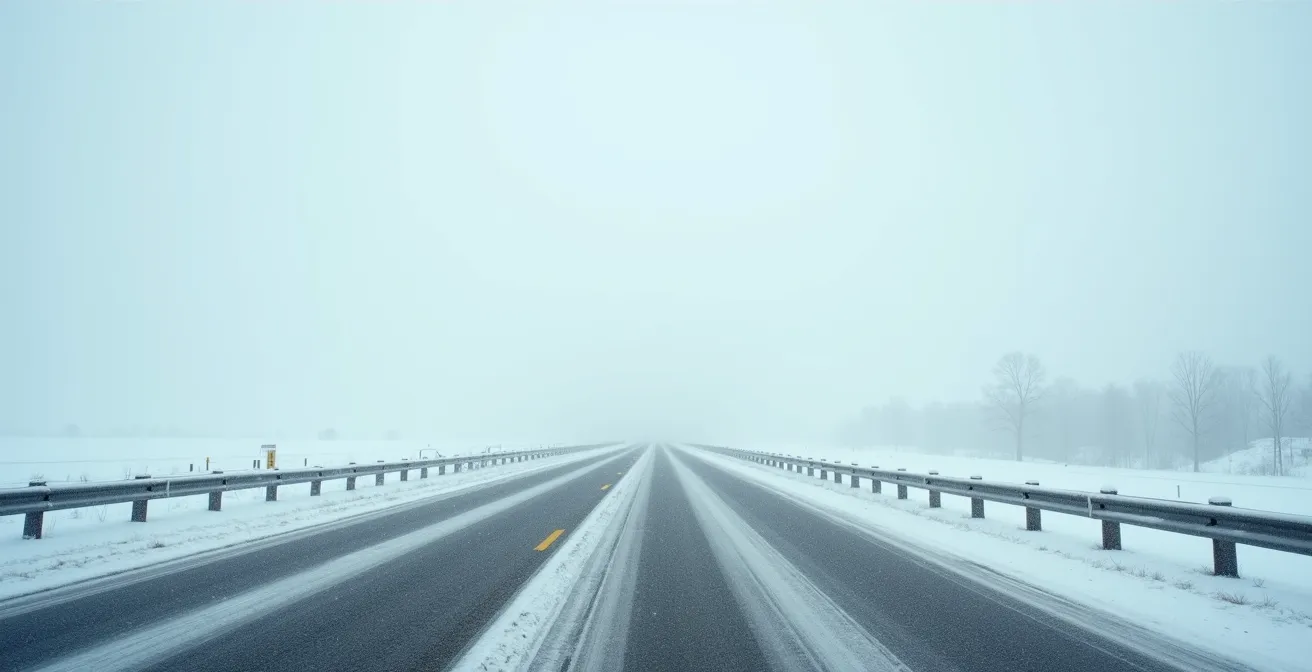
The desolate beauty of a Midwest winter highway, as seen in the image, hides a significant threat. Treating these crossings with respect and a clear plan is paramount.
The Visibility Error
One of the most terrifying and uniquely Midwestern driving hazards is the ground blizzard. Unlike a traditional blizzard where snow falls from the sky, a ground blizzard occurs when strong winds pick up loose snow already on the ground, creating a blinding, horizontal wall of white. Visibility can drop from miles to feet in a matter of seconds. In this scenario, the single most critical error a driver can make is to keep driving.
Instinct tells you to slow down and try to follow the taillights ahead or the edge of the road. This is a fatal mistake. You have no true frame of reference, and the vehicle in front of you could be stopped, or you could drift off the road into a deep ditch. Analysis of Midwest winter accidents shows that the correct protocol is counterintuitive: you must stop. The goal is to make yourself a stationary object rather than a moving hazard.
Whiteout Survival Protocol
In a ground blizzard whiteout, immediately reduce your speed, activate your emergency hazard lights, and pull as far off the roadway as possible, completely beyond the shoulder if you can. Turn your wheels away from the road. Once stopped, keep your seatbelt on. If you must run the engine for heat, do so intermittently (e.g., 10 minutes every hour) and first ensure your exhaust pipe is clear of snow to prevent carbon monoxide from entering the cabin. Do not leave your vehicle. Wait for visibility to improve or for help to arrive.
Of course, the best way to handle a whiteout is to have the tools to avoid being caught off guard. Proactive visibility management is key. This means preparing your vehicle to see and be seen in the worst possible conditions. A well-stocked visibility kit is not optional equipment; it’s essential survival gear.
Your Midwest Winter Visibility Kit should include:
- Windshield washer fluid rated for at least -35°F to prevent freezing lines.
- A hydrophobic glass treatment (like Rain-X) applied monthly to help shed snow and ice.
- An interior anti-fog solution and a dedicated microfiber cloth kept within easy reach.
- Winter-specific beam-style wiper blades, which resist ice buildup far better than traditional blades.
- A backup bottle of de-icer spray for emergencies when your windshield is encased in ice.
Key Takeaways
- Extreme cold is an attack on your battery’s chemistry, reducing its power by up to 60% while doubling the engine’s starting demand.
- Upgrading to an Absorbent Glass Mat (AGM) battery is the single most effective hardware change for ensuring reliable starts in the Midwest.
- A systematic approach involving battery health testing, alternator checks, parasitic drain management, and terminal maintenance is crucial for true winter resilience.
Managing Roadside Emergencies to Ensure Passenger Safety
Even with the most meticulously prepared vehicle, the ferocity of a Midwest winter can win. A hidden pothole can destroy a tire, a patch of black ice can send you into a ditch, or an unexpected mechanical failure can leave you stranded. When this happens, your focus shifts from prevention to survival. Your vehicle becomes your shelter, and the quality of your emergency kit can be the difference between a cold, uncomfortable wait and a genuine life-or-death situation.
The standard, flimsy “emergency kit” sold in auto parts stores is woefully inadequate for a Dakota winter. You need a kit built for purpose, designed to keep you warm, hydrated, fed, and visible for up to 48 hours. As AAA Michigan spokesperson Adrienne Woodland stated after an arctic blast, the spike in calls is predictable: “Whenever we have an arctic blast move in, we usually receive a noticeable uptick in calls to AAA, for things like dead batteries… and cars that simply won’t start.” Being prepared for that possibility is your ultimate insurance policy.
Your kit must prioritize warmth, visibility, and self-rescue. A collapsible shovel is critical for digging out a buried exhaust pipe or tires. A 20lb bag of cat litter provides excellent emergency traction under spinning wheels. Most importantly, sub-zero rated sleeping bags or heavy wool blankets are non-negotiable; they provide life-sustaining warmth if the engine cannot be run.
Another critical factor in rural areas is communication. As AAA reports, there are significant cellular coverage gaps along Midwest highways. A satellite messenger, while an investment, provides a reliable SOS link to emergency services when your phone has no signal. For frequent rural travelers, it is a justifiable safety expense. The ultimate goal of your kit is to give you the resources to wait safely for help to arrive.
The Ultimate Midwest Stranded Vehicle Survival Kit:
- Sub-zero rated sleeping bags or heavy wool blankets (minimum of two).
- A large pack of chemical body warmers (not just hand warmers).
- A sturdy, collapsible military-surplus-style shovel.
- A 20 lb bag of cheap clay cat litter for emergency traction.
- Emergency flares and reflective triangles to maximize your visibility to rescuers.
- A 48-hour supply of non-perishable, high-calorie food and water that won’t freeze solid.
- A portable, high-capacity jump starter rated for sub-zero operation.
By systematically addressing each of these areas—from battery chemistry to survival gear—you transform your relationship with winter driving from one of chance to one of control. The final step is to put this knowledge into action before the next polar vortex arrives. Evaluate your vehicle’s current state and build your resilience plan now.