
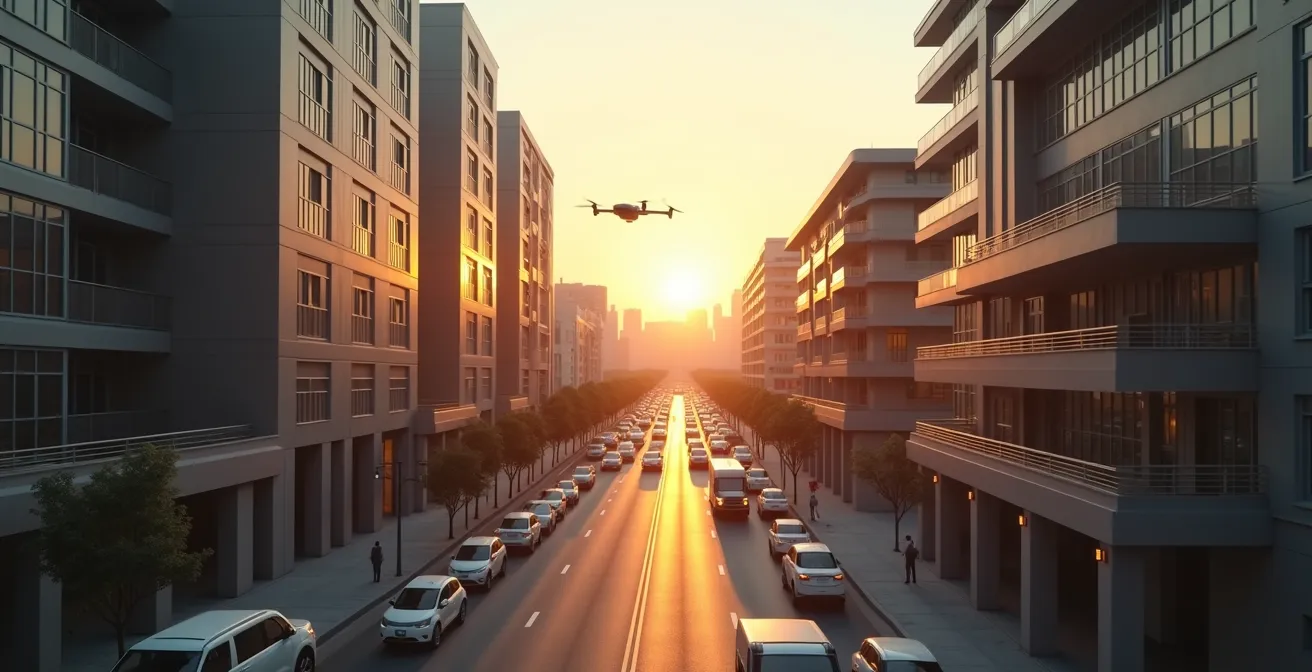
Investing in new delivery technology is not enough to slash last-mile costs; true efficiency comes from using it to dismantle the rigid, static operational models that cause failures.
- Success lies in creating a dynamic system that optimizes routes, inventory density, and labor in real-time.
- Moving from predictive to prescriptive analytics allows you to solve problems before they even occur.
Recommendation: Focus on implementing technologies that enable total operational fluidity, not just isolated point solutions, to achieve scalable and sustainable cost reductions.
For any logistics founder or e-commerce manager, the last mile is a source of constant pressure. It’s the most expensive, complex, and customer-facing part of the entire supply chain. In fact, industry data consistently shows that last-mile delivery accounts for up to 53% of total shipping costs, a figure that can make or break profitability. The conventional wisdom for tackling this challenge often involves a checklist of technological solutions: implement a route planner, explore drones, or digitize paperwork. While these steps are not wrong, they often miss the fundamental issue.
The real barrier to acceleration isn’t a lack of tools, but the persistence of a static operational mindset. Many businesses invest in advanced technology but continue to apply it within rigid, outdated frameworks—planning routes once a day, relying on a few large centralized warehouses, and treating labor as a fixed cost. This approach creates inherent brittleness, making the system vulnerable to real-world disruptions and leading to the very delivery failures and high costs you’re trying to avoid.
This article reframes the conversation. We will explore how emerging technologies are not just tools for optimization, but catalysts for a paradigm shift—from a static, reactive system to a dynamic, prescriptive one. The true power of AI, automation, and shared logistics lies in their ability to create unprecedented operational fluidity, allowing your network to adapt, predict, and self-correct in real time. It’s time to move beyond simply doing things faster and start doing them smarter.
To navigate this strategic shift, this guide breaks down the core operational pillars of residential delivery. We will dissect how a dynamic, technology-driven approach transforms everything from routing and depot strategy to labor management and customer communication, providing a blueprint for building a truly resilient and cost-effective last-mile operation.
Summary: Beyond the Buzz: How Emerging Tech Actually Accelerates Residential Delivery
Understanding Delivery Failure
A failed delivery is more than a logistical hiccup; it’s a financial drain and a customer experience disaster. The root cause, however, is rarely a single point of error. More often, it’s a systemic consequence of a static operational model that cannot adapt to real-world variables. When a customer isn’t home, an address is incorrect, or access is blocked, a rigid plan shatters. The cost of re-delivery, customer support, and potential lost business accumulates rapidly, contributing significantly to the last mile’s disproportionate share of shipping expenses.
The strategic shift required is from a reactive to a proactive and prescriptive approach. Instead of just tracking failures after they happen, leading companies are using technology to prevent them. This involves leveraging data to identify high-risk deliveries before they even leave the warehouse. By analyzing historical data, traffic patterns, and even weather forecasts, AI can flag potential issues and suggest alternative actions, such as confirming a delivery window with the customer via SMS or rerouting to a secure drop-off point.
A prime example of this is DHL’s implementation of AI-driven optimization. As a logistics trendsetter, DHL uses predictive analytics to identify and flag high-risk deliveries before dispatch. This proactive intervention has been instrumental in reducing delivery failures, demonstrating that the most effective way to solve the problem is to prevent it from ever occurring. This is the first crucial step in dismantling the static mindset: using intelligence to build a resilient, self-correcting system.
The Static Routing Error
One of the most common and costly mistakes in last-mile logistics is the Static Routing Error. This occurs when routes are planned at the beginning of the day based on a fixed set of stops and then executed without deviation, regardless of real-time conditions. This “plan and pray” approach is fundamentally flawed because it ignores the dynamic nature of urban environments: unexpected traffic jams, road closures, or last-minute delivery changes can render an entire route inefficient, leading to missed windows, increased fuel consumption, and driver overtime.

The antidote to this error is AI-powered dynamic route optimization. Unlike static planners, these systems continuously ingest real-time data from GPS, traffic feeds, and order management systems to recalculate and optimize routes on the fly. This moves beyond simple A-to-B navigation to solve a complex multi-variable problem: finding the most efficient path that balances distance, fuel, delivery windows, and vehicle capacity. Reports show that logistics operators embracing AI can achieve a reduction in operational costs by up to 15%, a direct result of enhanced efficiency.
This technological evolution is not a one-time upgrade but a continuous process. As Chris Caplice from the MIT Center for Transportation and Logistics notes, the definition of advanced AI is constantly changing:
AI is a moving target. It’s not sitting still; it’s aspirational because what was considered AI 30 years ago — even 20 years ago — is not considered cutting-edge AI anymore.
– Chris Caplice, MIT Center for Transportation and Logistics
For a founder, this means investing in platforms that are built for continuous learning and adaptation, ensuring that your routing capabilities evolve alongside the technology itself. This is the core of building a future-proof, dynamic logistics operation.
Optimizing Drop-off Density
The traditional hub-and-spoke model, with a few large distribution centers located far from residential areas, is another relic of the static mindset. While efficient for long-haul freight, it creates a massive, costly gap in the last mile. Drivers spend a disproportionate amount of time traveling from a distant warehouse to their first drop-off point, burning fuel and time before a single package is delivered. This lack of density is a primary driver of inefficiency in urban logistics.
The modern solution is to decentralize inventory through a network of micro-fulfillment centers (MFCs). These are small-scale, highly automated storage and dispatch hubs located directly within or on the edge of urban and suburban neighborhoods. By placing products closer to the end customer, MFCs dramatically increase drop-off density, allowing drivers to complete more deliveries within a smaller geographic area. This model transforms the economics of the last mile, and its potential is reflected in massive market growth; the hardware segment of the micro-fulfillment market alone is projected to reach over $35 billion by 2032.
The implementation of MFCs is a key strategy for alleviating last-mile challenges in dense urban areas where space is limited. As detailed in recent studies, this approach delivers a trifecta of benefits: a significant reduction in CO2 emissions due to shorter travel distances, the deployment of advanced automation technologies for rapid order processing, and a marked increase in customer satisfaction through faster delivery times. It represents a fundamental shift towards a more agile and distributed logistics network.
Comparing Labor and Automation
The debate over labor versus automation is often framed as a simple replacement scenario, but this view misses the strategic nuance. For a lean startup or a growing e-commerce business, the choice is not binary. It’s about creating a hybrid system where human adaptability and automated efficiency complement each other to create maximum operational fluidity. Human labor offers unparalleled flexibility for handling complex or unexpected situations, while automation provides consistent, scalable performance for repetitive tasks.
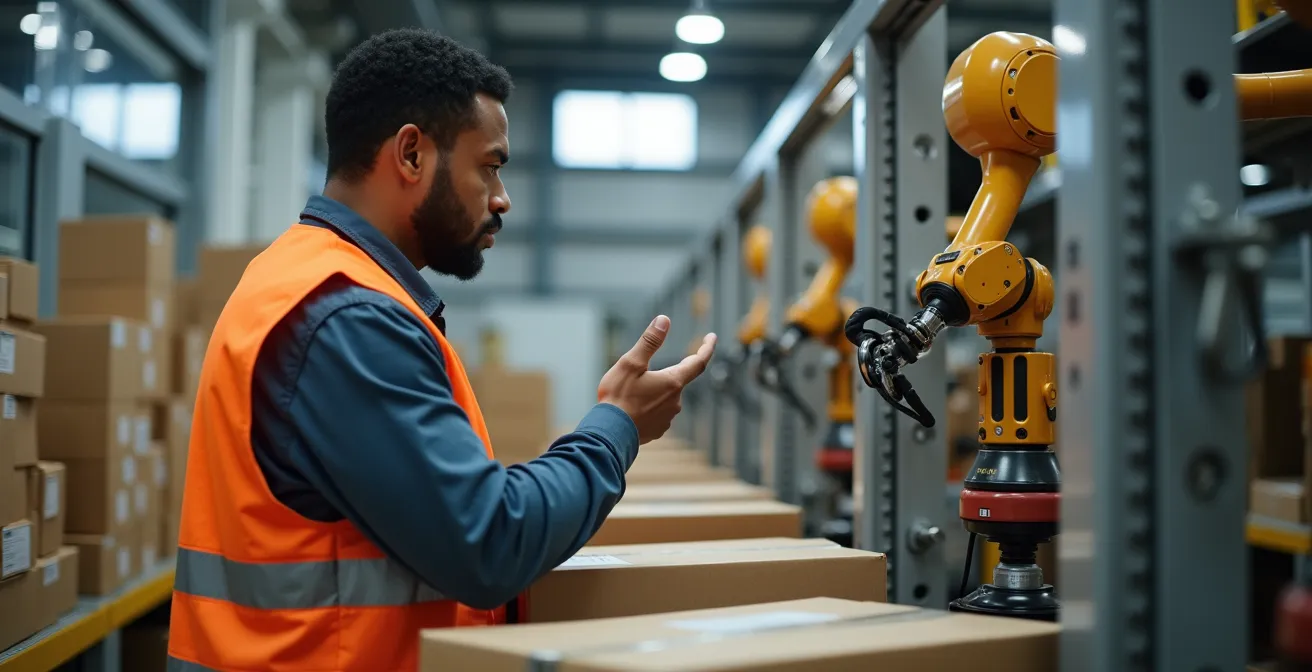
A cost analysis reveals a clear trade-off. Human labor typically requires lower initial investment but accounts for the largest portion of ongoing operating costs—often 50-60% of total delivery expenses. Automated systems, such as robotic sorting or autonomous delivery vehicles, demand significant upfront capital but can drastically lower the per-unit cost at scale and operate with unwavering reliability. A strategic analysis, such as the one provided by Precedence Research, helps illustrate these key differences.
| Factor | Human Labor | Automated Systems |
|---|---|---|
| Initial Investment | Lower upfront costs | Higher initial capital |
| Operating Costs | 50-60% of delivery costs | Lower per-unit cost at scale |
| Scalability | Limited by workforce availability | Easily scalable with infrastructure |
| Reliability | Variable based on human factors | Consistent performance metrics |
| Flexibility | High adaptability to complex situations | Limited to programmed scenarios |
The optimal strategy is not to eliminate labor but to augment it. In a modern fulfillment center, this looks like a human worker making complex picking decisions while robotic arms handle the sorting and packing. On the road, it could mean a human driver managing a fleet of sidewalk delivery bots for a hyper-dense neighborhood. This synergistic approach allows a business to scale intelligently, investing in automation where it drives the most value while retaining the critical problem-solving skills of its human workforce.
Planning Delivery Windows
In today’s on-demand economy, customer expectations for speed and convenience have fundamentally reshaped the last mile. The vague “all-day” delivery window is no longer acceptable. According to recent surveys, an astonishing 77% of online shoppers expect delivery within two hours for certain types of products. Meeting this demand with a static, pre-planned system is virtually impossible and a direct path to customer churn.
The solution lies in offering dynamic delivery windows, a system where customers can choose a specific time slot that works for them, often for a variable fee. This approach transforms the delivery from a logistical burden into a premium, customer-centric service. However, it can only be achieved through a deeply integrated technology stack. AI-based route optimization must be able to calculate the cost and feasibility of adding a time-specific stop in real time, while live tracking and accurate ETAs provide the transparency needed to make the system trustworthy.
Implementing such a system requires a methodical approach that connects routing intelligence, pricing strategy, and customer-facing technology. By establishing a feedback loop where machine learning algorithms continuously refine time predictions based on actual performance, your operation becomes progressively more accurate and efficient over time. This not only meets high customer expectations but also opens up new revenue streams through premium, time-guaranteed delivery options.
Your 5-Step Action Plan for Dynamic Window Implementation
- Integrate Multi-Objective AI: Implement an AI-based route optimization platform that simultaneously considers travel distance, fuel consumption, and specific delivery time windows.
- Deploy Real-Time Tracking: Give customers full visibility with live tracking systems that provide accurate, constantly updated ETAs for their deliveries.
- Introduce Dynamic Pricing: Connect your system to a dynamic pricing model that automatically adjusts delivery costs based on real-time demand, urgency, and route efficiency.
- Connect to Smart Ecosystems: Explore integrations with smart home platforms to enable automated coordination for unattended deliveries, further increasing success rates.
- Establish a Learning Feedback Loop: Use machine learning to analyze delivery outcomes and continuously refine and improve the accuracy of future time predictions and route planning.
Understanding the Impact of Urbanization on Freight
The global shift towards urban living is the single greatest force shaping the future of logistics. As cities become denser, the final leg of the delivery journey becomes exponentially more challenging. Increased traffic congestion, limited parking, and a higher density of deliveries in concentrated areas put immense strain on traditional freight models. This isn’t a future problem; it’s a present-day reality that is fundamentally breaking static, inefficient supply chains.
The scale of this challenge is staggering. A landmark report from the World Economic Forum predicts that last-mile deliveries in urban areas will increase by 78% by 2030. This surge will lead to more than just longer delivery times; it will result in a significant increase in delivery vehicles on the road, exacerbating congestion and CO2 emissions unless a more intelligent approach is adopted. A static model simply cannot scale to meet this demand without collapsing under its own inefficiency.
This relentless pressure of urbanization is the primary catalyst forcing the industry to innovate. It makes the case for dynamic routing, micro-fulfillment, and automation not just as “nice-to-haves” but as essential survival strategies. For a founder or manager, understanding this macro-trend is critical. It provides the context for every strategic decision, reinforcing the urgent need to build a logistics network that is not just fast, but also agile, sustainable, and designed for the complex reality of the modern city.
Optimizing Shared Use
In the new logistics paradigm, the concept of “ownership” is becoming less important than “access.” The move towards a dynamic model requires a shift in thinking about assets, treating them not as fixed, siloed resources but as components of a fluid, interconnected ecosystem. Optimizing shared use—whether of physical space, vehicle capacity, or data—is the key to unlocking a new level of efficiency and scalability that is impossible to achieve alone.
Micro-fulfillment centers, for instance, don’t need to be proprietary. A single, well-placed urban MFC could serve multiple e-commerce retailers, creating shared-cost efficiencies for all. Similarly, delivery vehicles can be part of a collaborative network, where capacity is dynamically allocated based on real-time demand across different companies. This approach maximizes asset utilization and minimizes idle time, directly attacking the high fixed costs of logistics infrastructure.
This principle of shared use extends powerfully to data. Breaking down data silos between partners in the supply chain is critical for creating true end-to-end visibility. Maersk provides a powerful case study in this domain by implementing smart contracts on Ethereum-based platforms. This system enables the seamless and secure exchange of documentation during cargo transport, drastically reducing paperwork and improving communication flow among all partners involved in a shipment. It’s a clear demonstration of how shared, transparent data architecture creates a more efficient and resilient logistics network for everyone.
Key takeaways
- The “static mindset”—relying on fixed routes, schedules, and infrastructure—is the true root cause of last-mile inefficiency and cost overruns.
- Emerging technology’s real power is not just optimization, but enabling a shift to a fully dynamic, prescriptive system that solves problems before they occur.
- Investing in decentralized models like micro-fulfillment and shared-use platforms creates operational fluidity, increasing asset utilization and slashing costs.
Digitizing Logistics for Total Visibility
Ultimately, all the technologies and strategies discussed—AI routing, micro-fulfillment, automation, and shared assets—serve a single, overarching goal: achieving total operational visibility. In an era where customers expect real-time updates and businesses need to make split-second decisions, the ability to see and control every moving part of the supply chain has become non-negotiable. Digitization is the backbone that makes this possible.
Total visibility moves beyond simple package tracking. It means having a single source of truth that integrates data from your vehicles, inventory, workforce, and customers. It allows a manager to see not only where a package is but also to understand the capacity of the entire network, identify potential bottlenecks hours in advance, and reallocate resources dynamically to prevent disruptions. This level of control turns logistics from a cost center into a strategic competitive advantage.
This shift is a fundamental change in how logistics is managed. As a recent industry report aptly states, visibility is no longer a luxury but a core requirement for survival and success.
In an on-demand world, total visibility has moved from nice-to-have to non-negotiable.
– FarEye Industry Report, The Future of the Last Mile Delivery Industry
By digitizing every touchpoint and integrating every data stream, you build a logistics machine that is not just efficient but intelligent. It can learn from its own performance, adapt to external shocks, and consistently deliver a superior customer experience. This is the end state of the journey from a static to a dynamic operational model.
To truly accelerate your residential delivery, begin by auditing your current processes for static bottlenecks. The next logical step is to identify one key area—be it routing, inventory placement, or delivery windows—and pilot a dynamic, technology-driven approach to measure the impact on your bottom line and build the case for a broader transformation.