

The real cost of a work truck isn’t its purchase price, but the hidden financial drains from over-speccing, inefficient cargo management, and overlooked maintenance liabilities.
- Diesel engines only become profitable after a specific mileage threshold, factoring in higher maintenance and fluid costs.
- Every factory option, from 4×4 systems to crew cabs, comes with a direct “payload penalty” that reduces your daily earning capacity.
Recommendation: Calculate the Total Cost of Ownership (TCO), not just the monthly payment, before signing any deal to ensure the vehicle is a true financial asset.
For a general contractor or tradesman, a pickup truck is more than a vehicle; it’s a primary business asset. Yet, the purchasing decision is often dominated by sticker price, horsepower, and brand loyalty. This approach overlooks the most critical metric: Total Cost of Ownership (TCO). The common debate of gas versus diesel, for example, is usually a superficial comparison of fuel prices, ignoring the deeper financial realities. Similarly, the appeal of a fully-loaded truck can mask the direct hit to profitability caused by reduced payload and increased complexity.
The true path to a profitable work truck lies not in saving a few thousand on the initial purchase, but in understanding the long-term financial equation. This involves a strategic analysis of how every choice—from the engine type to the bed organization system—impacts your bottom line over the vehicle’s entire service life. It’s about shifting the mindset from buying a tool to investing in a profit-generating platform. The difference between a truck that makes you money and one that quietly drains your accounts is found in the details that most buyers ignore.
This guide provides a financial framework to deconstruct that TCO. We will move beyond the dealership brochure and into the real-world numbers that define profitability. By treating your truck as a financial asset, you can make a calculated decision that boosts your business’s efficiency and financial health for years to come.
This article provides a detailed roadmap for evaluating a work truck as a financial asset. Explore the sections below to master each component of its total cost of ownership and profitability.
Summary: Beyond the Sticker Price: A Financial Framework for a Profitable Work Truck
Calculate the diesel break-even point
The diesel versus gas debate is the classic starting point for any truck purchase analysis, but most discussions are dangerously oversimplified. A true financial evaluation requires calculating the specific mileage at which the higher upfront cost of a diesel engine is offset by its fuel efficiency and power advantages. This is the profitability threshold. The initial price premium for a diesel model is significant, often ranging from $8,000 to $11,000. This is your initial investment deficit that must be recouped.
However, the calculation doesn’t stop at fuel savings. You must factor in higher scheduled maintenance costs and the recurring expense of Diesel Exhaust Fluid (DEF). A real-world cost analysis over 15,000 annual miles reveals the complexity: while a gas truck might have higher fuel and depreciation costs totaling $35,420, a diesel’s lower fuel bill is offset by higher maintenance, bringing its total to $32,680. In this scenario, the diesel owner saves $2,740 annually, meaning it would take approximately three to four years to break even on an average $9,500 price premium.
This break-even point is a moving target influenced by fuel price volatility and your specific usage patterns. A contractor who drives high annual miles will reach the threshold much faster than one who primarily works locally. Ignoring these variables means you’re not making a financial calculation; you’re making a guess. A diesel engine is not inherently “better” or “worse”—it’s a financial tool whose value is entirely dependent on your operational context.
The mistake of over-speccing the truck
One of the most common and costly errors in purchasing a work truck is over-specification. It’s easy to get drawn in by the appeal of a top-tier trim, a premium sound system, or aggressive off-road packages. However, every non-essential option adds weight, increases complexity, and inflates the purchase price without contributing to the truck’s core function: generating revenue. When fleet analysis reveals average operating costs reach $1.00 per mile for commercial trucks, every ounce of unnecessary weight and every dollar of added cost directly erodes your profit margin.
This is the concept of payload penalty. A 4×4 system can reduce your real-world payload capacity by 200-300 lbs. A spacious crew cab subtracts another 150-200 lbs compared to a regular cab. Even larger wheels and tires can cost you 50-100 lbs of capacity. Cumulatively, these popular options can easily erase over 500 lbs of payload, which could be the difference between making one trip or two, or the ability to carry a critical piece of equipment. You are, in effect, paying more for a truck that can legally and safely haul less.
The strategic alternative is to specify the truck for its mission. This means prioritizing components that enhance productivity and durability—like an efficient engine, a robust frame, and a functional cargo management system—while forgoing cosmetic or convenience features that don’t produce a return on investment. A well-configured base or mid-trim model will almost always be more profitable than a fully-loaded luxury trim for a working professional.
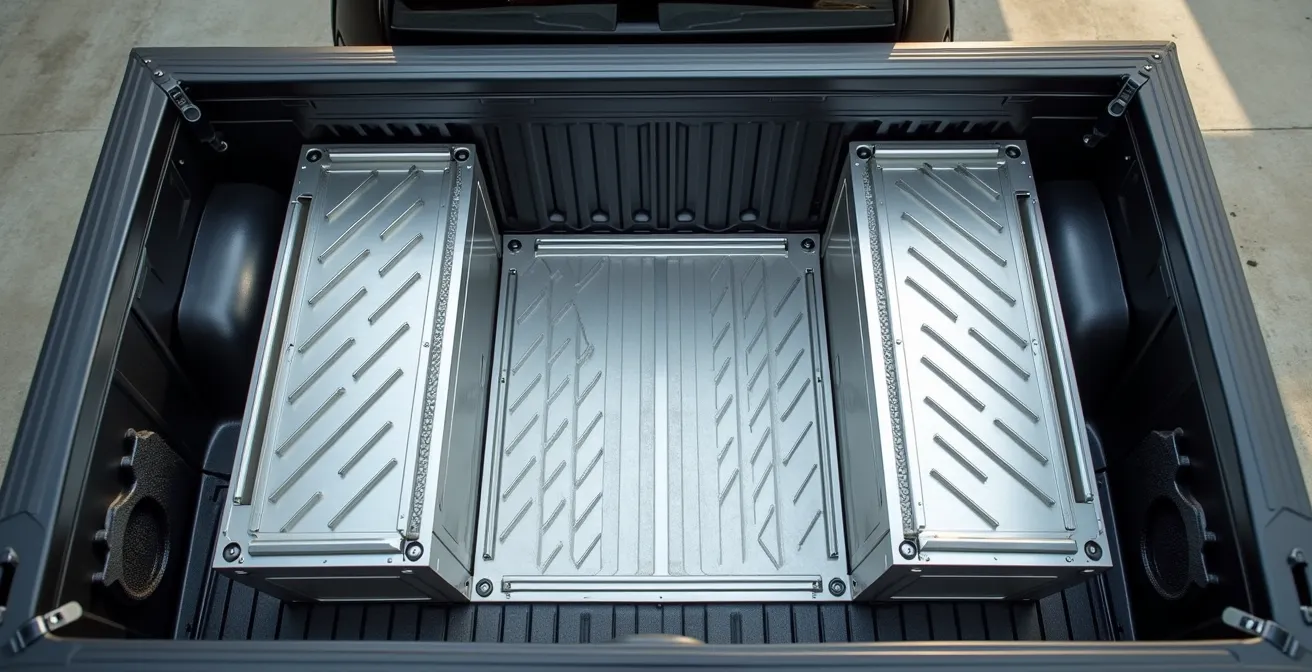
As seen in the image, a thoughtfully configured truck bed with modular systems is a far better investment than aesthetic upgrades. This approach focuses on maximizing utility and efficiency, which are the true drivers of profitability in a commercial vehicle. The goal is to build a tool, not a trophy.
Optimizing cargo space
A standard, empty pickup bed is an inefficient space. Tools and materials slide around, get damaged, and become difficult to find, leading to what can be termed “operational drag”—time wasted that could have been spent on billable work. Optimizing this cargo space with a dedicated organization system is not an expense; it’s a direct investment in productivity with a measurable Return on Investment (ROI).
Even a basic bed organization system can save several minutes per job. If a system saves you just 10 minutes a day, that translates to over 40 hours of recovered productive time per year. For a contractor billing at $75/hour, that’s a $3,000 annual return. The data on this is clear. Organized cargo systems are a key reason some professional contractors report earning up to $1,000 per day by being able to handle multiple service calls efficiently. The less time you spend searching for a tool, the more time you spend completing a job and moving to the next one.
The choice of system depends on your trade, but the financial principle is universal. A full modular system may have a high initial cost, but its impact on daily efficiency can lead to a rapid ROI, often within the first year. The following table provides a clear breakdown of the potential returns.
This comparison from a recent analysis of cargo system ROI highlights the direct financial benefit of investing in organization.
| Cargo Solution | Initial Cost | Time Saved Daily | Annual ROI |
|---|---|---|---|
| Basic Bed Organization | $500 | 5 minutes | $975 saved |
| Drawer System | $1,500 | 10 minutes | $1,950 saved |
| Full Modular System | $3,000 | 15 minutes | $2,925 saved |
| Bed Cover + Organization | $2,000 | 8 minutes + fuel savings | $2,340 saved |
Investing in cargo management transforms the truck bed from a simple container into an organized, mobile workshop. This enhancement directly reduces wasted time, protects valuable tools, and ultimately increases your daily earning potential.
Comparing real-world payload capacities
One of the most misleading specifications on any truck brochure is the “maximum payload” figure. This number almost always refers to a stripped-down, base model configuration that few professionals actually buy. The true, usable payload capacity of the specific truck you’re considering is found on the Tire and Loading Information label on the driver’s side door jamb. The difference between the brochure and the sticker can be staggering.
Your truck’s real-world payload is its Gross Vehicle Weight Rating (GVWR) minus its actual curb weight. Every single option adds to that curb weight, directly subtracting from your payload. This includes the weight of all passengers, tools, cargo, and the trailer tongue weight if you are towing. Failing to account for this can lead to dangerous and illegal overloading, putting you at risk of fines, voided insurance, and catastrophic component failure. The brochure spec is a marketing number; the door-jamb sticker is a legal limit.
This disconnect between advertised and actual capacity is where many well-intentioned purchases go wrong. You might think you’re buying a one-ton truck with 4,000 lbs of payload, but after adding a crew cab, 4×4, a heavy-duty towing package, and a diesel engine, your actual legal capacity might be closer to 3,000 lbs. Understanding this distinction is fundamental to choosing a truck that can legally and safely perform the tasks your business requires.
As industry veteran Darry Stuart noted in Fleet Equipment Magazine, the real-world performance of a truck often defies simple spreadsheet calculations. This is especially true for payload.
You cannot put enough data in a spreadsheet for a suitable ROI calculation when equipment is off the books. How do you do an ROI on a 12-year-old shop pickup truck with 300,000 miles, other than ‘it is just time’?
– Darry Stuart, Fleet Equipment Magazine
His point underscores the need to look past theoretical numbers and focus on the practical, legal limits that govern your day-to-day operations.
Planning maintenance for emission control systems
For modern diesel trucks, the emission control system—primarily the Diesel Particulate Filter (DPF) and Selective Catalytic Reduction (SCR) system using DEF—represents a significant and often underestimated long-term maintenance liability. These systems are critical for meeting environmental regulations, but they add complexity and cost that are absent in gasoline counterparts. Ignoring their maintenance requirements is a recipe for expensive, business-halting downtime.
The DPF requires periodic “regeneration” cycles to burn off trapped soot. While this can happen passively during highway driving, trucks used primarily for short trips or in city traffic often fail to reach the necessary temperatures. This forces manual regenerations and, eventually, leads to a clogged DPF that can cost thousands to clean or replace. Furthermore, the SCR system requires a constant supply of DEF, and while the fluid itself is not expensive, the emission control systems add approximately $0.02 per mile to your operating costs. The sensors within these systems, such as NOx sensors, are also finite-life components that can cost several hundred dollars each to replace.
A proactive maintenance strategy is non-negotiable. This involves understanding the truck’s regeneration behavior, budgeting for periodic professional DPF servicing, and monitoring DEF consumption. Forgetting to refill the DEF tank will cause the truck to enter a “limp mode” or refuse to start, bringing your workday to an abrupt halt. These are not optional maintenance items; they are a core part of the modern diesel TCO.
Your Action Plan: DPF Maintenance Strategy for City Driving
- Schedule weekly highway drives of 20+ minutes at operating temperature to trigger passive regeneration.
- Monitor DPF percentage through diagnostic tools – initiate manual regen at 80% capacity.
- Budget $400-600 annually for professional DPF cleaning services.
- Track DEF consumption rates – expect 2-3% of diesel fuel volume usage.
- Plan for NOx sensor replacement every 100,000-150,000 miles at $300-500 each.
Comparing weight and payload
The physical weight of the truck itself is a critical variable in the TCO equation, directly influencing both fuel consumption and, most importantly, legal payload capacity. The advent of high-strength, military-grade aluminum alloy bodies in trucks like the Ford F-150 introduced a significant trade-off: higher material cost versus lower curb weight. From a purely financial perspective, that weight reduction is a direct investment in payload.
An aluminum body can make a truck up to 700 pounds lighter than a comparable steel-bodied version. This 700-pound difference is not just an engineering statistic; it’s 700 pounds of additional cargo, tools, or materials you can legally and safely carry on every single trip. For a bulk material hauler, this could mean fewer trips per day. For a mobile mechanic, it could mean carrying a welder or air compressor that would otherwise overload the vehicle. This increased capacity is a direct revenue-generating advantage.
While concerns about higher repair costs for aluminum exist, the financial benefits can often outweigh them. A real-world analysis shows the depreciation difference alone can be substantial. An aluminum-bodied truck might depreciate by $14,000 in a given period, whereas a heavier steel-bodied equivalent could lose $17,500. That $3,500 annual depreciation advantage, combined with the daily utility of the extra 700 lbs of payload, makes a compelling financial case. The lighter weight also contributes to modest fuel savings and reduced wear on tires and suspension components, further sweetening the TCO calculation.
The decision between steel and aluminum is not about which material is “tougher” in the abstract, but about which one provides a better financial return for your specific application. If your business consistently operates near the truck’s GVWR limit, the payload advantage of a lighter truck is a powerful profit multiplier.
Comparing Diesel vs. Gas for torque
Beyond fuel economy and maintenance costs, the fundamental performance difference between diesel and gasoline engines lies in torque delivery. For a professional who frequently tows heavy loads or operates a truck laden with equipment, this is not a trivial matter. Torque is the measure of rotational force—the “pulling power” that gets a heavy load moving from a standstill or up a steep grade. In this domain, diesel engines have a distinct, physics-based advantage.
The Hall Chrysler Technical Team provides a succinct explanation of why this is the case. The very nature of diesel combustion gives it an edge for heavy work.
The torque advantage of diesel engines is better suited for pulling heavy loads up steep grades. The relatively high-compression ratio necessary to ignite diesel fuel (17:1 diesel versus 9:1 gasoline) allows the diesel engine to generate all its torque and power at a lower rpm.
– Hall Chrysler Technical Team, Hall Chrysler Dodge Jeep RAM Virginia Beach
This ability to produce massive torque at low engine speeds (RPM) is what gives a diesel truck its feeling of effortless strength. A gasoline engine, by contrast, typically needs to rev much higher to reach its peak torque and power, leading to more noise, strain, and often, higher fuel consumption under load. While modern V8 and turbocharged V6 gasoline engines have made impressive strides, the low-RPM grunt of a diesel remains the gold standard for heavy-duty applications.
This torque advantage, combined with superior thermal efficiency, is also why the U.S. Department of Energy confirms diesels offer 30-35% better fuel economy than similar-sized gasoline engines. For a business, this isn’t just about performance; it’s about efficiency under stress. The diesel engine does its hardest work with less effort, translating to better fuel economy when towing and a more confident, stable driving experience.
Key Takeaways
- True profitability is determined by Total Cost of Ownership (TCO), not the initial purchase price.
- Every optional feature carries a “payload penalty,” reducing the truck’s legal hauling capacity and earning potential.
- Modern diesel emission systems (DPF, DEF) are a significant, non-optional maintenance liability that must be factored into the TCO.
Ensuring safety and legality in heavy towing
For businesses that rely on heavy towing, operating safely and legally is the ultimate expression of professionalism and financial prudence. Exceeding your truck’s Gross Combination Weight Rating (GCWR) or Gross Axle Weight Ratings (GAWR) is not just a safety risk; it’s a massive financial and legal liability. In the event of an accident, an overloaded vehicle can result in voided insurance, personal liability lawsuits, and potentially business-ending financial consequences.
Understanding and respecting these ratings is paramount. The GCWR is the maximum legal weight of your loaded truck and loaded trailer combined. The GAWR specifies the maximum weight that can be placed on the front and rear axles, respectively. It’s possible to be within your GCWR but still overload an axle, especially the rear one. Properly setting up a trailer, including ensuring the tongue weight is 10-15% of the total trailer weight for stability, and using a functional brake controller are non-negotiable safety procedures.
The financial upside of running a professional towing operation is significant, with some independent operators earning between $6,000 and $10,000 per month. However, this earning potential is predicated on a foundation of safety and legality. This means:
- Verifying your GCWR and maintaining a safe operating margin (e.g., 80% of max).
- Installing and checking a brake controller before every commercial haul.
- Maintaining adequate commercial towing insurance to protect your assets.
- Documenting pre-trip inspections to demonstrate due diligence.
This disciplined approach protects you, your equipment, and the public, while safeguarding the profitability of your business.
By applying this financial framework, your next work truck purchase can be a strategic investment that drives profitability. The next step is to analyze your specific needs and apply these principles to evaluate potential vehicles.
Frequently asked questions about Making a Professional Pickup Truck Purchase Profitable
How do options affect actual payload capacity?
Popular options like 4×4 systems can reduce payload by 200-300 lbs, crew cabs subtract 150-200 lbs versus regular cabs, and larger wheels/tires can remove another 50-100 lbs from advertised capacity.
What’s the difference between GVWR and actual payload?
GVWR (Gross Vehicle Weight Rating) minus curb weight equals maximum payload, but you must also subtract weight of all passengers, options, and tongue weight for true available capacity.
Why does door-jamb sticker payload differ from brochure specs?
The door-jamb Tire and Loading Information label shows actual payload for your specific truck configuration including all installed options, while brochure specs show base model maximum.