

Worried a strange noise or clumsy shift means a $4,000 transmission bill? It often doesn’t.
- Learn to perform “fluid forensics” by interpreting color and smell to gauge urgency.
- Understand why even a minor leak can trigger a catastrophic failure if ignored.
Recommendation: Use this diagnostic framework to confidently assess your transmission’s health and have an informed conversation with your mechanic, potentially saving thousands.
That sudden jerk, a strange whining sound, or an unexpected red puddle on your driveway—these are signals from the heart of your car’s drivetrain: the transmission. For many owners, these signs trigger immediate anxiety, dominated by the fear of a repair bill that can easily soar into the thousands. The common advice is often a frantic “see a mechanic immediately,” which, while sometimes necessary, robs you of the power to understand what’s happening. Many resources list generic symptoms but fail to explain how to differentiate a simple fix from a looming disaster.
But what if the key wasn’t just recognizing the symptoms, but interpreting them? This guide is built on a different premise. We’re moving beyond the panic-inducing checklists to empower you with a diagnostic framework. This is about transforming you from a worried driver into an informed first-responder for your vehicle. You’ll learn to conduct fluid forensics, understand the thermal signature of your transmission, and calculate the real cost of delaying small repairs. It’s not about replacing your mechanic; it’s about knowing when to call them, what to tell them, and how to prevent catastrophic failure in the first place.
This article will walk you through a systematic process, starting with the simplest visual checks and progressing to understanding the complex interplay of heat and mechanics. By the end, you will have a clear roadmap for assessing your transmission’s health and making cost-effective decisions.
Summary: A Systematic Guide to Transmission Diagnostics
- Understand the color of the fluid
- The error of neglecting minor leaks
- Optimize the life of the gearbox
- Compare simple draining and complete flushing
- Plan the professional diagnosis
- Understand the thermal expansion of fluids
- The mistake of privileging high RPMs
- Prevent total engine destruction through thermal monitoring
Understand the color of the fluid
The single most accessible diagnostic tool you have is the transmission fluid dipstick. The color and smell of the Automatic Transmission Fluid (ATF) offer a direct window into the internal health of the system. This process is less a simple check and more a form of fluid forensics. Brand new fluid is typically a bright, translucent cherry red, indicating a healthy, well-maintained system. Over time, it is normal for the fluid to darken slightly to a light brown due to oxidation from heat cycles. This is not an immediate cause for alarm, but a signal that a fluid change should be on your horizon.
The real warning signs appear with more dramatic changes. A milky pink or strawberry milkshake appearance is a critical alert, indicating that engine coolant is contaminating the transmission fluid through a breach in the radiator or transmission cooler. This is an emergency that requires immediate service to prevent catastrophic failure. Likewise, fluid that is dark brown or black and carries a burnt toast odor is a sign of severe overheating. This burnt smell indicates that the fluid’s protective properties have broken down and the internal clutch packs may be degrading, creating friction and even more heat. For a quick and effective check, you can perform a simple blotter test. Just place a drop of fluid on a white paper towel; as it spreads, it can reveal fine metallic particles or other contaminants not otherwise visible to the naked eye, signaling internal wear.
Transmission Fluid Diagnostic Guide
- Cherry Red (New): Indicates fresh fluid from a recent service or new vehicle. No action needed.
- Milky Pink: Critical coolant contamination. Requires immediate professional attention to prevent total failure.
- Light Brown: Normal oxidation after moderate use. Monitor closely and plan for a fluid change.
- Dark Brown/Black: Fluid is burnt from overheating. Change immediately to prevent further damage.
- Check Smell: A distinct burnt toast odor is a strong indicator of clutch pack degradation and severe wear.
The error of neglecting minor leaks
A few drops of red fluid on the garage floor might seem insignificant, but ignoring a minor transmission leak is one of the most expensive mistakes a car owner can make. The transmission is a sealed hydraulic system that relies on a precise fluid level to function. This fluid not only lubricates moving parts but also cools the unit and provides the hydraulic pressure needed to shift gears. When the fluid level drops, this entire balance is thrown off. In fact, being just one quart low on fluid can raise operating temperatures by as much as 75°F. This spike initiates a vicious cycle: the remaining fluid overheats, its lubricating properties degrade, friction increases, and component wear accelerates exponentially.
What starts as a slow drip from a dried-out pan gasket or a failing axle seal can quickly escalate into a complete loss of fluid, leading to total transmission failure. The financial equation, or cost-of-delay calculus, is brutally clear. Replacing a simple gasket or cooler line is a minor, preventative expense. Allowing the leak to continue until the transmission is internally damaged transforms that small repair into a multi-thousand-dollar rebuild or replacement. Understanding this relationship is key to avoiding catastrophic bills.
The table below starkly illustrates the difference between proactive prevention and reactive repair. A small investment in fixing a leak is exponentially more cost-effective than dealing with the consequence of a starved and overheated transmission. The data is based on a recent analysis of transmission service costs.
| Preventive Service | Cost | Consequence if Ignored | Repair Cost |
|---|---|---|---|
| Pan Gasket Replacement | $20-50 | Complete fluid loss | $3,500+ rebuild |
| Axle Seal Replacement | $150-250 | Transmission failure | $3,500+ rebuild |
| Cooler Line Repair | $100-200 | Overheating damage | $3,500+ rebuild |
Optimize the life of the gearbox
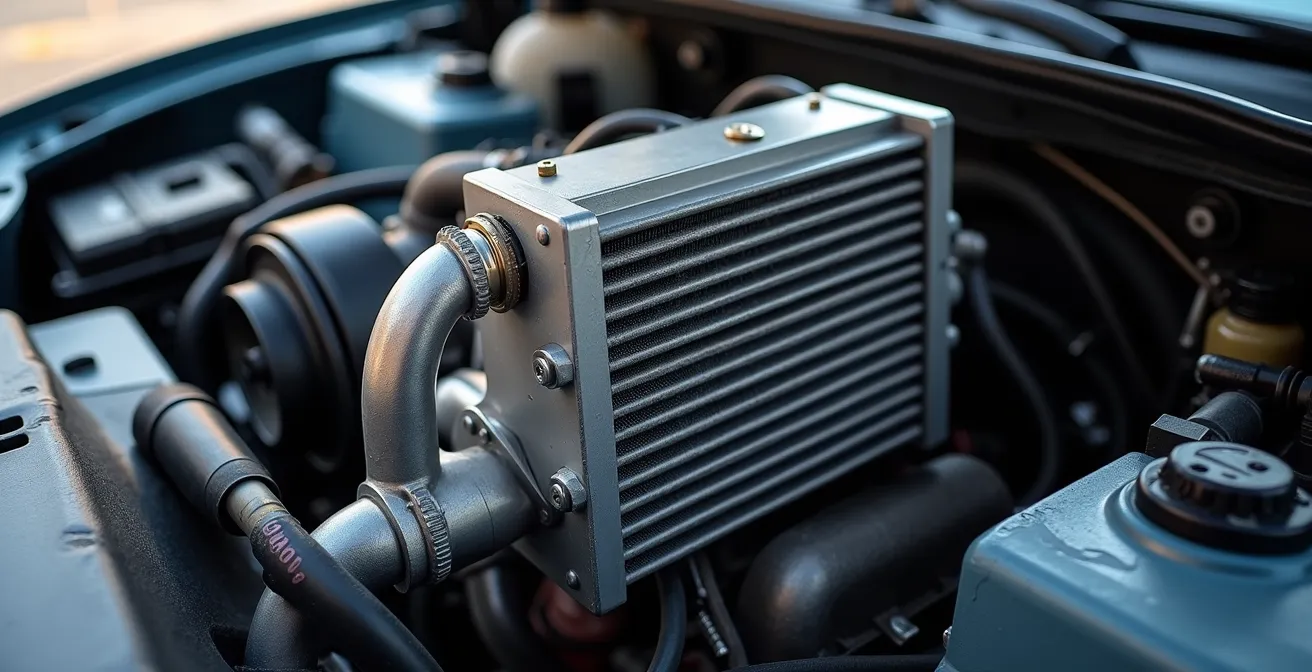
Moving beyond reactive repairs, proactive measures can significantly extend the life of your transmission, often pushing it well past the 200,000-mile mark. The number one enemy of an automatic transmission is heat. Therefore, the most effective strategy for longevity is superior thermal management. For vehicles that are used for towing, hauling heavy loads, or are driven in mountainous terrain or stop-and-go city traffic, the stock cooling system may be inadequate. Installing an auxiliary transmission cooler is one of the best investments you can make. This device works in tandem with the factory cooler (usually integrated into the radiator) to provide an extra layer of heat dissipation, keeping fluid temperatures in the optimal range and preventing premature breakdown.
This image showcases a clean installation of an auxiliary cooler, a key component in a preventative maintenance strategy.
Furthermore, optimizing lifespan requires accurate diagnosis. It’s crucial to understand that not all shifting problems originate in the transmission itself. An engine misfire, a faulty throttle position sensor, or even a failing mass airflow sensor can send incorrect signals to the transmission control module, causing harsh shifts, hesitation, or what feels like gear slippage. A skilled diagnostic approach involves checking the engine for codes and performance issues before condemning the transmission. As the experts at Firestone Complete Auto Care state, understanding the complete system is vital.
Automatic transmission vehicles need transmission fluid to create the hydraulic pressure that powers movement – without proper fluid levels, transmissions can overheat and essential gears can slip or become ground down, potentially causing total vehicle failure.
– Firestone Complete Auto Care, Transmission Problems & Diagnosis Guide
Compare simple draining and complete flushing
When it comes to servicing your transmission fluid, you’ll typically encounter two options: a “drain-and-fill” or a “full flush.” The difference between them is significant, and choosing the right one depends heavily on your vehicle’s age, mileage, and service history. A simple drain-and-fill is exactly what it sounds like: a technician drains the fluid from the transmission pan, replaces the filter, and refills the system. The major limitation of this method is that it only removes a fraction of the total fluid. According to transmission service comparison data, a drain-and-fill replaces only about 40-60% of the fluid, as a large volume remains trapped inside the torque converter and cooler lines.
A full transmission flush, by contrast, uses a specialized machine that connects to the cooler lines. It simultaneously pushes out the old, degraded fluid while pumping in fresh fluid until the entire system is replenished. This process replaces over 95% of the old fluid, providing a much more thorough cleaning. However, this method comes with a crucial caveat, especially for older, high-mileage transmissions with a spotty service history. The forceful flushing action can dislodge built-up sediment and sludge, which can then travel through the system and clog narrow passages in the valve body, potentially causing more problems than it solves. For this reason, many specialists recommend a more conservative approach for neglected transmissions.
Transmission Service Decision Guide
- Over 100,000 miles with unknown service history: Choose a drain-and-fill. This gentler method avoids the risk of dislodging debris that could cause blockages.
- Under 100,000 miles with regular maintenance: A full flush is ideal. It provides a thorough cleaning and ensures nearly 100% fresh fluid for optimal protection.
- High-mileage transmission already showing symptoms: A drain-and-fill is the safer bet. A flush could worsen existing issues by moving sediment into critical components.
- Cost comparison: A drain-and-fill is more affordable (typically $80-$250), while a flush is more comprehensive but costs more ($165-$450).
Plan the professional diagnosis
When DIY diagnostics reach their limit, it’s time to consult a professional. However, arriving at the shop armed with precise information can dramatically improve the accuracy of the diagnosis and save you money. This is the final step in your diagnostic triage: handing off the case with a clear, concise report. Instead of saying “it’s making a weird noise,” describe the symptoms with specifics: “There is a harsh 2-3 upshift, but only after the car has been running for 20 minutes,” or “I hear a whining noise that increases with engine RPM, but not with vehicle speed.” This level of detail helps a technician narrow down the potential causes, distinguishing between a pressure issue, a sensor failure, or a mechanical problem.
Professionals will use an OBD-II scanner to pull diagnostic trouble codes (DTCs) from your vehicle’s computer. It’s important to know that generic engine codes (P0xxx) may not tell the whole story. You should ask the technician to look for transmission-specific codes, typically in the P07xx range. For example, a code like P0732 (Incorrect Gear 2 Ratio) confirms the computer has detected slippage in second gear. While this code provides a critical hint, it doesn’t pinpoint the exact cause—that could be a worn clutch, a faulty solenoid, or a hydraulic pressure leak. A true specialist will use these codes as a starting point, combining them with live data monitoring and pressure tests to find the root of the problem.
Your Pre-Mechanic Diagnostic Checklist
- Symptom Log: Write down exactly what happens, when it happens (hot/cold, accelerating/braking), and what it sounds/feels like. Note any warning lights.
- Fluid Check: Perform the fluid forensics check (color, smell, level) and record your findings to share with the mechanic.
- Leak Documentation: If there’s a leak, note its location (front, middle of car), color, and approximate size (a few drops vs. a puddle).
- Recent History: List any recent repairs or maintenance, even if they seem unrelated (e.g., a radiator change could affect the transmission cooler).
- Find a Specialist: For complex issues, seek out a dedicated transmission shop rather than a general repair facility. Their specialized tools and experience are invaluable.
Understand the thermal expansion of fluids
At the core of nearly all automatic transmission failures is a single culprit: excessive heat. Understanding the physics of thermal expansion and fluid degradation is crucial for preventative care. Transmission fluid is engineered to operate within a specific temperature window. When fluid gets hot, it expands. This is why checking the fluid level must be done under the conditions specified by the manufacturer (often with the engine warm and running in Park or Neutral). An inaccurate reading on cold fluid can lead to overfilling, which causes the fluid to foam up as it heats and expands. This aerated fluid cannot provide the stable hydraulic pressure needed for shifting and also loses its ability to cool effectively.
More importantly, high temperatures fundamentally alter the fluid’s chemical composition. Prolonged operation above the ideal range causes the fluid to “burn,” breaking down the additives that provide lubrication, corrosion resistance, and friction modification. As transmission temperature monitoring research confirms, this degradation is not linear; it’s exponential. Degraded fluid is a poor lubricant, which increases friction between moving parts. This friction, in turn, generates even more heat, creating a runaway thermal cycle that quickly leads to permanent damage to clutches, seals, and the torque converter. Monitoring your transmission’s thermal signature is therefore not just a best practice; it is the foundation of long-term reliability.
The mistake of privileging high RPMs
A driver’s habits have a direct and measurable impact on the lifespan of a transmission, whether it’s an automatic or a manual. One common mistake is the belief that keeping the engine at high Revolutions Per Minute (RPMs) is a sign of performance driving. While appropriate in some situations, consistently aggressive driving—hard accelerations, frequent downshifts to engine brake, and holding gears to the redline—places immense stress on transmission components. In an automatic transmission, this behavior increases heat and hydraulic pressure, accelerating wear on clutch packs and bands. The constant high-pressure cycles can fatigue seals and solenoids over time.
For manual transmissions, the impact is even more direct. A common failure mode results from drivers who frequently ride the clutch or perform aggressive shifts without a full, clean engagement. This behavior causes excessive slippage of the clutch disc, rapidly burning away the friction material and leading to premature clutch failure. An example of this is when a driver accelerates hard and shifts quickly without fully releasing the clutch pedal between gears, causing rapid burnout that necessitates a costly clutch replacement service. Gentle, smooth inputs are always more mechanically sympathetic. Letting the transmission shift at its designed points in an automatic, or practicing smooth clutch engagement in a manual, will add tens of thousands of miles to its operational life.
Key takeaways
- The color and smell of your transmission fluid are your best early warning system; burnt or milky fluid requires immediate attention.
- Ignoring small leaks is a costly mistake, as low fluid levels dramatically increase heat and accelerate wear.
- For high-mileage or neglected transmissions, a simple drain-and-fill is often safer than a full flush, which can dislodge harmful sediment.
Prevent total engine destruction through thermal monitoring
We’ve established that heat is the primary enemy of your transmission. Therefore, the ultimate preventative strategy is to actively monitor its thermal signature. While most cars have a coolant temperature gauge, very few come with a factory transmission temperature gauge. This leaves drivers blind to the single most critical health metric of their gearbox. Fortunately, technology provides an accessible and affordable solution. With a simple and inexpensive OBD-II Bluetooth scanner (often under $20) and a compatible smartphone app (like Torque or Car Scanner), you can gain real-time access to your transmission’s temperature data.
Monitoring this data allows you to see how your driving style and external conditions affect the transmission. You’ll see temperatures rise while towing a trailer up a mountain pass or sitting in bumper-to-bumper summer traffic. This knowledge empowers you to take corrective action, such as pulling over to let the system cool down or shifting into a lower gear to increase fluid flow through the cooler. Knowing and staying within the safe operating range is the key to preventing the thermal breakdown of fluid and averting catastrophic failure.
Transmission Temperature Monitoring Guide
- Normal Operation Range: 175-195°F (77-90°C). This is the ideal window for most automatic transmissions.
- Caution Zone (When Towing/Hauling): 200-220°F (93-104°C). Temperatures in this range are acceptable for short periods but indicate high stress.
- Danger/Damage Zone: Above 230°F (110°C). Prolonged exposure above this temperature causes rapid fluid degradation and permanent damage.
- Monitoring Tool: Use an inexpensive OBD-II Bluetooth scanner paired with a smartphone app like Torque or Car Scanner for real-time data.
By learning to interpret your transmission’s signals—from its fluid to its thermal behavior—you shift from being a passive passenger to an active, informed owner. This knowledge demystifies the machine, replaces fear with confidence, and is your best defense against unexpected and expensive repairs. The next logical step is to apply this knowledge by regularly checking your fluid and considering an affordable OBD-II scanner to monitor temperatures, ensuring you catch any issue long before it becomes a catastrophe.
Frequently Asked Questions about Diagnosing Transmission Problems
What specific information should I provide to my mechanic?
Describe symptoms precisely, such as ‘harsh 2-3 upshift only when hot’, and request monitoring of input/output speed sensors during the test drive for an accurate diagnosis. Vague descriptions lead to longer, more expensive diagnostic times.
Should I request specific diagnostic codes?
Yes, ask specifically for the P07xx range of transmission diagnostic trouble codes (DTCs), not just the generic check engine codes. These codes provide a much more direct clue to the internal workings of the transmission.
When should I seek a transmission specialist over a general repair shop?
For anything beyond a simple fluid and filter change, a transmission specialist is highly recommended. They possess the diagnostic expertise and specialized tools (like pressure gauges and solenoid testers) that save time and money in the long run by accurately pinpointing the failure instead of replacing parts by trial and error.