
The common advice for mountain driving—”use a lower gear”—is dangerously incomplete; true safety comes from understanding your vehicle’s entire braking system as an energy management tool.
- Brake failure is rarely sudden; it’s a predictable result of heat overwhelming system components like pads (glazing) and fluid (boiling).
- Proactive maintenance, including fluid checks, pad selection, and proper bedding-in, is far more critical than reactive driving techniques.
Recommendation: Before any mountain trip, treat your braking system as a non-negotiable safety priority. Understand its limits and prepare it to handle the immense thermal loads it will face.
For a driver accustomed to the flatlands, the first sight of a steep mountain descent sign—”6% Grade, Next 8 Miles”—can be intimidating. The common wisdom passed down is simple: shift into a lower gear and don’t “ride” the brakes. While not wrong, this advice is a dangerous oversimplification. It treats a complex issue of physics and mechanical engineering as a simple driving tip, leaving you unprepared for the immense forces at play. Your brakes aren’t just for slowing down; on a mountain, they are energy converters, transforming the colossal kinetic energy of your vehicle into heat.
The real key to mountain safety isn’t just about how you drive, but about a deeper, system-level understanding of your vehicle. It’s about recognizing that your brake pads, fluid, calipers, and even your tires form an interconnected system with finite thermal limits. Pushing past these limits doesn’t just reduce performance; it leads to catastrophic failure through phenomena like pad glazing, fluid boiling, and complete loss of stopping power, known as brake fade. This guide moves beyond the platitudes to give you the mechanical knowledge and preparation strategy needed to manage that energy safely.
This article will deconstruct the braking system piece by piece, providing a clear roadmap for inspection, preparation, and on-road technique. By understanding the “why” behind the warnings, you can approach the Rockies, Sierras, or any mountain range not with fear, but with the confidence that comes from being truly prepared.
Table of Contents: A System-by-System Guide to Mountain Braking
- Identifying brake pad glazing
- Understanding moisture absorption in brake fluid
- The mistake of neglecting rear brakes
- Optimizing friction material choice
- Planning the bed-in for new brakes
- Understanding the physics of brake overheating
- Optimizing trailer braking
- Mastering high-mountain driving to preserve mechanics
Identifying brake pad glazing
Brake pad glazing is one of the most common and insidious forms of brake fade. It occurs when the brake pads get so hot that the resin binders in the friction material crystallize, creating a hard, glass-like surface. This dramatically reduces the pad’s coefficient of friction, meaning it can no longer effectively grip the rotor. The scary part is that your brake pedal might still feel firm, but the car simply won’t slow down as it should. This failure happens when temperatures exceed 200°C (392°F), a threshold easily surpassed during a long, steep descent if you rely too heavily on your brakes.
Identifying glazed pads is a critical pre-trip inspection step. You don’t need to be a master mechanic to spot the warning signs. Visually, a glazed pad surface will look shiny and smooth, almost polished, instead of the dull, slightly rough texture of a healthy pad. You can often feel this smoothness by carefully running a finger over the pad surface (ensure the brakes are completely cold before doing so). Sonically, the signs are just as clear. Glazed pads often produce a high-pitched squeal or a deep groaning noise during braking, a clear signal that the pad is skipping and vibrating against the rotor instead of gripping it.
If you suspect your pads are glazed, they must be addressed. In some minor cases, a series of hard stops can wear away the glazed layer, but the safest solution is replacement. Ignoring these symptoms is a direct path to a dangerous situation on a mountain road, where full stopping power is not a luxury but a necessity. This proactive check is the first line of defense in ensuring your vehicle’s systemic integrity.
Understanding moisture absorption in brake fluid
While brake pads get most of the attention, the fluid that actuates them is an equally critical, and often neglected, component. Most vehicles use glycol-based brake fluid which is hygroscopic, meaning it naturally absorbs moisture from the atmosphere. Even in a perfectly sealed system, brake fluid can absorb 1-2% moisture per year. This might not sound like much, but it has a devastating effect on the fluid’s boiling point. When your brakes work hard descending a mountain, the fluid in the calipers gets extremely hot. If it boils, it turns from an incompressible liquid into a compressible gas. The result? A “spongy” or “soft” brake pedal that goes to the floor with little to no braking force. This is a complete hydraulic failure.
The impact of water contamination is not theoretical; it’s a matter of physics. Fresh, clean brake fluid has a high boiling point, but even a small amount of water drastically lowers this thermal threshold. As an SAE study revealed, an average one-year-old car can have 2% moisture in its fluid, and 25% of randomly tested cars had a dangerously high water content of 4% or more. This silent degradation of your braking system’s performance is a major risk for any driver heading into the mountains.
The table below clearly illustrates how quickly your margin of safety erodes as moisture content increases. For a flatland driver, fluid that is 3% water might feel perfectly fine in city traffic, but it becomes a critical failure point under the sustained heat of mountain braking.
| Moisture Content | DOT 3 Boiling Point | DOT 4 Boiling Point |
|---|---|---|
| 0% (Fresh) | 205°C (401°F) | 230°C (446°F) |
| 1% Water | 188°C (370°F) | 210°C (410°F) |
| 2% Water | 160°C (320°F) | 185°C (365°F) |
| 3% Water | 145°C (295°F) | 165°C (329°F) |
Therefore, a pre-trip brake fluid flush is not an upsell; it’s a fundamental safety measure. A mechanic can test the moisture content of your fluid in seconds. If it’s over 2%, or if the fluid hasn’t been changed in two years, replacing it is the single most effective way to restore your hydraulic system’s thermal resilience.
The mistake of neglecting rear brakes
In modern vehicles, the front brakes do the majority of the work—typically 60-70% of the stopping. This leads many people to focus exclusively on the front pads and rotors, treating the rear brakes as an afterthought primarily for the parking brake. This is a critical error in judgment, especially when preparing for mountain driving. The rear brakes are an essential part of the vehicle’s overall energy management system. When functioning correctly, the rear brakes can absorb 30-40% of the braking energy. If they are worn, seized, or otherwise ineffective, that entire thermal load is shifted to the front brakes, drastically increasing the risk of them overheating and failing.
A comprehensive pre-trip inspection must include a thorough check of the rear braking system. This goes beyond simply looking at pad thickness. On vehicles with disc brakes, it’s vital to check that the caliper slide pins are properly lubricated and moving freely. Seized slide pins are a common issue that prevents the caliper from applying even pressure, leading to one pad doing all the work and overheating quickly. For vehicles with rear drum brakes, an inspection of the shoes, wheel cylinders, and hardware is just as important.
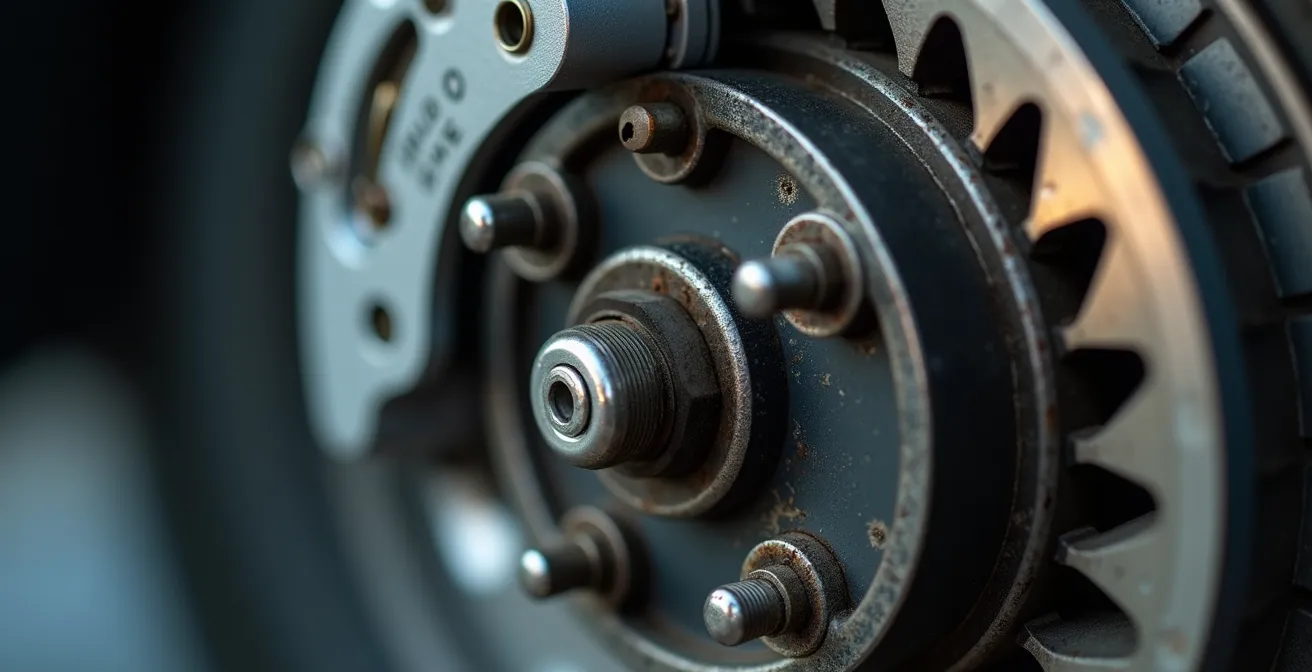
As the image above illustrates, the rear brake assembly is a precise mechanical system. The parking brake mechanism, integrated into the caliper on many modern cars, can also be a point of failure if cables are stretched or seized. A fully functional rear braking system distributes the thermal load across all four corners of the vehicle, increasing your overall thermal capacity and providing a much larger margin of safety on long descents. Neglecting them is like asking two people to do the work of four; eventually, they will be overwhelmed.
Optimizing friction material choice
Not all brake pads are created equal. The material they are made from—the “friction material”—dictates their performance characteristics, especially their ability to handle heat. For daily driving in a flat area, standard Organic or OEM pads are perfectly adequate. They offer good “cold bite” (they work well from the first stop), are quiet, and are gentle on brake rotors. However, their lower thermal threshold makes them a poor choice for the sustained high temperatures of mountain descents. Using them in such conditions is a direct route to the brake glazing discussed earlier.
Choosing the right pad material is a proactive step that significantly enhances safety. For a family SUV or truck that will be loaded with gear and people, upgrading to a higher-performance pad is a wise investment. Ceramic pads are an excellent all-around choice, offering high heat resistance, good cold bite, low noise, and minimal rotor wear. Semi-metallic pads offer even higher heat resistance and are very effective, but can be noisier and wear rotors more quickly. Performance-hybrid pads offer the highest heat tolerance but often have poor cold bite, meaning they need to warm up to work effectively, which may not be ideal for a family vehicle.
The following table provides a clear comparison to help guide your decision, balancing the trade-offs between heat handling and everyday usability. For a flatlander’s vacation vehicle, Ceramic pads often represent the best blend of safety and comfort.
| Pad Type | Heat Resistance | Cold Bite | Rotor Wear | Mountain Suitability |
|---|---|---|---|---|
| OEM Organic | Low-Medium | Good | Low | Fair |
| Ceramic | High | Good | Excellent | |
| Semi-Metallic | High | Medium | Medium | Very Good |
| Performance/Hybrid | Very High | Poor when cold | High | Good (with warm-up) |
Ultimately, investing in a quality ceramic or semi-metallic pad from a reputable brand provides a crucial buffer against overheating. It increases the thermal capacity of your entire braking system, giving you peace of mind when you need it most.
Planning the bed-in for new brakes
Installing new, high-quality brake pads and rotors is a fantastic step toward mountain-readiness, but the job isn’t finished yet. There is one final, critical process that is almost universally ignored by average drivers: the bedding-in procedure. Bedding-in (or “burnishing”) is the process of conditioning new pads and rotors to work together optimally. It involves a series of controlled heat cycles that accomplish two things. First, it cooks off any residual resins from the manufacturing process. Second, and more importantly, it lays down a thin, even layer of friction material onto the face of the brake rotor.
This transferred layer is essential for maximum braking performance. When properly bedded-in, the brakes work by shearing the bond between the pad and the transferred layer on the rotor, which is much more effective and heat-tolerant than the raw pad-on-iron friction of un-bedded brakes. Failing to bed-in your brakes can lead to uneven material deposits on the rotor, which causes vibration and a pulsing sensation often misdiagnosed as “warped rotors.” In a mountain driving scenario, un-bedded brakes are far more likely to glaze and fade because they haven’t been conditioned to handle high temperatures.
Each manufacturer has a slightly different procedure, but the general principle is the same: a series of increasingly firm stops with cooling periods in between. This must be done in a safe, controlled area with no traffic.
Your Pre-Trip Bed-In Procedure
- Start with gentle stops from 30-35 mph to warm the system gradually.
- Progress to moderate stops from 45-50 mph, allowing cooling between applications.
- Perform 8-10 firm stops from 60 mph down to 10 mph (never to a complete stop).
- Allow 30-60 seconds of cooling (by driving) between each firm stop.
- Drive for 5-10 minutes at moderate speed without using the brakes to allow them to cool completely.
This simple procedure, which takes less than 20 minutes, ensures your new brakes deliver the full performance and thermal resistance you paid for. It’s the final step in ensuring the mechanical integrity of your system before you face the first steep grade.
Understanding the physics of brake overheating
To truly appreciate the challenge of mountain braking, you must think like a physicist. A moving vehicle possesses a tremendous amount of kinetic energy. When you apply the brakes, you are not making that energy disappear; you are tasking your braking system with converting it into thermal energy, or heat. On flat ground, this happens in short bursts, and the brakes have ample time to cool. On a long, steep mountain descent, this energy conversion is relentless. The sheer amount of energy that must be dissipated is staggering. For example, analysis shows that a 4,500lb SUV descending 3,000 feet must dissipate enough energy to boil nearly 3 gallons of water.
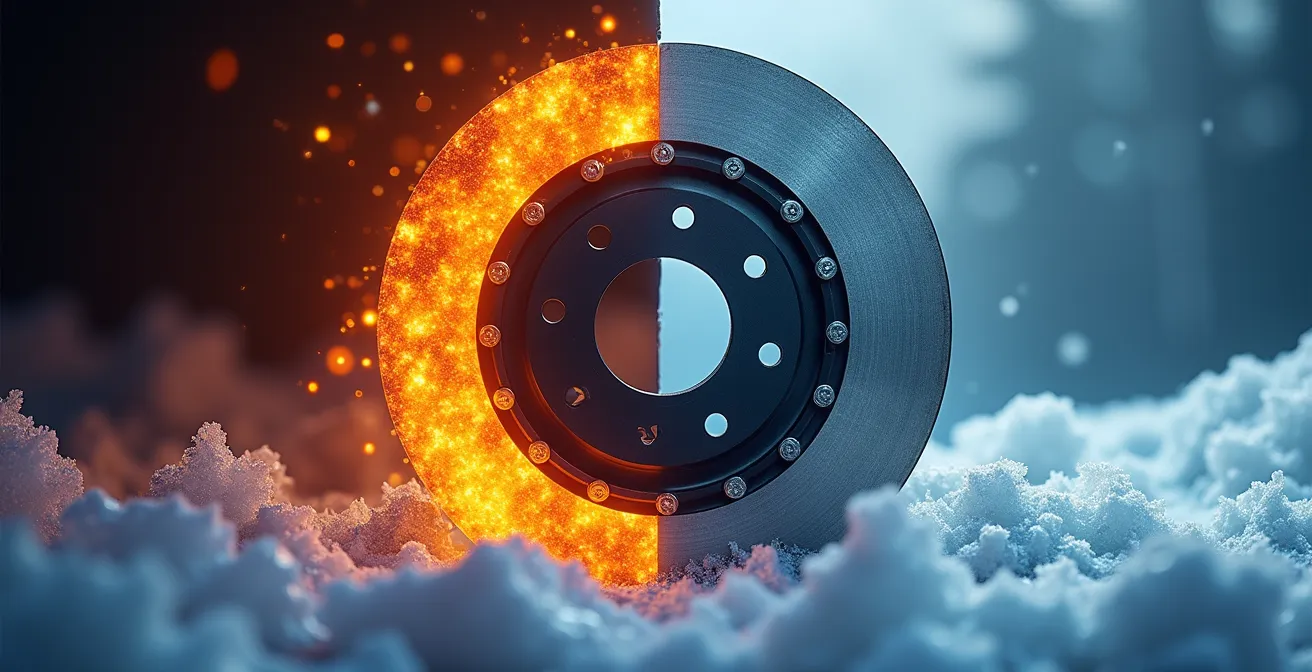
Your braking system is designed to shed this heat into the surrounding air. However, its capacity to do so is finite. If you generate heat faster than the system can dissipate it—by riding the brakes continuously—the temperature of the rotors, pads, and fluid will climb exponentially. This is the root cause of every form of brake failure on a mountain. The rotors can get so hot they glow red, the pads will glaze, and the fluid will boil. Understanding this energy management equation is the key to safe mountain driving. Your goal is not to avoid braking, but to manage the rate of heat generation.
This is precisely why using a lower gear is so important. Engine braking doesn’t use your service brakes. Instead, it uses the engine’s internal resistance to hold the vehicle’s speed, converting kinetic energy into a smaller, manageable amount of heat within the engine and drivetrain, which are designed to handle it. This saves your brakes for when you truly need them, allowing them to remain cool and effective. Every second you are in a lower gear, you are giving your brakes a critical opportunity to shed heat and recover.
Optimizing trailer braking
Adding a trailer to the equation dramatically increases the demands on your braking system. You are not just stopping the weight of your tow vehicle; you are responsible for controlling the combined mass of the entire rig. Towing in the mountains without a properly set up and functioning trailer brake system is exceptionally dangerous. The trailer’s own weight will constantly try to push the tow vehicle down the grade, forcing you to use your brakes far more aggressively and leading to rapid overheating. This is why a trailer’s independent braking system is not an option; it’s an absolute necessity.
The heart of this system is the trailer brake controller mounted in your vehicle’s cab. There are two main types: time-delayed and proportional. Time-delayed controllers apply a preset amount of braking power after a fixed delay. Proportional controllers are far more advanced and safer. They use an internal accelerometer to sense how rapidly the tow vehicle is slowing down and apply the trailer brakes with a precisely matched, or “proportional,” amount of force. This results in smooth, controlled, and stable braking, with the trailer effectively braking for itself instead of pushing the tow vehicle.
The importance of this technology for mountain safety cannot be overstated. As Dan Drella, Schneider’s Safety Team Director, emphasizes:
A proportional brake controller is a non-negotiable safety item for mountain towing, as its ability to dynamically match the trailer’s braking effort to the tow vehicle’s is critical on variable grades.
– Dan Drella, Schneider Safety Team Director
Before your trip, you must ensure your brake controller is set up correctly. In a large, empty parking lot, test the brakes at low speed. The trailer brakes should engage firmly without locking up the wheels. You should feel the trailer gently tugging the vehicle to a stop. If the tow vehicle is doing all the work, you need to increase the “gain” or power on the controller. Proper setup ensures the trailer is a partner in braking, not a liability pushing you toward disaster.
Key Takeaways
- Braking is energy management: Your goal is to control the conversion of kinetic energy into heat, not just to slow down.
- Systemic integrity is paramount: A weakness in one component (fluid, rear brakes, pads) compromises the entire system’s thermal capacity.
- Proactive preparation is key: A thorough pre-trip inspection and component upgrade is far more effective than any reactive driving technique.
Mastering high-mountain driving to preserve mechanics
Once your vehicle is mechanically prepared, the final piece of the puzzle is you, the driver. All the preparation can be undone by improper technique. The most common and dangerous mistake is “riding the brakes”—maintaining light, constant pressure on the pedal. This creates continuous friction and heat with very little airflow for cooling, guaranteeing your brakes will overheat. Studies have shown that inexperienced drivers often go 20 mph over their safe speed, forcing them into this exact braking pattern.
The correct method is a professional technique known as “pulse” or “snub” braking. This technique is designed to maximize cooling time for your brakes. It involves firm braking for short periods, followed by longer periods of complete release. The goal is to keep your speed within a safe, manageable range, using engine braking as your primary speed control and your service brakes as a secondary tool to check increases in speed.
The proper technique follows a clear cycle:
- Select the right gear: Before starting the descent, shift into a lower gear (L, 2, or use your manual/paddle shifters). The right gear is one that holds your vehicle at a safe speed with minimal or no brake application. If you have to brake constantly, you are in too high a gear.
- Establish a safe speed: Determine your target speed for the descent (e.g., 45 mph).
- Brake firmly: When your speed drifts about 5 mph above your target (e.g., 50 mph), apply the brakes firmly and decisively to bring your speed down to 5 mph below your target (e.g., 40 mph). This should only take a few seconds.
- Release completely: Take your foot completely off the brake pedal. Let the vehicle’s speed naturally creep back up to your target, using only engine braking to slow the acceleration. This is the crucial cooling phase.
- Repeat the cycle: Continue this “brake-and-release” cycle throughout the entire descent.
This method keeps the brakes cool and ready for an emergency. It transforms you from a passenger reacting to the mountain into a pilot actively managing your vehicle’s energy and mechanical health.
Having a mechanically sound vehicle is the foundation of mountain safety. Before any trip into significant terrain, the most prudent action is to have your braking system thoroughly inspected by a qualified professional who understands these principles. This provides the ultimate peace of mind, allowing you to focus on the road and the scenery.