
The greatest risk in off-roading isn’t a challenging obstacle; it’s inadequate preparation that could damage your daily-use vehicle.
- Successful off-roading relies on a risk mitigation framework, not just a bigger lift kit.
- Mastering information fidelity—from property lines to offline maps—is more critical than raw driving skill.
Recommendation: Prioritize vehicle preservation by meticulously matching your stock or lightly modified truck’s capabilities to verified trail data before you even turn the key.
The sight of a dirt path branching off the highway can ignite a sense of adventure in any 4×4 owner. It’s a call to explore the world beyond the pavement, a promise of stunning views and a thrilling challenge. For the hobbyist whose capable truck also serves as their daily commuter, this excitement is often tempered by a significant concern: the risk of cosmetic damage, mechanical failure, or legal trouble far from home. The fear of a dented fender on Monday’s commute or a costly recovery bill can keep that adventure just out of reach.
Many resources suggest simply downloading an app or joining a forum, but this often overlooks the fundamental discipline required for safe exploration. The common approach of “just send it” is a recipe for disaster when your primary vehicle is on the line. True off-road readiness isn’t about having the most aggressive tires or the tallest suspension; it’s about adopting a systematic process of risk assessment that ensures every trip ends with a safe return.
This guide reframes the approach to off-roading for the daily-driver owner. Instead of focusing on conquering extreme terrain, we will establish a framework for responsible adventure. The core principle is vehicle preservation. We’ll move beyond generic tips to provide a structured method for understanding trail systems, respecting boundaries, preparing for the worst-case scenario, and making intelligent choices about your vehicle that serve your real-world use, ensuring your weekend fun doesn’t compromise your weekday reliability.
This article provides a comprehensive roadmap to building that confidence. We will cover everything from decoding trail ratings and navigating without a cell signal to planning for group safety and making smart modification choices. Follow along to develop the mindset that turns uncertainty into calculated, repeatable adventure.
Summary: Finding Legal and Secure Trails for 4×4 Practice
Understand trail rating systems
The first step in any risk mitigation framework is understanding the language of the environment you’re about to enter. Off-road trail ratings are this language, but they are not universally standardized. A “moderate” trail in one region might be considered “difficult” in another, and a generic rating rarely accounts for your specific vehicle’s capabilities. Relying solely on a color-coded map is a gamble; a responsible driver dissects what that rating truly means and how it applies to their own setup. This involves checking ground clearance requirements and understanding that a trail’s designation can have legal and financial implications.
For instance, some trail systems have specific permit requirements, even for street-legal vehicles. In Colorado, many “Full Size Trails” are open to full-width 4x4s but are legally designated for recreation, not transport. Using these trails requires a specific Colorado Off-Highway Vehicle Permit, regardless of your vehicle’s home state registration. This highlights a crucial point: “public” does not always mean “unrestricted.”
The most effective approach is to move beyond passive consumption of trail ratings and actively create a personal scorecard for your vehicle. Document your truck’s vital statistics: its exact ground clearance (at the lowest point, often the differentials), tire size and type, and whether you have protective armor like skid plates or rock sliders. When you evaluate a trail, compare its specific challenges—known rock obstacles, water crossing depths, steep grades—against your vehicle’s documented capabilities. This turns a vague rating into a clear go/no-go decision based on data, not hope.
This analytical process is the foundation of vehicle preservation and ensures you’re choosing adventures that match your readiness.
The mistake of venturing onto private land
One of the most significant and easily avoidable risks in off-roading is trespassing. A trail that appears open can quickly cross into private property, and the consequences are not trivial. Getting this wrong can lead to more than just an awkward conversation; it can result in severe legal and financial penalties. For a hobbyist, such a mistake can tarnish the enjoyment of the entire activity and lead to access issues for the entire off-road community. Understanding and respecting property boundaries is a non-negotiable part of responsible exploration.

The penalties for off-roading outside of designated areas are a stark reminder of the seriousness of this issue. According to the National Park Service, violations can be significant. Depending on the jurisdiction, illegal trespassing can lead to a $5,000 maximum fine and up to six months in prison. This is a steep price to pay for a moment of navigational uncertainty and underscores the importance of absolute certainty about your location and right of way.
Fortunately, technology provides a powerful tool for maintaining “information fidelity” regarding land ownership. Gone are the days of guessing based on faded signs or old fences. Modern navigation apps have evolved to address this specific problem.
Case Study: onX Offroad’s Digital Land Ownership Mapping
To prevent accidental trespassing, platforms like onX Offroad integrate detailed land ownership data directly into their maps. With their Elite membership, users can see property boundaries, landowner names, and acreage overlaid on the trail map. This feature works offline, allowing a driver to simply tap on a parcel of land to verify if it is public (BLM, U.S. Forest Service) or private. This transforms a potential legal risk into a simple, on-the-spot data check, forming a critical layer of your risk mitigation framework.
Using these tools proactively is a sign of an expert driver who plans not just the route, but the legality of every mile.
Optimize offline navigation
The most beautiful trails are often found where cell signals fear to tread. A “no service” notification on your phone can be a welcome sign of disconnection, but it can be disastrous if you’re relying on a live internet connection for navigation. A recovery-first mindset means planning for this eventuality is not optional. Optimizing your ability to navigate offline is a cornerstone of self-sufficiency and safety. While traditional paper maps have their place as a backup, modern digital tools offer a far more dynamic and information-rich solution, provided you prepare them correctly.
The key is downloading maps for your intended area *before* you lose service. This saves not just the trail routes but also critical data points like trail difficulty, photos, and property boundaries. This ensures your primary navigation tool remains fully functional when you need it most. The difference between a prepared offline map and a static paper one is significant.
As an expert from the Bronco Nation Forum highlights, a robust navigation plan should also include a dedicated emergency communication device for when things go truly wrong. He states:
I have a Zoleo satellite communicator that I can use in case of a real serious emergency. That will get me in touch with their emergency communication center who can dispatch the appropriate authority to my location (note that the Zoleo will send them my GPS coordinates).
– onX Trail Guide & Tread Lightly Member, Bronco Nation Forum Discussion
This combination of pre-downloaded trail data for navigation and a satellite device for emergencies creates a powerful safety net, embodying the principle of planning for recovery first.
The following table illustrates why investing time in setting up a modern offline mapping solution is a superior strategy for any serious hobbyist.
| Feature | onX Offroad | Basic Paper Maps |
|---|---|---|
| Offline Map Storage | Interactive land and trail data preserved offline | Static information only |
| Trail Details | Difficulty ratings, open/close dates, photos accessible offline | Limited to printed information |
| Property Boundaries | Private landowner information available offline | Not typically shown |
| GPS Tracking | Real-time location tracking without cell service | Requires separate GPS device |
| Coverage | 650K+ miles of motorized roads and trails | Limited to purchased map region |
Ultimately, your goal is to make getting lost a technical impossibility through redundant and reliable systems.
Prepare the vehicle for scratches
For the owner of a daily-driven 4×4, the first scratch hurts the most. While some trail damage is a badge of honor for dedicated rigs, it’s a source of stress and expense for a vehicle needed for Monday’s commute. Vehicle preservation, therefore, involves a two-pronged approach: driving with mechanical sympathy and implementing practical, often temporary, protection. The goal is not to build an indestructible tank, but to shield the most vulnerable areas from the common scrapes and scuffs of trail driving.
Driving technique is your first line of defense. As one experienced off-roader explains, speed is the enemy of an undercarriage. A slow, deliberate pace allows your suspension to articulate and gives you time to react to obstacles.
If you have a ground clearance deficiency, going slow helps here, in that, if you do hit a rock with the differential or another rock grabber, it will usually stop the vehicle on impact or you will lightly scrape over it. If you were going too fast and hit a rock or other obstacle, it could knock a hole in the oil pan, differential, or even knock off the oil filter.
Beyond technique, physical protection is key. This doesn’t necessarily mean a full, permanent armor package. For a daily driver, temporary and targeted solutions can be highly effective. These focus on protecting high-contact areas like door panels and the undercarriage from the most common types of trail damage—pinstriping from branches and impacts from rocks.
Consider these practical steps to safeguard your vehicle’s finish and critical components:
- Regular Inspections: Before any trip, ensure your vehicle is in top mechanical shape. Check brakes, tire condition, and all fluids. A well-maintained vehicle is less likely to have a failure on the trail.
- Tire Pressure: Adjusting tire pressure for the terrain is crucial. Airing down increases the tire’s footprint for better traction and allows the sidewall to flex around sharp rocks, reducing the risk of punctures.
- Temporary Body Protection: On tight, overgrown trails, magnetic door panels or removable vinyl wrap sections can be applied to protect your paint from pinstriping. They can be easily removed after the trip, preserving your vehicle’s appearance.
- Essential Armor: If you plan to tackle rocky terrain, installing permanent rock sliders and skid plates is the single best investment in vehicle preservation. They protect your rocker panels and vulnerable undercarriage components like the oil pan and transfer case.
These measures allow you to explore with confidence, knowing you’ve taken sensible precautions to keep your daily driver looking and running its best.
Plan group outings for safety
The romantic image of the lone explorer forging a path through the wilderness is best left to fiction. In the real world of off-roading, there is safety in numbers. Planning outings with at least one other vehicle is one of the most effective risk mitigation strategies you can employ. A group provides immediate assistance in case of a breakdown, a stuck vehicle, or a medical emergency. It multiplies your available recovery gear, spare parts, and collective problem-solving skills, turning a potential trip-ending disaster into a manageable inconvenience.
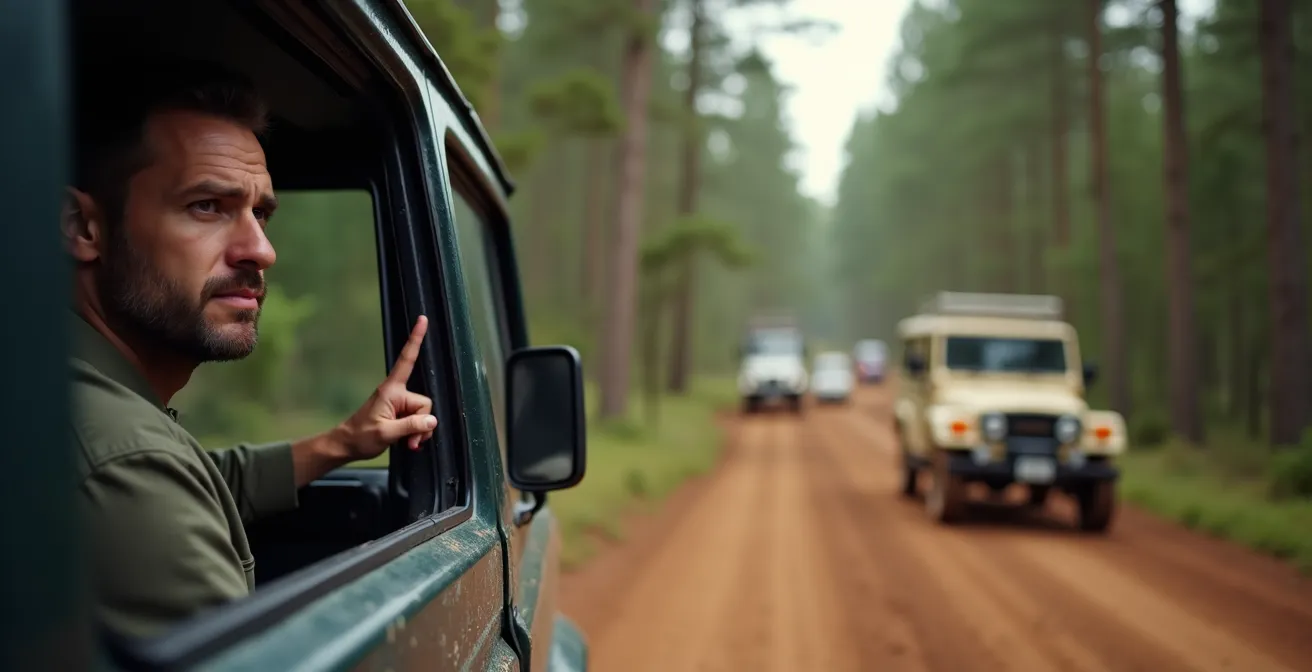
This isn’t just anecdotal wisdom; it’s a core principle of responsible trail use. The shared responsibility and resources inherent in a group are invaluable. A simple situation like a flat tire becomes much less stressful with friends to help, and a more serious issue like a drivetrain failure is far less dire when a tow-strap and a partner vehicle are readily available. In fact, trail safety experts recommend that the correct etiquette for this activity is to always travel in a group or, at the very minimum, with a second vehicle.
Effective group travel, however, requires more than just showing up at the same trailhead. It demands coordination and communication:
- Establish a Leader and a Sweeper: The lead vehicle, typically driven by someone familiar with the trail, sets the pace. The last vehicle, the “sweeper,” ensures no one is left behind and communicates any issues forward.
- Maintain Safe Distances: Tailgating is dangerous. Leave enough room to stop safely, but not so much that you lose sight of the vehicle ahead. A good rule of thumb is to always be able to see the vehicle behind you in your rearview mirror.
- Use Communication: A simple set of GMRS or CB radios is an inexpensive and highly effective tool for keeping the group connected, allowing drivers to call out obstacles, announce turns, or signal a stop.
- Pre-Trip Meeting: Before hitting the trail, gather to discuss the route, confirm everyone’s readiness, and ensure all vehicles have basic recovery gear (e.g., tow straps, shackles, a shovel).
It transforms off-roading from a solitary risk into a shared, and significantly safer, adventure.
Optimize on-road ride quality
For a vehicle that spends 95% of its life on pavement, on-road comfort is not a luxury; it’s a necessity. The modifications that create a trail monster can often create a daily-driving nightmare, characterized by a harsh ride, loud tire noise, and poor fuel economy. The art of building a capable daily driver lies in striking a delicate balance: enhancing off-road performance without excessively compromising the civility required for commuting, errands, and road trips. This means making deliberate choices about tires and suspension that align with your actual use case.
Tires are the most common modification and have the biggest impact on ride quality. The choice between All-Terrain (A/T) and Mud-Terrain (M/T) tires is a classic example of this trade-off. While M/T tires offer superior traction in extreme mud and rocks, they come with significant on-road drawbacks.
This comparative table from a guide on 4×4 driving techniques clearly outlines the compromise:
| Characteristic | All-Terrain Tires | Mud-Terrain Tires |
|---|---|---|
| On-Road Comfort | Quieter, better fuel economy | Louder, reduced fuel efficiency |
| Tread Life | Longer lasting on pavement | Faster wear on roads |
| Off-Road Capability | Good for light to moderate trails | Superior in mud and rocks |
| Best For | 80% road, 20% trail use | Heavy off-road use |
For most daily-driver owners, a high-quality All-Terrain tire is the logical choice, offering a capable blend of trail performance and on-road manners. Similarly, when considering suspension, the goal should be to maintain factory geometry as much as possible to preserve handling. Consider investing in adjustable shock absorbers that allow you to switch between a softer setting for the highway and a firmer one for the trail. This gives you the best of both worlds and is a hallmark of a well-planned, dual-purpose build.
By making informed choices, you can build a truck that’s ready for a weekend adventure without making the Monday morning commute a chore.
Manage a breakdown in a desert dead zone
The ultimate test of a recovery-first mindset is how you handle a critical failure in a remote area with no cell service. A breakdown in a desert or a vast, unpopulated forest is one of the most serious situations an off-roader can face. Panic is the enemy; a calm, systematic approach is your greatest asset. Your ability to manage this scenario depends entirely on the preparations you made before you ever left home. The right communication tools and a clear decision-making process can mean the difference between a long wait and a life-threatening ordeal.
In a communications “dead zone,” your smartphone is useless for calling for help. This is where dedicated satellite communication devices become essential, life-saving equipment. As many experienced off-roaders recommend, satellite communication devices like a Zoleo or Garmin inReach allow you to send an SOS signal with your exact GPS coordinates to an emergency response center from anywhere on the planet. This single piece of gear is the most critical safety investment for anyone venturing into remote areas.
If a breakdown occurs, your first decision is whether to stay with the vehicle or attempt to walk out. In almost every situation, the answer is to stay with your vehicle. Your truck provides essential shelter from the elements—sun, wind, or cold—and it is a much larger and more visible target for search and rescue teams to spot from the air or ground. Leaving your vehicle dramatically decreases your chances of being found quickly.
Before any remote trip, ensure your preparation includes:
- A fully charged satellite communicator.
- Extra water and non-perishable food, far more than you think you’ll need for the planned duration of the trip.
- Warm clothing or blankets, even in the desert, as temperatures can plummet at night.
- A well-maintained vehicle, as the best way to manage a breakdown is to prevent it in the first place with regular checks of brakes, tires, and fluids.
This preparation gives you the confidence to explore, knowing you have a reliable plan if the unexpected happens.
Key takeaways
- Systematic risk assessment is more crucial for a daily driver than aggressive modifications.
- Absolute certainty on land status (public vs. private) and reliable offline navigation are non-negotiable.
- Vehicle preservation is achieved through a combination of slow, deliberate driving and targeted, practical protection.
Choose the right suspension modification for real use
In the world of off-roading, it’s easy to get caught up in an arms race of bigger lifts, larger tires, and more suspension travel. However, for the owner of a daily-driven truck, the most important question is not “what can I add?” but “what do I truly need?” Choosing the right modifications is the final step in the risk mitigation framework, and it should be guided by honest self-assessment, not by what looks impressive in a parking lot. The most effective builds are those that are perfectly tailored to the owner’s actual, demonstrated use.
An off-road safety expert puts it best when discussing the most important factor of all: the driver. It’s crucial to always drive within your ability. This principle also applies to modifying your vehicle; you should build within your *reality*. A 6-inch lift and 37-inch mud tires are overkill and detrimental if your adventures consist of forest service roads and the occasional muddy field. This is the concept of graduated exposure: start with a capable stock vehicle, learn its limits, identify its shortcomings through experience, and *then* make targeted upgrades to address those specific needs.
This prevents you from over-investing in capability you’ll never use, which often comes at the cost of the on-road comfort you use every day. To make an informed decision, you must conduct a frank self-interview about your off-roading habits.
Action plan: The Use-Case Self-Interview for Suspension Selection
- Primary Use: Honestly define what you do most. Is it high-speed desert running, slow-speed rock crawling, or long-distance overlanding with heavy gear?
- Usage Percentage: Calculate the actual percentage of time your vehicle spends off-road versus on-road. If it’s less than 10%, prioritize on-road manners.
- Payload Needs: Assess your typical payload. Do you carry heavy camping gear, rooftop tents, or equipment? This will dictate spring rate requirements.
- Travel vs. Lift: Prioritize usable suspension travel over simple lift height. A small lift with high-quality components that improve articulation is often more effective than a large, cheap spacer lift.
- Phased Upgrades: Plan a phased upgrade path. Start with the basics like good A/T tires and recovery gear. Only upgrade suspension when you consistently find your stock setup is holding you back.
By following this disciplined approach, you create a vehicle that is not only more capable on the trail but also remains a pleasure to drive every single day.
Frequently asked questions about Finding Legal and Secure Trails for 4×4 Practice
What communication tools should I carry in remote areas?
Keep communication tools. Carry a radio or satellite phone, especially in areas with poor cell reception.
Should I stay with my vehicle or attempt to walk out?
Evaluate your resources (water, food, shelter) and environment. Generally, staying with your vehicle provides shelter and makes you easier to locate for rescue teams.
What are the essential safety items for desert off-roading?
Vehicle inspection. Regularly check your vehicle for any maintenance issues, ensuring brakes, tires, and lights are in optimal condition.