
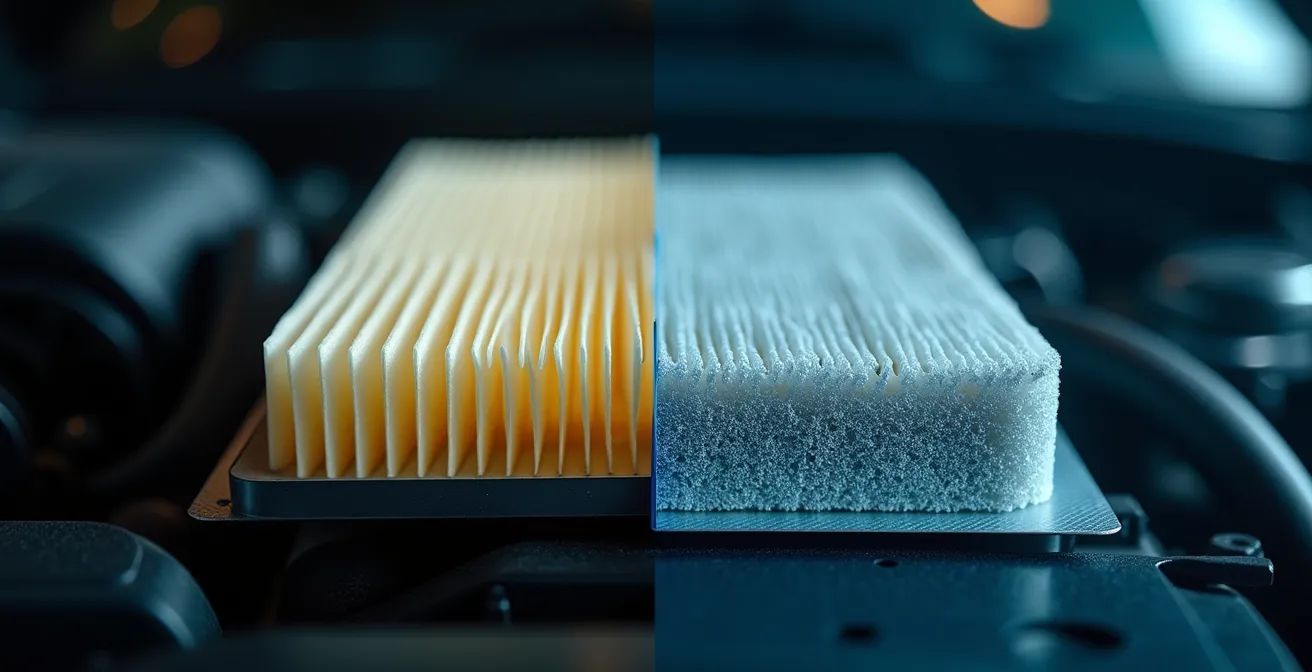
Optimizing your car’s filtration is the single most effective strategy for simultaneously boosting engine performance and protecting passenger health.
- A restricted air filter directly impacts fuel mixture and consumption, while a clean cabin filter reduces HVAC strain and improves interior air quality.
- Advanced filters (HEPA, activated carbon) are not just for allergies; they are crucial for removing harmful pollutants like PM2.5 and VOCs from the air you breathe.
Recommendation: Move beyond the manufacturer’s generic schedule and adopt an environment-based replacement plan to maximize both vehicle longevity and occupant well-being.
For most drivers, filters are an afterthought—a line item on a maintenance bill or a begrudging DIY task. We tend to view them as simple, disposable parts. But this perspective misses a crucial reality: your vehicle’s filtration is not just one component but a complete, interconnected ecosystem. This system acts as the lungs for both your engine and your cabin, determining not only performance and fuel efficiency but also the quality of the air you and your family breathe. The engine air filter protects the intricate mechanics from abrasive particles, while the cabin air filter shields occupants from allergens, pollution, and odors.
The common advice is to simply “change them regularly,” but this oversimplifies a complex dynamic. What does “regularly” mean for a parent driving through a high-pollen area versus a commuter in a smog-filled city? How does a seemingly minor installation error cascade into expensive sensor failures? The standard approach fails to account for the direct and measurable link between filtration quality and the dual goals of engine health and passenger wellness. For a parent concerned about a child’s allergies, or a tuner chasing every last bit of horsepower, the generic approach is insufficient.
This article reframes the conversation. We will move beyond the basic checklist to explore the science behind filtration’s impact. Instead of seeing filters as a chore, we will treat them as a strategic tool. The true key to unlocking both performance gains and a healthier in-car environment lies in understanding this system as a whole—a dynamic ecosystem that actively manages both mechanical longevity and human well-being. By making small, informed choices, you can achieve significant, tangible returns in both areas.
In the following sections, we will deconstruct this filtration ecosystem. We will explore how to diagnose issues before they become costly, understand the real-world impact on consumption, and learn to tailor your maintenance strategy to your specific driving environment for optimal results.
Summary: Unlocking Vehicle Health Through Advanced Filtration
Identifying Saturated Filters
The most common method for checking an engine air filter is a simple visual inspection. If it looks dirty, it needs replacing. While this isn’t wrong, it fails to capture the full story. A filter can appear relatively clean but be functionally saturated, restricting the engine’s “mechanical breathing.” This restriction forces the engine to work harder, creating a richer air-fuel mixture that wastes fuel and can trigger a Check Engine Light. The true sign of a saturated filter lies in the data.
Your vehicle’s Mass Airflow (MAF) sensor is constantly measuring the volume and density of air entering the engine. A clean, unrestricted system allows for a predictable amount of airflow. However, as a filter becomes clogged with dust, pollen, and road debris, the airflow is reduced. The MAF sensor detects this drop and reports it to the Engine Control Unit (ECU). For technicians, this data is a clear indicator of a problem; diagnostic data confirms that MAF sensors should read between 2-7 grams per second at idle. A reading below this range often points directly to a clogged filter or another intake obstruction.
This makes the MAF sensor an invaluable diagnostic tool, turning an invisible problem into a measurable fault. For the driver, the symptoms might be subtle at first—a slight hesitation during acceleration or a marginal decrease in fuel economy. But for the engine’s control system, the data is black and white. Recognizing that a saturated filter is more than just a dirty part—it’s a data-proven performance bottleneck—is the first step toward proactive maintenance.
Recognizing the data-driven signs of a saturated filter is crucial for maintaining engine health. Now that we have established how to identify the problem, let’s explore its direct financial consequences.
Understanding the Impact on Consumption
A choked engine air filter doesn’t just reduce performance; it directly increases fuel consumption. When the MAF sensor detects reduced airflow, the ECU may incorrectly compensate by injecting more fuel to maintain the desired power output, leading to a richer-than-necessary air-fuel mixture. This process, known as running “rich,” means unburned fuel is wasted and can even lead to long-term damage to the catalytic converter. The impact isn’t just theoretical; it’s a tangible cost felt at every visit to the pump. This connection between clean air and fuel efficiency illustrates the performance delta between a well-maintained vehicle and a neglected one.
This principle extends beyond the engine. A clogged cabin air filter forces the vehicle’s HVAC (Heating, Ventilation, and Air Conditioning) system to work harder. The blower motor must spin faster and draw more power to push air through the obstruction, placing additional load on the engine’s electrical system and, by extension, increasing fuel use. This hidden cost is often overlooked but contributes to overall inefficiency.

The economic impact is becoming increasingly recognized, especially in areas with poor air quality. For instance, the case of major Chinese cities highlights how extreme pollution accelerates filter degradation. Urban air pollution in cities like Beijing often exceeds WHO recommendations by a staggering amount, driving consumer demand for effective filtration not just for health, but also to mitigate the negative effects on vehicle efficiency and operating costs. This shows a clear link between environmental conditions, filtration effectiveness, and the owner’s wallet.
The financial toll of a clogged filter is clear, affecting both fuel and component longevity. However, even with a brand new filter, a simple mistake can negate all benefits.
The Installation Error
Purchasing a high-quality filter is only half the battle. A flawless part can be rendered useless—or even harmful—by a simple installation mistake. This is a critical point often overlooked in DIY tutorials and even by some quick-lube shops. An improperly fitted filter can create gaps, allowing unfiltered air to bypass the filter media entirely. This introduces dust, sand, and other abrasive particles directly into the engine’s cylinders or the cabin’s HVAC system.
The consequences of these small errors can be severe and costly. As the technical experts at Samarins note, “An improperly installed or collapsed air filter can cause the air flow sensor to fail sooner.” Contaminants that bypass the filter can coat the delicate hot wire or film of the MAF sensor, leading to inaccurate readings, poor performance, and an eventual failure that costs hundreds of dollars to fix. It’s a perfect example of how a $20 part, incorrectly installed, can lead to a $300 repair.
The risks are not limited to the engine air filter. A cabin filter installed backward can reduce airflow and strain the blower motor, while an oil filter that is either over-tightened or under-tightened can lead to leaks or catastrophic engine damage. These errors transform a routine maintenance task into a significant liability.
To better understand these risks, the following table outlines the direct consequences of common installation errors, based on information from automotive DIY resources like an analysis by AutoZone.
| Installation Error | Immediate Effect | Long-term Damage |
|---|---|---|
| Pinched Gasket | Air leaks, Check Engine Light | MAF sensor contamination, cylinder wear |
| Wrong Filter Orientation | Reduced airflow | HVAC system strain, premature failure |
| Improper Oil Filter Torque | Oil leaks or difficult removal | Engine damage, fire risk |
Avoiding installation errors is fundamental. Once we ensure the filter is correctly installed, we can focus on maximizing its primary function for passengers: cleaning the air they breathe.
Optimizing Allergen Filtration
For parents of children with allergies or anyone sensitive to air quality, the car cabin can be either a sanctuary or a source of misery. Standard cabin air filters are effective at trapping larger particles like dust and pollen, but they do little to stop microscopic pollutants. This is where optimizing your filtration system becomes a direct investment in your family’s health. Upgrading to advanced filter types can transform your car’s interior into a clean-air zone.
The gold standard in air purification is the HEPA (High-Efficiency Particulate Air) filter. By definition, a true HEPA filter can capture 99.97% of particles as small as 0.3 microns. This includes common allergens like pollen, mold spores, and pet dander, as well as more dangerous fine particulate matter (PM2.5) from exhaust fumes and industrial pollution. For an allergy sufferer, the difference is not just noticeable; it can be life-changing, reducing symptoms like sneezing, coughing, and watery eyes during a drive.
However, HEPA filters do not capture everything. Volatile Organic Compounds (VOCs), which are gases emitted from plastics, glues, and cleaners inside the car, as well as harmful gases like Nitrogen Oxides (NOx) from traffic, require a different solution: activated carbon. Filters that combine a HEPA layer with an activated carbon layer offer the most comprehensive protection. The carbon layer uses a process called adsorption to trap gas molecules and neutralize odors, effectively managing the full “health payload” of airborne contaminants.
Case Study: Prana Air’s Multi-Layer Filtration System
Prana Air’s advanced car cabin filter system exemplifies the power of multi-layer technology. By combining HEPA and activated carbon layers, their filters are designed to capture not only PM2.5 and allergens but also VOCs and NOx. This approach provides a comprehensive solution for drivers concerned about air quality, demonstrating a tangible reduction in respiratory irritation and allergy symptoms while eliminating unpleasant odors from traffic and industrial sources. It’s a clear example of how a filtration upgrade directly enhances the well-being of passengers during daily commutes.
Choosing the right filter is a powerful step. The next is to ensure it is replaced at the right time, a schedule that depends entirely on where you drive.
Planning Replacement Based on Environment
The “replace every 15,000 miles” rule is a useful guideline, but it’s fundamentally flawed because it ignores the single most important factor: your driving environment. A car driven primarily on clean suburban highways has a vastly different filtration load than one navigating dusty rural roads or crawling through polluted urban traffic. Adopting a strategy of environmental calibration—adjusting your replacement schedule based on real-world conditions—is key to maintaining optimal performance and air quality.
Someone living in an agricultural area during harvest season or a region prone to wildfires will find their filters saturate much faster than the manufacturer’s estimate. In these cases, waiting for the recommended interval means months of driving with restricted airflow and poor cabin air quality. Conversely, a vehicle in a clean, low-pollen environment may not need a replacement as frequently. The goal is to move from a passive, one-size-fits-all schedule to an active, condition-based one.
This proactive approach not only ensures your filters are working when you need them most but also saves money by avoiding unnecessary replacements. By paying attention to your local environment—pollen counts, air quality alerts, nearby construction—you can create a personalized maintenance plan that truly serves your vehicle and its occupants.
Your Action Plan: Environment-Based Filter Replacement
- Assess Your Driving Zones: Identify your primary environments. Are you mostly in urban traffic, dusty rural areas, or high-pollen regions? List all contributing factors.
- Establish a Baseline: Start with the manufacturer’s recommendation (e.g., 15,000 miles) as your baseline for standard conditions.
- Calibrate the Interval: Adjust the interval based on your environment. For high-pollution or dusty areas, reduce the interval by 30-50% (e.g., to 8,000-10,000 miles). For very clean environments, you might extend it slightly.
- Schedule Seasonal Checks: Perform a visual inspection of both engine and cabin filters at the beginning of high-stress seasons like spring (pollen) and summer (dust). This helps you catch saturation before it becomes a problem.
- Plan for Acute Events: After a significant air quality event, such as a nearby wildfire or dust storm, plan for an immediate inspection and likely replacement, regardless of the schedule.
Calibrating your replacement schedule is a smart strategy for all drivers. For those seeking to actively boost performance, the next step is to look at the intake system itself.
Optimizing Air Intake
For the performance-oriented driver, optimizing air intake is about more than just maintenance; it’s about unlocking horsepower. The logic is simple: an engine is an air pump, and more cold, dense air means a more powerful combustion. This has led to a market of aftermarket solutions, but it’s crucial to understand the trade-offs. Are expensive upgrades worth it, or can a high-quality stock-style filter suffice?
The two most popular options are a high-flow drop-in filter and a full cold air intake (CAI) system. A high-flow filter is designed to fit in the stock airbox but uses a less restrictive media (like oiled cotton gauze) to improve airflow. A CAI system replaces the entire stock intake tract, relocating the filter outside the hot engine bay to draw in cooler, denser air. Both promise performance gains, but their effectiveness and risks differ significantly. A CAI generally delivers more power, but often at the cost of reduced filtration efficiency, potentially allowing more fine particles into the engine over time.
As noted by technical experts, a clogged filter is not the only cause of restricted airflow; a plugged catalytic converter can produce similar symptoms, reinforcing the idea of the car as an interconnected system. The choice between a high-flow filter and a CAI depends on your goals. For a daily driver, a premium, high-flow filter often provides the best balance of a modest performance bump, cost-effectiveness, and maintaining OEM-level engine protection. For a dedicated track car, a full CAI might be justified.
The following table compares these two popular upgrades, helping to clarify which option provides the best value depending on the driver’s goals.
| Feature | Cold Air Intake | High-Flow Filter |
|---|---|---|
| Horsepower Gain | 5-15 HP typical | 1-5 HP typical |
| Filtration Efficiency | Varies, often reduced | Maintains OEM standards |
| Long-term Engine Wear | Potentially increased | Minimal impact |
| Cost | $150-500 | $30-100 |
Optimizing the intake is one part of a larger engineering puzzle. To fully appreciate this, we must see how filtration fits into the vehicle’s overall design philosophy.
Understanding Active Aerodynamic Devices
At first glance, aerodynamics and air filtration might seem like separate domains. One deals with the external flow of air over the car’s body to reduce drag, while the other manages the internal flow of air into the engine and cabin. However, in modern vehicle design, they are two sides of the same coin: total system efficiency. Automakers are increasingly using active aerodynamic devices—such as grille shutters that open and close automatically—to optimize airflow for cooling and fuel economy. This directly impacts the filtration ecosystem.
When active grille shutters are closed at highway speeds to reduce drag, the engine bay receives less cooling air. This makes the performance of the entire cooling system, including the flow through the radiator and AC condenser, even more critical. A clogged engine air filter in this scenario can exacerbate heat issues by making the engine work harder. Similarly, these aerodynamic optimizations are designed with a certain intake pressure in mind. A saturated filter disrupts this balance, undermining the carefully engineered efficiency gains.
This holistic approach is evident in the global automotive market. The Asia Pacific region, which leads the global cabin air filter market, also demonstrates this synergy in its vehicle exports. For example, with China exporting over 5 million vehicles annually, these cars must be designed to meet diverse global standards. This means they must have both excellent external aerodynamic efficiency for fuel economy and robust internal air quality systems (filtration) to handle the varied pollution levels of their destination markets, from Europe to North America. It proves that engineers no longer treat these as separate challenges, but as a unified system for overall vehicle performance and passenger comfort.
This integrated design philosophy shows that every part of the vehicle works in concert. For owners of older vehicles, applying this holistic view can yield surprising benefits.
Key Takeaways
- Filtration is an interconnected ecosystem impacting both engine and passenger health, not just a maintenance task.
- Filter saturation is a measurable data point (via MAF sensor) that directly affects fuel consumption and triggers engine warnings.
- Optimizing cabin air with HEPA and activated carbon filters is a direct investment in health, protecting against allergens, PM2.5, and VOCs.
Improving Old Vehicle Consumption Without Performance Loss
Owners of older vehicles often feel they have to choose between performance and fuel economy. As components age, efficiency naturally declines. However, one of the most cost-effective ways to restore a significant portion of that lost efficiency without sacrificing performance is to perform a complete overhaul of the filtration ecosystem. This goes far beyond just the engine air filter and addresses the entire system that keeps a vehicle’s vital fluids and air clean.
With a massive existing vehicle fleet of over 1.4 billion vehicles globally in 2024, the potential for improvement is enormous. For a vehicle with over 100,000 miles, contaminants and sludge have built up throughout its systems. A fresh start for the filtration network can have a profound impact. This includes not just the engine and cabin air filters, but also the fuel and oil filters, which are often neglected.
A comprehensive filtration overhaul on an older car can deliver remarkable results. It’s a holistic strategy that addresses the core health of the vehicle’s “respiratory” and “circulatory” systems. The following steps outline a complete filtration system refresh:
- Replace engine air filter: This is the baseline. It restores proper airflow, improves the air-fuel mixture, and prevents contamination of the MAF sensor.
- Change cabin air filter: This simple step improves the efficiency of the HVAC system, reducing the electrical load on the engine and improving passenger comfort.
- Install a new fuel filter: Over time, fuel filters become clogged with sediment and, in modern fuels, ethanol-related deposits. A new filter protects sensitive fuel injectors, ensuring a clean, efficient spray pattern.
- Upgrade to a high-mileage oil filter: These filters are designed with enhanced media to help capture sludge and deposits that have built up in an older engine, which can help restore compression and improve overall health.
This strategic refresh treats the vehicle as the integrated system it is. It’s the most intelligent first step in bringing an older vehicle back to a state of optimal health and efficiency, proving that you don’t always need expensive mechanical work to see a real difference.
By shifting your perspective from simple maintenance to strategic ecosystem management, you can unlock tangible benefits. Start today by assessing your driving environment and planning a comprehensive filtration check-up to enhance both your car’s performance and your own well-being.