
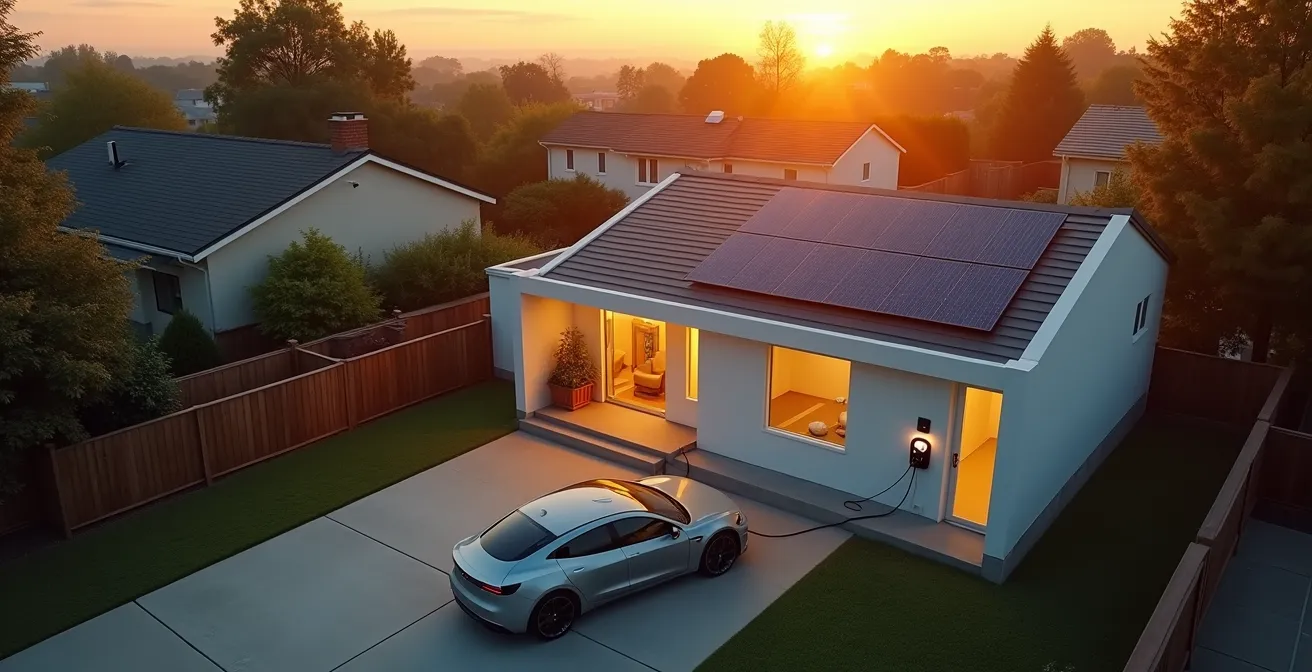
Your EV is more than a car; it’s a powerful home energy asset that can provide backup power and generate income.
- Profitability depends directly on regional electricity price gaps (“grid arbitrage”) and is not guaranteed everywhere.
- Proper planning of your electrical panel and understanding local grid capacity are non-negotiable to avoid system failure and costly upgrades.
Recommendation: Begin with a thorough audit of your home’s electrical capacity and your utility’s policies before purchasing any bidirectional charging hardware.
The idea of using an electric vehicle to power a home during a blackout has captured the imagination of many homeowners. It represents a leap towards energy independence, transforming a car from a mere mode of transport into a personal power plant on wheels. Most discussions stop there, focusing on the simple convenience of backup power. However, this view barely scratches the surface of what’s possible and ignores the critical strategic planning required to make it a reality.
True integration of an EV into your home’s ecosystem is not a simple ‘plug-and-play’ affair. It’s a strategic decision that turns your vehicle into a manageable financial asset. The real value lies not just in surviving an outage, but in actively managing energy flows to reduce daily electricity bills, support the wider grid, and maximize the return on your EV investment. This requires a deeper understanding of technology standards, local grid limitations, and the economics of energy arbitrage.
This guide moves beyond the basics. We will explore the technical foundations of bidirectional charging, analyze the critical mistake of ignoring grid capacity, and detail the strategies for optimizing costs. By treating your EV as a central component of your home’s energy strategy, you can unlock its full potential, turning a significant expense into a dynamic and valuable asset. The following sections will provide a clear roadmap for planning, implementing, and mastering this advanced home energy solution.
This article provides a comprehensive overview of the key considerations for integrating an EV into your home energy system. Explore the sections below to understand each critical aspect, from the underlying technology to the practical logistics of long-distance travel.
Summary: A Strategic Guide to EV and Home Grid Integration
- Comprendre la charge bidirectionnelle
- L’erreur de surcharge du réseau local
- Optimiser les coûts de recharge
- Comparer les bornes intelligentes
- Planifier la capacité du panneau électrique
- Optimiser la charge parasitaire
- L’erreur de fiabilité des réseaux
- Maîtriser la logistique des voyages longue distance en électrique
Comprendre la charge bidirectionnelle
At its core, bidirectional charging allows your electric vehicle to both draw power from the grid to charge its battery (unidirectional) and push power back out to your home (Vehicle-to-Home or V2H) or the grid itself (Vehicle-to-Grid or V2G). This two-way flow is the key technology that transforms your car into a mobile battery storage unit. However, not all vehicles and chargers are created equal. The landscape is currently fragmented across several competing standards, each with its own connector type, power output, and list of compatible vehicles.
Understanding these standards is the first step in planning your system. The choice of standard will dictate which vehicles and chargers you can use, directly impacting the performance and future-proofing of your investment. For instance, the established CHAdeMO standard supports older models like the Nissan Leaf, while the emerging CCS standard with ISO 15118-20 is being adopted by newer vehicles like the Ford F-150 Lightning and Kia EV9, offering higher power outputs. Tesla’s NACS is also entering the space, but with limited compatibility for now.
The following table, based on an analysis of bidirectional charging standards, breaks down the key differences to help you navigate this complex ecosystem.
| Standard | Connector Type | Power Output | Compatible Vehicles | Status |
|---|---|---|---|---|
| CHAdeMO | DC | Up to 7kW | Nissan Leaf, Mitsubishi Outlander PHEV | Established |
| CCS with ISO 15118-20 | DC | 9.6-11.5kW | Ford F-150 Lightning, Kia EV9 | Emerging |
| NACS | DC | 11.5kW | Tesla Cybertruck | Limited |
Case Study: UC Irvine’s V2H Deployment in California
To see this technology in action, look no further than the recent demonstration project by UC Irvine. In a pioneering effort, researchers deployed the first mass-market V2H systems across six California homes using commercially available bidirectional chargers and Kia EV9s. Real-world testing confirmed the system’s potential to significantly lower homeowner electricity costs. By discharging the vehicle’s stored energy during peak grid hours (typically 4-8 p.m.), participants avoided high electricity rates. Furthermore, the system captured excess solar energy that would have otherwise been sent back to the grid, maximizing self-consumption and demonstrating a tangible path to market for V2H technology.
L’erreur de surcharge du réseau local
A common and costly mistake is assuming that V2H/V2G integration only concerns your property. In reality, your home is part of a delicate local energy network, and a high-power bidirectional charger can place significant stress on shared infrastructure like neighborhood transformers. Discharging a 60kWh EV battery to power a home that consumes 30 kWh per day is a substantial load. If several neighbors adopt this technology without coordinated planning, it can lead to localized brownouts or transformer failure, impacting the entire community.
Before investing, it is crucial to assess your local grid’s capacity. This involves more than just checking your own electrical panel; it means understanding the limitations of the utility infrastructure serving your street. According to data from National Grid, the average U.S. home consumes about 30 kWh per day. An EV battery can hold two to three times that amount, highlighting the immense power a single V2H system can inject or draw from the local grid. This makes communication with your utility provider an essential, non-negotiable step in the planning process.

This aerial perspective illustrates how individual homes are part of a larger, interconnected system. The flow of energy isn’t isolated; it’s a shared resource. Proactively engaging with your utility company to inquire about transformer capacity assessments, local grid constraints, and any available demand response programs is not just a recommendation—it’s a critical part of responsible system design. Ignoring this step can lead to unexpected limitations on your system’s performance or, in the worst-case scenario, contributing to a neighborhood-wide power issue.
Optimiser les coûts de recharge
The most compelling financial argument for V2G is “grid arbitrage”: charging your EV when electricity is cheap (off-peak hours) and selling that power back to the grid when prices are high (peak hours). However, profitability is not a given. It is highly dependent on your region’s electricity pricing structure and the “peak-valley gap”—the difference between the lowest and highest kWh price in a day. A narrow gap can render the entire V2G enterprise unprofitable, especially after accounting for battery degradation and system inefficiencies.
Future projections show a dynamic market. An economic analysis estimates V2G compensation needs to be around €132/MWh in 2030 to be viable, dropping to €70/MWh by 2050 as technology matures. This highlights that the financial case for V2G is an evolving target. Homeowners must analyze their specific utility’s time-of-use (TOU) rates carefully. If the price differential is only a few cents, the revenue generated may not outweigh the costs and complexities of a V2G setup.
Case Study: Global V2G Profitability Disparities
A comprehensive 2025 study across five regions reveals just how much location matters. Regions with large peak-valley price gaps, like Chengdu, China (0.65 USD/kWh differential), and Australia (0.53 USD/kWh), demonstrated that V2G could generate substantial net revenues of up to $25,000 per vehicle over its lifetime. In stark contrast, Shanghai, with its narrow price gap of only 0.03 USD/kWh, rendered V2G entirely unprofitable. The study also found that the break-even point varies by vehicle; a Tesla Model Y, for instance, requires a minimum price differential of 0.12 USD/kWh to make V2G economically viable. This proves that a one-size-fits-all approach to V2G economics is a recipe for financial disappointment.
Ultimately, maximizing your return requires a strategic approach. You must become an active energy asset manager, using your smart charger’s software to automate charging and discharging based on real-time pricing signals from your utility. Without this level of optimization and a favorable rate structure, the promise of V2G can quickly evaporate.
Comparer les bornes intelligentes
The bidirectional charger, or DC wallbox, is the brain of your V2H/V2G system. It manages the complex two-way flow of electricity, communicates with both your vehicle and the grid, and ensures the entire process is safe and efficient. Choosing the right charger is as important as choosing the right vehicle. Key factors to consider include power output, energy efficiency, software features like solar integration and blackout-mode functionality, and, most importantly, compatibility with your vehicle and the prevailing charging standards.
One of the most common concerns for prospective buyers is the impact of bidirectional charging on the EV’s battery health. However, this fear is largely unfounded. As the Wallbox Engineering Team notes in their technical documentation:
Bidirectional charging is potentially less stressful on your EV’s battery than normal driving. Drawing power at a consistent and steady rate of up to 11.5kW is far less demanding of your EV battery than the frequent high-power demands of accelerating and braking.
– Wallbox Engineering Team, Wallbox Quasar 2 Technical Documentation
This expert insight reframes V2H as a gentle, controlled process compared to the rigors of daily driving. The key is the charger’s ability to manage the flow smoothly. The market offers several compelling options, each with distinct features. The Wallbox Quasar 2 is known for its user-friendly app and blackout mode, while the StarCharge Halo and Ambibox models prioritize open standards like OCPP 2.0.1 for better grid integration.
This comparative table highlights some of the leading bidirectional chargers available in 2024, helping you identify which features align best with your goals.
| Charger Model | Power Output | Efficiency | Compatibility | Key Features |
|---|---|---|---|---|
| Wallbox Quasar 2 | 11.5kW | 97% | CCS2 (ISO 15118) | Blackout mode, Solar integration |
| StarCharge Halo | 7.4-11kW | 96-97% | CCS (ISO 15118-2/20) | OCPP 2.0.1, WiFi/4G |
| Ambibox DC Wallbox | Up to 22kW | Not specified | CCS | OCPP 2.0.1, MQTT |
| Ford Charge Station Pro | 9.6kW | Not specified | CCS (Ford only) | Proprietary ecosystem |
Planifier la capacité du panneau électrique
Your home’s electrical panel is the gateway for all energy, and it’s often the single biggest bottleneck for a V2H installation. A standard 100-amp panel, common in older homes, is typically insufficient to handle the home’s existing loads plus a high-power bidirectional EV charger, which can require a dedicated 40- to 60-amp circuit. Ignoring this physical limitation is a setup for failure, leading to tripped breakers or, worse, an electrical hazard. A panel capacity assessment is therefore a mandatory first step.
Upgrading an electrical panel from 100 amps to 200 amps is a common requirement for V2H projects. This provides the necessary headroom for the EV charger alongside other major appliances like an HVAC system or an induction stove. This is not a trivial expense; according to recent industry data, a panel upgrade can cost anywhere from $1,000 to $5,000, depending on the complexity of the job. This cost must be factored into the total budget for your V2H system from the very beginning.

Conducting a load calculation is essential. This involves adding up the amperage of all your major appliances and the planned EV charger to ensure the total does not exceed 80% of your panel’s total capacity, a safety requirement mandated by the National Electrical Code (NEC). If you are approaching the limit, smart load management devices can help by intelligently pausing high-consumption appliances when the EV is charging, but a panel upgrade is often the most robust solution.
Your Electrical Panel Assessment Checklist
- Document Current Capacity: Identify and record your current panel’s amperage rating (usually printed on the main breaker; typically 100A, 125A, 150A, or 200A).
- Inventory Existing Loads: Count your available breaker slots and list all major circuits, such as your HVAC, water heater, oven, and dryer.
- Calculate Total Load: Add the amperage of all existing major appliances to the planned future loads, including the EV charger (40-60A), a potential heat pump (30-50A), or an induction stove (40-50A).
- Verify NEC Compliance: Compare your calculated total load to 80% of your panel’s total capacity. If your load exceeds this threshold, an upgrade is necessary.
- Plan for a Solution: If approaching capacity, research smart load management devices as a potential interim solution, but prioritize consulting with a certified electrician about a full panel upgrade for long-term stability.
Optimiser la charge parasitaire
An often-overlooked factor in the efficiency of a V2H system is parasitic drain. This refers to the standby power consumed by the system’s components—primarily the bidirectional charger and its inverter—even when it’s not actively charging or discharging. While small on an hourly basis, this continuous energy consumption can add up over time, silently eating into your cost savings and reducing the overall efficiency of your energy asset. A system that consumes excessive power while idle is like a leaky bucket, slowly draining the value it’s supposed to create.
Minimizing this drain is key to maximizing your return on investment. High-quality bidirectional chargers are designed with low-power “sleep” or “standby” modes that activate during periods of inactivity. It is crucial to configure these settings properly. For example, you can schedule the system to enter a deep sleep mode overnight or during times when you know you won’t be using V2H capabilities. Additionally, disabling unnecessary monitoring features or reducing the frequency at which the system “polls” for data can further reduce idle consumption.
Putting Capacity in Perspective: EV vs. Stationary Battery
To understand the scale of your EV as an energy asset, it’s helpful to compare it to a dedicated home battery. A typical Tesla Powerwall stores about 13.5kWh of energy. In contrast, an average EV battery holds around 65kWh—nearly five times as much. This vast reservoir of power means a fully charged EV can support an average home’s energy needs for several consecutive days, far longer than most stationary batteries. However, this large capacity also means that even a small percentage of parasitic drain can represent a significant amount of wasted energy over time, reinforcing the need for optimization.
Practical steps to combat parasitic drain include using a plug-in energy meter to monitor the inverter’s standby consumption, setting minimum state-of-charge thresholds to prevent the system from waking unnecessarily, and aligning system activity with your time-of-use rate periods. These small adjustments ensure that your powerful energy asset isn’t slowly being depleted when it should be at rest.
L’erreur de fiabilité des réseaux
While V2H is often marketed as the ultimate solution for power outages, it’s a mistake to view it as an infallible source of grid reliability. The most obvious limitation is a practical one: the system only works if your car is at home and connected. If a power outage occurs while you are at work or running errands, your V2H system is useless. This creates a potential gap in your home’s energy resilience, a factor that is frequently underestimated by enthusiastic early adopters.
For homeowners whose primary goal is 100% uninterrupted power, relying solely on V2H can be a gamble. A more robust strategy for systemic resilience often involves a hybrid approach. This could mean combining your V2H system with a smaller, stationary home battery (e.g., 5-10kWh). In this setup, the stationary battery handles essential loads and ensures immediate backup when an outage occurs, regardless of the EV’s location. The EV then serves as a massive secondary reserve, ready to take over and power the entire home for multiple days once it’s connected.
The capability of an EV battery is indeed impressive. Industry analysis indicates that a standard 60 kWh EV battery can power the essential loads of a typical home for approximately two days. With conservative usage, this duration can be extended even further. Modern V2H systems also feature automatic transfer switches that can transition from grid power to battery power in milliseconds, fast enough to prevent most electronics from resetting. However, this seamless experience is entirely conditional on the vehicle’s presence, reinforcing the need for a well-considered, multi-layered backup strategy.
Key Takeaways
- Your EV is an energy asset, not just a car. Its value comes from strategic management, not just passive backup.
- Profitability is not guaranteed. It hinges on your local electricity price differences (grid arbitrage) and requires active management.
- System planning is non-negotiable. You must assess your electrical panel and local grid capacity before investing to avoid failure and unforeseen costs.
Maîtriser la logistique des voyages longue distance en électrique
The concept of managing your EV as an energy asset extends beyond the driveway. The same principles of energy optimization that apply at home are crucial for mastering the logistics of long-distance travel. A successful electric road trip is not just about finding the next charging station; it’s about maximizing every kilowatt-hour of energy to extend your range and minimize your downtime. This begins before you even leave home.
One of the most effective strategies is to use your home’s bidirectional charging setup for pre-conditioning. As noted in the EV Travel Efficiency Guide, pre-conditioning on grid or solar power “preserves precious range for the first leg of the journey.” By using your home connection to heat or cool the cabin and battery to their optimal operating temperature before you unplug, you start your trip with a full battery dedicated entirely to driving, rather than wasting the first few miles on climate control.
Mobile Power on the Go: The Ford F-150 Lightning’s V2L Application
The versatility of bidirectional power is not limited to V2H. Vehicle-to-Load (V2L) technology, as demonstrated by the Ford F-150 Lightning, turns the vehicle into a mobile power station. Equipped with multiple AC power outlets, it can power tools on a worksite, run camping equipment in the wild, or even provide emergency assistance to another stranded EV. This showcases how the energy stored in your vehicle can be deployed in a variety of contexts, making your EV a flexible tool for both daily life and adventurous travel.
Ultimately, mastering long-distance travel in an EV requires the same mindset as managing it at home: proactive energy management. By leveraging your home system for preparation and understanding the full capabilities of your vehicle, you transform long-distance travel from a source of range anxiety into a well-planned, efficient, and enjoyable experience.
To truly leverage your electric vehicle as a cornerstone of your home’s energy independence, the next logical step is a professional evaluation of your specific situation. Assess your home’s electrical system and consult with a certified installer to design a solution tailored to your needs.
Frequently Asked Questions on Integrating an EV into your home grid
How long can my EV power my home during an outage?
A typical 60-75kWh EV battery can power essential loads for 2-4 days, depending on consumption. With conservative usage focusing on critical circuits (refrigerator, lights, internet), backup duration can extend significantly.
What happens if my car isn’t home during a power outage?
This is a key limitation of V2H systems. Consider combining V2H with a smaller stationary battery (5-10kWh) to handle essential loads when the vehicle is away, creating redundancy in your backup system.
How quickly does the system switch to backup power?
Modern V2H systems with automatic transfer switches typically transition within 10-20 milliseconds, fast enough to prevent most electronic devices from resetting.