
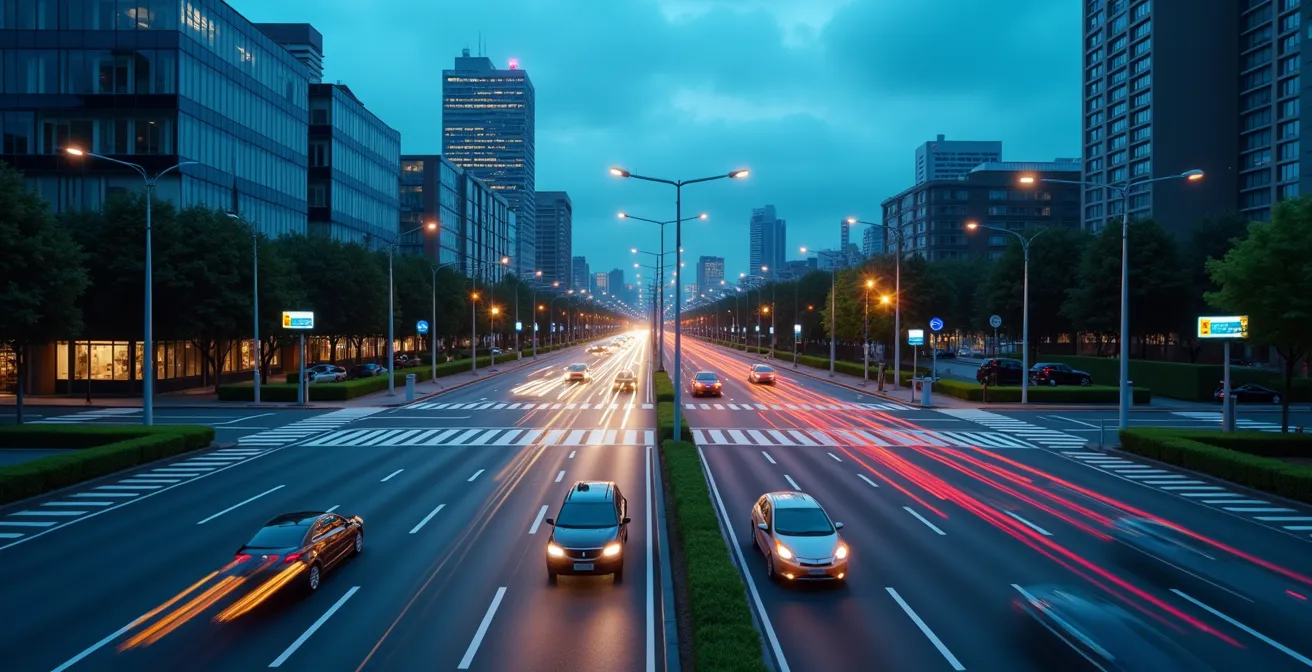
The future of road safety isn’t just in the car; it’s in the robust communication fabric connecting it to the world.
- Vehicle-to-Everything (V2X) relies on a blend of technologies like 5G and DSRC, each with specific strengths for different safety scenarios.
- Real-time data processing, powered by edge and fog computing, is the key to translating network signals into instantaneous, life-saving actions.
Recommendation: Shift focus from simply what V2X does to how its underlying network architecture is deployed, retrofitted, and optimized for ultimate reliability.
For any tech enthusiast, the concept of a car that knows a traffic light will turn red before they do feels like the logical next step in automotive evolution. We’re accustomed to on-board sensors—cameras, LiDAR, radar—that build a picture of the immediate environment. But this approach has inherent limitations. A sensor’s line of sight can be blocked by a truck, a building, or adverse weather. The true paradigm shift lies in giving the vehicle information its own sensors can’t possibly gather: data from around the corner, from the traffic management center, and from the pedestrian’s smartphone in their pocket.
This is the domain of Vehicle-to-Everything (V2X) communication. It expands the concept of Vehicle-to-Vehicle (V2V) chatter into a comprehensive ecosystem. In V2X, vehicles communicate not only with each other but also with infrastructure (V2I), pedestrians (V2P), and the broader network (V2N). The common discourse often stalls at the high-level benefits, like preventing accidents. However, the real genius is found within the network architecture itself. The crucial question isn’t just *if* it makes us safer, but *how* a resilient, multi-layered communication fabric translates raw data signals into dependable, split-second safety decisions.
This article moves beyond the surface to dissect the core mechanics of this interaction. We will explore the different types of alerts, the challenge of upgrading our existing roads, and the critical debate between competing communication standards. Ultimately, we will decode what it takes to build a perception system that is not just intelligent, but truly trustworthy.
This guide breaks down the essential components of V2X technology and its interaction with road infrastructure. Below is a summary of the key topics we will cover to provide a comprehensive understanding of this complex ecosystem.
Summary: A Technical Look at V2X and Road Infrastructure
Understanding Security Alerts
At its core, V2X security is about providing predictive, non-line-of-sight warnings. These are not the simple beeps of a parking sensor; they are complex alerts generated from a fusion of data sources. Imagine receiving a “hard braking ahead” warning from a vehicle hidden by a curve, or a “pedestrian crossing” alert from a signalized intersection before the individual is even visible. These alerts function by translating low-latency data packets into actionable intelligence for the driver or the vehicle’s autonomous driving system. The system can warn of everything from a slippery road surface reported by a car ahead to the presence of an emergency vehicle approaching an intersection.
The effectiveness of these systems is demonstrated in targeted deployments. For instance, the NYC DOT’s Vision Zero initiative tested a V2X smartphone app to assist vision-impaired pedestrians. The result was that 83% of pedestrian participants felt safer using the application, while drivers reported that the connected vehicle alerts helped them drive more safely. This highlights the human-centric benefit: V2X isn’t just about vehicle automation; it’s about creating a safer environment for everyone, especially the most vulnerable road users. These alerts provide a crucial layer of perception that onboard sensors alone cannot match.
This system’s value is also apparent in mitigating common risk factors. While V2X can’t solve driver fatigue, it can drastically reduce the consequences by providing an early warning system when a drowsy driver’s vehicle behaves erratically or fails to respond to a changing traffic light. By creating a collaborative perception network, V2X effectively gives every vehicle and pedestrian a digital safety net.
The Obsolete Infrastructure Mistake
One of the most significant barriers to widespread V2X adoption is the misconception that it requires a complete, top-to-bottom replacement of our existing road infrastructure. This “rip-and-replace” mindset frames the challenge as a prohibitively expensive undertaking. The reality, however, is far more nuanced and pragmatic. The critical mistake is not the cost itself, but failing to adopt a strategic, phased approach to upgrades. The most effective path forward is a “retrofit-first” strategy, where current infrastructure is augmented with V2X capabilities.
This involves installing Roadside Units (RSUs)—compact devices with sensing and communication capabilities—onto existing traffic lights, gantries, and poles. As Jihyeong Han, CEO of Autonomous A2Z, notes, a “‘retrofit-first’ approach enables rapid, cost-effective integration of autonomous systems into existing vehicles” and, by extension, infrastructure. While there is a cost— ITS America estimates V2X infrastructure deployment costs between $15,000 to $27,000 per intersection—this is an investment in augmentation, not a complete rebuild.
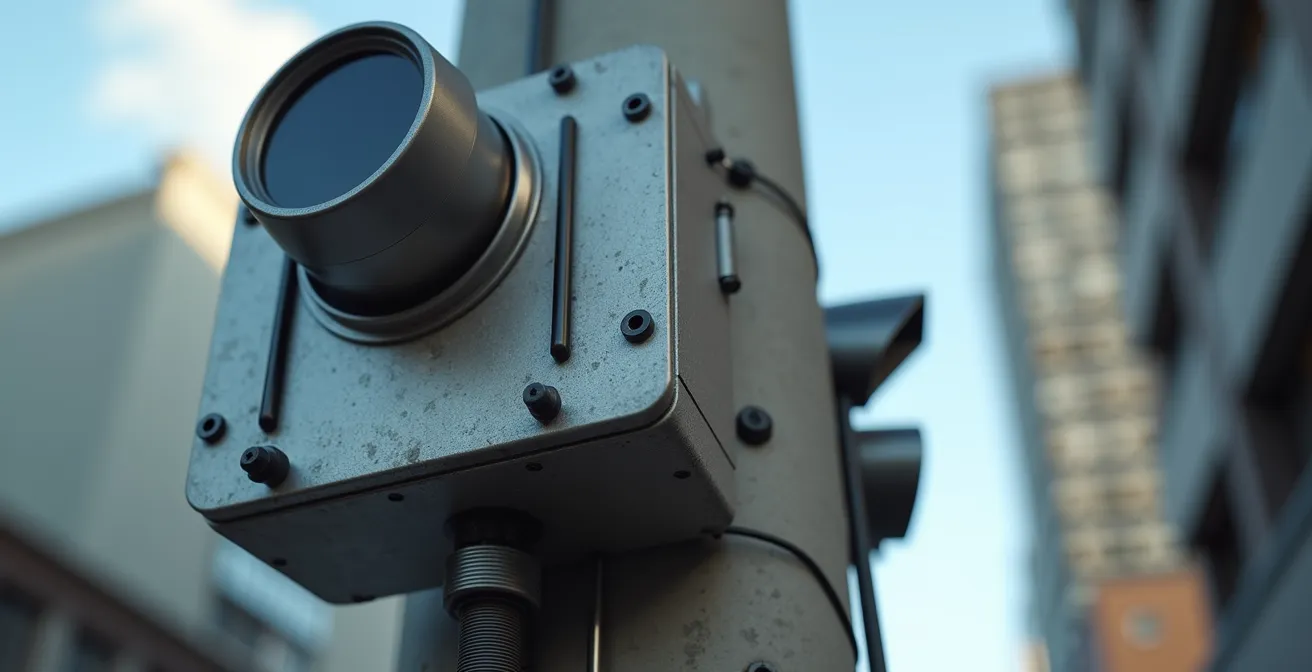
As the image illustrates, this process involves integrating sleek, modern technology onto weathered, traditional structures. This synergy between the old and the new is the key to scalable deployment. By focusing on high-traffic corridors and critical accident hotspots first, cities can deliver an immediate return on investment in terms of safety and efficiency, creating a foundational network that can be expanded over time. Ignoring this incremental path in favor of an all-or-nothing approach is the surest way to stall progress indefinitely.
Optimizing Transit Speed
Beyond direct safety alerts, V2X’s interaction with infrastructure is a powerful tool for optimizing traffic flow and, by extension, reducing travel time and emissions. This is achieved through real-time communication between vehicles and traffic management systems, enabling dynamic adjustments based on actual road conditions. Instead of relying on fixed-timer traffic lights, a V2X-enabled system can adjust signal phasing to accommodate an approaching platoon of vehicles, clear a path for an emergency vehicle, or prevent the stop-and-go waves that cause congestion and inefficiency. Studies have shown this can lead to a significant 15% reduction in emissions with full V2X adoption.
Processing this immense volume of data with minimal delay is a significant technical challenge. A centralized, cloud-only approach would introduce unacceptable latency. The solution lies in a distributed computing model.
Case Study: Florida’s V2X Data Exchange Platform
To tackle the data processing challenge, the Florida Department of Transportation (FDOT) developed a V2X Data Exchange Platform. This system utilizes a sophisticated cloud-fog-edge architecture. By implementing fog and edge computing nodes close to the data’s origin (i.e., at the roadside), the system can process high volumes of traffic data in real-time. This distributed approach enables critical functions like real-time route visualization and traffic analysis through heat maps, all while minimizing the delay between data collection and actionable insight. This strategy is essential for making dynamic traffic optimization a reality.
This ability to process data at the edge of the network is what allows for the creation of “green waves” and other traffic-smoothing strategies. It transforms the relationship between vehicle and infrastructure from a passive, one-way interaction to a dynamic, collaborative dialogue aimed at maximizing system-wide efficiency.
Comparing 5G and DSRC
For a tech enthusiast, the debate at the heart of the V2X communication fabric is the choice of radio technology: Dedicated Short-Range Communications (DSRC) versus Cellular V2X (C-V2X), which is built on 5G standards. This isn’t a simple case of one being “better” than the other; they are different tools with distinct strengths. DSRC, based on the Wi-Fi (802.11p) standard, excels at low-latency, direct V2V and V2I communication over short distances. It’s a mature, reliable technology purpose-built for basic safety messages.
C-V2X, on the other hand, leverages the massive investment in cellular infrastructure. It offers two primary modes of operation: direct communication (PC5 interface) for safety-critical messages, similar to DSRC, and network-based communication (Uu interface) for everything else. This dual-mode capability allows C-V2X to support a much broader range of applications, from high-bandwidth sensor data sharing to infotainment services, all while promising an evolutionary path with future 5G advancements like network slicing for guaranteed quality of service.
The following table, based on information from industry analyses, breaks down the key technical differences.
| Feature | DSRC | 5G C-V2X |
|---|---|---|
| Technology Base | Wi-Fi (802.11p) | Cellular (3GPP) |
| Frequency | 5.9 GHz | 5.9 GHz + cellular bands |
| Latency | Low (direct) | Ultra-low (PC5 interface) |
| Range | Limited (300-1000m) | Extended (via network) |
| Infrastructure | Dedicated RSUs required | Leverages existing cellular |
| Best Use Case | Safety-critical V2V | V2N and scalable applications |
While the technologies can coexist, the market is clearly trending in one direction. Driven by its scalability and broader ecosystem support, a recent report shows that C-V2X technology captured 68.38% market share in 2024 and is projected to grow significantly. This momentum suggests that while DSRC laid the groundwork, C-V2X is poised to define the future of the connected vehicle communication fabric.
Planning Rural Deployment
While discussions about smart infrastructure often conjure images of dense urban environments, the safety benefits of V2X are arguably even more critical in rural areas. These regions are characterized by long stretches of road, limited visibility, higher speeds, and a lack of traditional infrastructure like traffic lights and streetlights. Deploying a DSRC-based network requiring a dedicated Roadside Unit (RSU) at every intersection or high-risk point would be economically unfeasible.
This is where the strategic advantage of C-V2X becomes undeniable. By leveraging existing cellular networks, connectivity can be extended to vast rural areas without the need for extensive new hardware installations. For a tech enthusiast, the logic is clear: use the infrastructure that’s already there. Estimates suggest that a pure cellular V2X deployment is 40-45% less costly than RSU-dependent approaches in these environments. This makes rural V2X deployment a matter of strategic planning rather than insurmountable cost.
A successful rural strategy focuses on high-impact scenarios unique to these areas, such as unmarked railroad crossings, sharp curves with poor visibility, and corridors with frequent wildlife activity. The plan must be multi-faceted, using every available layer of the communication fabric.
Action Plan: A Phased Strategy for Rural V2X Deployment
- Leverage Existing Cellular: Prioritize 4G/5G coverage for immediate, wide-area V2N communication, providing foundational connectivity without new RSU builds.
- Implement Mesh Networks: Use vehicle-to-vehicle (V2V) direct communication to create ad-hoc mesh networks that extend connectivity through cellular “dead zones.”
- Deploy Satellite Backhaul: For the most critical but isolated intersections (e.g., a high-speed rural crossroads), deploy a limited number of RSUs with satellite backhaul for guaranteed reliability.
- Utilize Fleet Data: Aggregate data from connected fleet vehicles (delivery trucks, service vans) to dynamically map rural hazards, road quality, and temporary conditions, creating digital twins of rural road networks.
- Focus on High-Impact Scenarios: Target initial deployments on use cases with the highest safety return, such as alerts for unmarked farm crossings, animal detection, and approaching vehicles on single-lane bridges.
This pragmatic, layered approach is the only viable way to bridge the digital divide in road safety and ensure that the benefits of V2X technology extend beyond the city limits.
Understanding the Green Wave
The “green wave,” or Green Light Optimal Speed Advisory (GLOSA), is one of the most tangible efficiency benefits of V2X infrastructure. It is the real-world application of the transit optimization principles discussed earlier. The concept is simple: the traffic management system calculates the optimal speed for a vehicle to travel to arrive at the next series of intersections just as the lights turn green. This information is then transmitted directly to the vehicle, which can display it to the driver or use it as an input for its adaptive cruise control system.
The result is a smooth, continuous flow of traffic that minimizes stopping, idling, and harsh acceleration. This not only reduces driver frustration but also has a significant environmental impact. By eliminating the inefficiencies of stop-and-go driving, a network of fully autonomous vehicles operating with optimized traffic flow could cut fuel use by up to 18% and CO2 emissions by 25%. This transforms traffic signals from static obstacles into dynamic pacemakers for the entire road network.
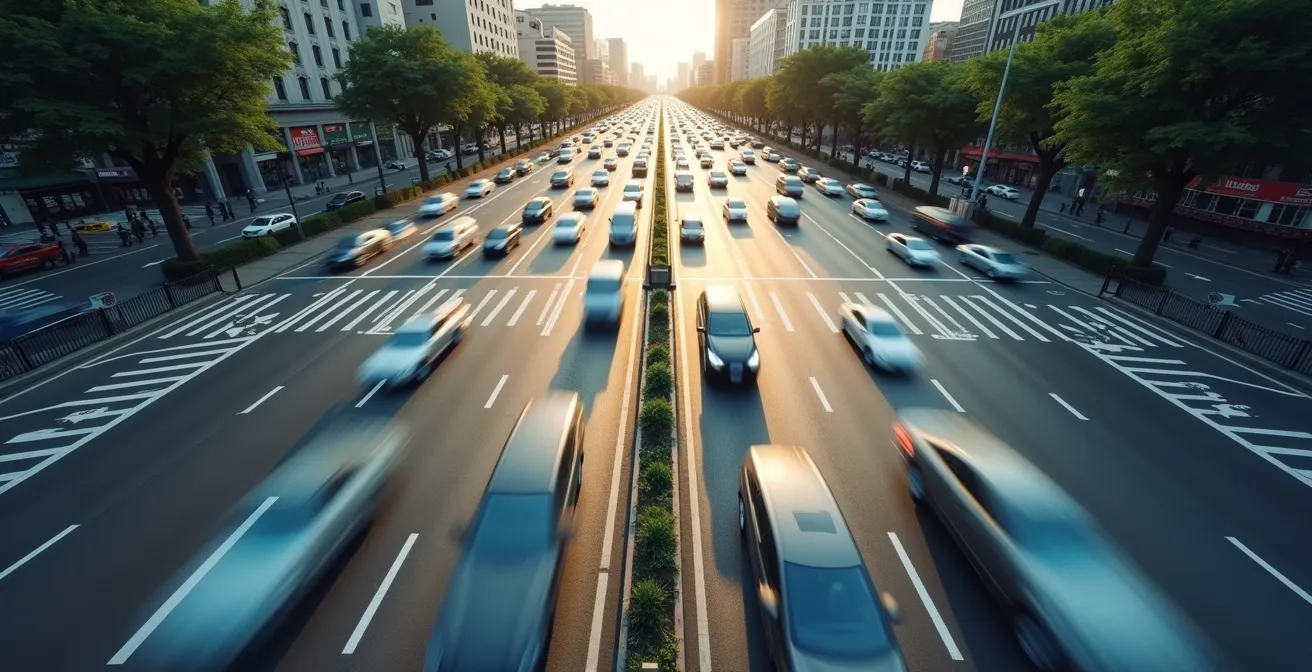
As the visual shows, a successful green wave creates a rhythmic, synchronized pattern of movement. Achieving this requires ultra-low latency communication between vehicles and the infrastructure managing the signal phasing (SPaT – Signal Phase and Timing). This is a perfect use case for the direct communication capabilities of both DSRC and C-V2X, where even a slight delay could cause a vehicle to miss the wave, creating a cascading disruption behind it. It’s a clear demonstration of how micro-level data exchanges can produce macro-level efficiency gains.
The Mistake of Neglecting Construction Zones
While fixed infrastructure is a known quantity, the most dangerous scenarios on the road are often temporary and dynamic. Construction zones are a prime example: they feature lane shifts, reduced speed limits, and the presence of vulnerable workers, all of which change frequently. Neglecting to integrate these dynamic zones into the V2X communication fabric is a critical safety mistake. A vehicle’s static map data will be wrong, and its on-board sensors may be confused by unusual lane markings and temporary barriers.
V2X provides the solution by broadcasting real-time information about the work zone’s status directly to approaching vehicles. A temporary, portable RSU can transmit data on lane closures, active work crews, and the location of slow-moving construction vehicles. This digital “heads-up” is proven to be effective; studies on in-vehicle warning messages in work zones showed a 16.4% improvement in driver response time and compliance with warnings. It effectively creates a digital perimeter around the hazardous area.
The same principle applies to other dynamic road events, such as accidents or adverse weather requiring priority vehicles. For example, during the 2019-2020 winter season, the Utah DOT equipped snowplows with V2X technology. This allowed the plows to request signal preemption, giving them priority passage through intersections. The system improved the effectiveness of snow clearing operations and reduced crash rates during snow events. This case demonstrates the power of V2X to manage not just static infrastructure, but the fluid, ever-changing reality of the road.
Key Takeaways
- V2X safety is built on a “communication fabric” that combines different technologies (5G, DSRC) to provide predictive, non-line-of-sight alerts.
- A “retrofit-first” strategy, augmenting existing infrastructure rather than replacing it, is the most pragmatic and cost-effective path to deployment.
- The real power of V2X lies in its ability to enable dynamic traffic optimization and handle temporary hazards, moving beyond static safety features.
Decoding the Reliability of Machine Perception Systems
Ultimately, for a tech enthusiast, the entire V2X ecosystem hinges on one question: can we trust the data? A perception system is only as good as the information it receives. While NHTSA research suggests V2X systems could help prevent a vast number of crashes, this potential is entirely dependent on the integrity and reliability of the data flowing through the communication fabric. The challenge is ensuring that data is not only received quickly but is also accurate and trustworthy, especially in adverse conditions.
This is where the concept of perception redundancy becomes critical. V2X data is not meant to replace a vehicle’s onboard sensors (LiDAR, cameras, radar) but to augment them. When a car’s camera is blinded by sun glare, a V2X message can confirm a pedestrian is in the crosswalk. When its radar is confused by heavy rain, a signal from the infrastructure can report a stalled vehicle ahead. It’s this fusion of independent data streams that builds a robust and reliable perception of reality. However, this system can be compromised if any single component fails.
If that sensor isn’t properly prepared for adverse weather conditions or adverse operating conditions where it can widely operate without losing data then you have a challenge. You end up with data that ultimately, under certain conditions, isn’t trustworthy.
– Miles Flamenbaum, CEO of Actasys
Flamenbaum’s point is crucial. The reliability of the entire system depends on the resilience of its individual nodes—from the sensors on a car to the RSU on a traffic pole. This necessitates rigorous testing, standardization, and the development of security protocols to prevent malicious data injection. The journey toward a fully trustworthy V2X system is not just about building the network, but about hardening every link in the chain.
The journey towards fully integrated and intelligent road infrastructure is an ongoing process. The next logical step is to analyze how these technologies can be applied to your specific context, whether as a city planner, automotive engineer, or simply an informed enthusiast, to advocate for smarter, safer roads.