
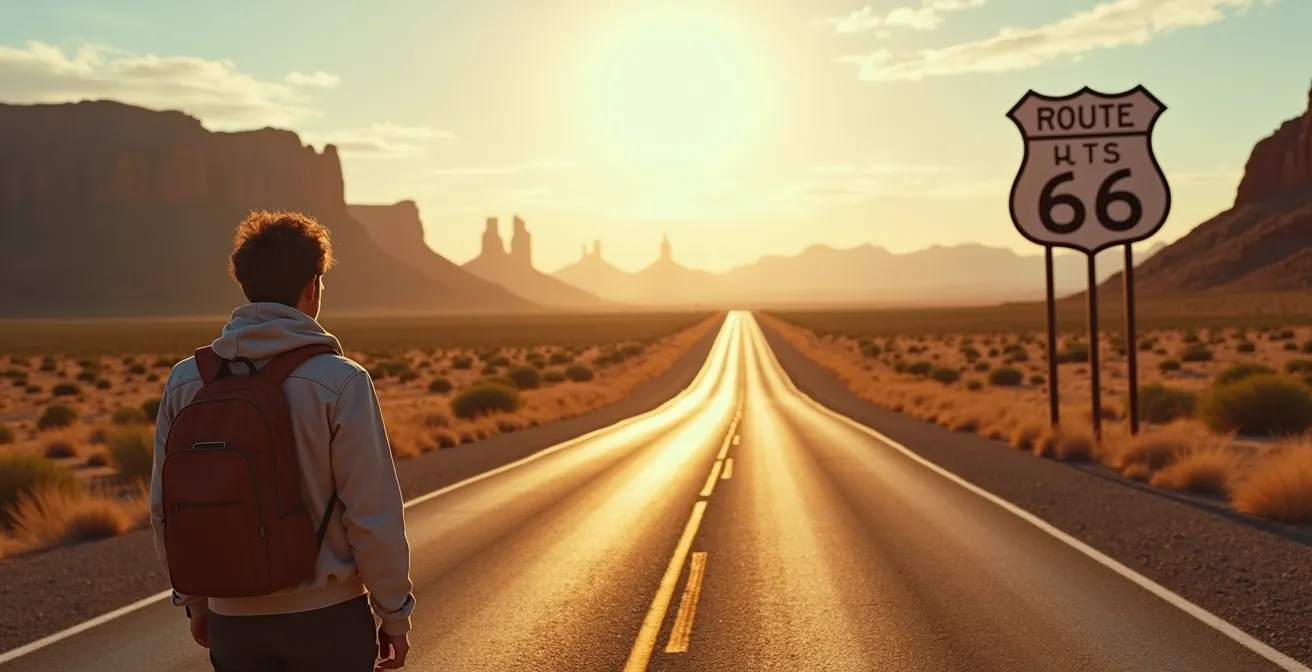
The image of Route 66 is seared into the global consciousness: a single ribbon of asphalt stretching toward the horizon, lined with gleaming chrome diners and quirky roadside giants. It’s the ultimate symbol of the American road trip, a journey into the heart of the country’s mid-century optimism. But for the prospective traveler in the 21st century, a critical question looms: Is that dream still alive, or is the Mother Road now just a collection of ghost towns and tourist traps? The common advice is to “take a trip back in time,” but this romantic notion often glosses over the hard reality of decommissioned roads and economic decline.
Many assume the journey is a continuous, signposted experience from Chicago to Santa Monica. The reality is a complex tapestry of pristine, restored segments, impassable dirt tracks, and sections that have been completely swallowed by the interstate highway system. Simply pointing your car west and hoping for the best is a recipe for frustration, leading many to wonder if the authentic experience has been lost forever. The key to unlocking the magic of the modern Route 66 isn’t to mourn what’s gone, but to change your perspective entirely.
This guide proposes a new approach: treat Route 66 not as a single road, but as a fragmented, open-air museum of American identity. Its value lies not in a continuous drive, but in the deliberate act of curating a personal journey through its surviving, disconnected cultural exhibits. By understanding which sections to prioritize, how to navigate its fractured path, and where your tourist dollars have the most impact, you can transform a potentially disappointing drive into a profound and personal exploration of American history, resilience, and change.
This article will guide you through this curatorial process. We will explore how to identify the most rewarding sections of the road, the essential tools for navigation, and how to critically engage with everything from souvenirs to sleeping arrangements to create a truly meaningful adventure.
Summary: A Curated Journey on the Modern Mother Road
- Identifying the stretches worth your while
- The mistake of relying solely on GPS
- Understanding the state of decay in certain areas
- Comparing the east vs. west experience
- Optimizing the search for authentic souvenirs
- Optimizing reliability for a modern drive
- Choosing between motels and camping for economy
- Choosing the right modern American performance car for the trip
Identifying the stretches worth your while
The first step in curating your Route 66 experience is to abandon the idea of a single, uniform road. The “Mother Road” is a collection of disparate pieces, with some states offering vast, immersive landscapes while others feature only fleeting glimpses. For instance, the stark contrast in Route 66’s state-by-state coverage, from a mere 13 miles in Kansas to nearly 400 in New Mexico, proves that a “one-size-fits-all” itinerary is impossible. The modern traveler must act as a curator, selecting “exhibits” based on their interests rather than attempting to see every mile.
Instead of a linear path, think in terms of themed trails. You can focus on a “Ghost Town Trail” in western Arizona, exploring the authentic, sun-baked decay of mining towns like Oatman. Or, you might curate a “Neon Art Gallery” tour along the Tucumcari-to-Albuquerque stretch in New Mexico, which boasts one of the highest concentrations of vintage, buzzing neon signs. For those seeking solitude, the quiet desert drives between Kingman and Seligman, Arizona, offer a meditative experience far from the roar of Interstate 40.
This approach also allows for more strategic planning. You can use a city like Flagstaff, Arizona, as a multi-day hub, allowing for excursions to the Grand Canyon and other nearby attractions without the pressure of constant packing and unpacking. This hub-and-spoke strategy acknowledges the reality of the road: the eastern states offer frequent, dense stops every 10-20 miles, while the western states demand a different pace, with vast, 50-plus mile stretches between points of interest. By choosing your segments, you take control of the narrative.
The mistake of relying solely on GPS
Once you’ve curated your desired segments, the next challenge is navigation. The greatest mistake a modern Route 66 traveler can make is to blindly trust a single technology like Google Maps or a dedicated GPS. These tools are programmed for efficiency and will constantly try to pull you onto the faster, characterless interstates, causing you to miss the very alignments you came to see. Furthermore, specialized Route 66 apps, while useful, have their own critical flaws.
Real-world testing shows that even paid apps can be unreliable. One study of the popular Route 66 Navigation app found that users frequently experienced signal loss in remote areas and were given incorrect turn directions for historical alignments. Many successful travelers report that the only foolproof method is a hybrid navigation approach, combining the best of old and new technologies. This means using a highly-regarded paper guide like the “EZ66 Guide for Travelers” for the big picture and for areas without cell service, supplemented by Google Maps (with offline maps downloaded) for locating modern amenities like gas stations and restaurants.
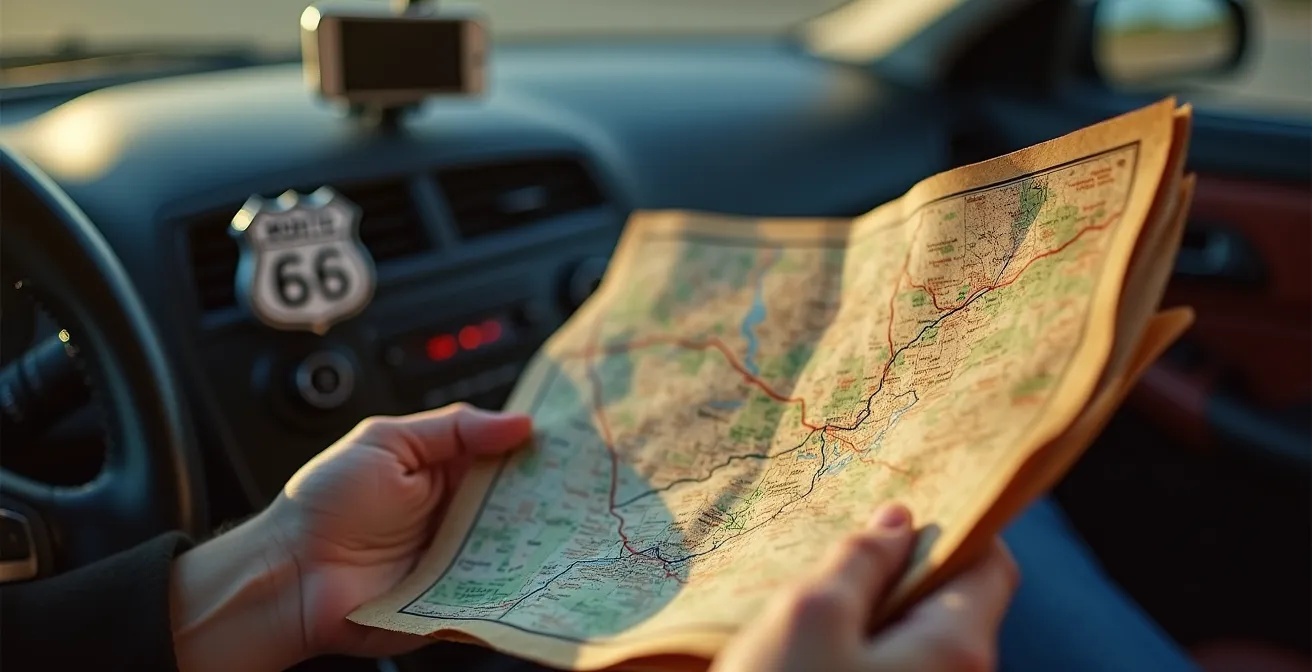
This “navigational hybridization” is the key to successfully tracing the road’s multiple, often unmarked, historical paths. The table below, based on an in-depth analysis of navigation methods, breaks down the strengths and weaknesses of each tool.
| Navigation Method | Strengths | Weaknesses | Best Use Case |
|---|---|---|---|
| Dedicated Route 66 Apps | Historic alignment tracking | $50 cost, connectivity issues | Urban sections with cell coverage |
| Paper Maps (EZ66 Guide) | No battery needed, full route view | No real-time updates | Remote desert sections |
| Hybrid Approach | Combines all advantages | Requires multiple tools | Complete Route 66 journey |
Understanding the state of decay in certain areas
It’s undeniable: parts of Route 66 are in a state of advanced decay. Boarded-up motels, crumbling gas stations, and faded billboards are a common sight. This “ruin porn” can be disheartening if you’re expecting a perfectly preserved time capsule. However, framing this decay through a historical lens transforms it from a sign of failure into a powerful, tangible lesson in American economic history. These ruins are not just sad; they are artifacts of the seismic shift caused by the Interstate Highway Act of 1956, which bypassed entire communities overnight.
But the story isn’t just one of decline. It’s also a powerful narrative of resilience and preservation, often driven by passionate individuals. This effort is more successful than many realize; despite decades of decline, preservation efforts have protected over 250 buildings and sites listed on the National Register of Historic Places. These are not just buildings; they are victories against time and indifference, saved by communities and advocates who refused to let their history be paved over.
This preservation movement has its heroes, people who have dedicated their lives to the cause. As one guide notes, recognizing these figures is part of the journey. For example, in Seligman, Arizona, the birthplace of the historic Route 66 revival:
Angel Delgadillo has been the driving force to help protect and preserve the Mother Road
– Road Bear RV Travel Guide, Best Stops Along Route 66
Visiting Delgadillo’s gift shop isn’t just shopping; it’s participating in this living history. Understanding this dynamic—the tension between decay and preservation—is crucial. The ruins tell the story of what was lost, while the restored sites and the people behind them tell the story of what has been saved. Your journey is a front-row seat to both acts of this American drama.
Comparing the east vs. west experience
The journey on Route 66 is not geographically uniform; the experience of driving the eastern half (Illinois to Oklahoma) is fundamentally different from the western half (Texas to California). This isn’t just about landscape, but also about the density of attractions and the very narrative of the trip. The direction you travel—eastbound or westbound—also profoundly shapes the psychological journey.
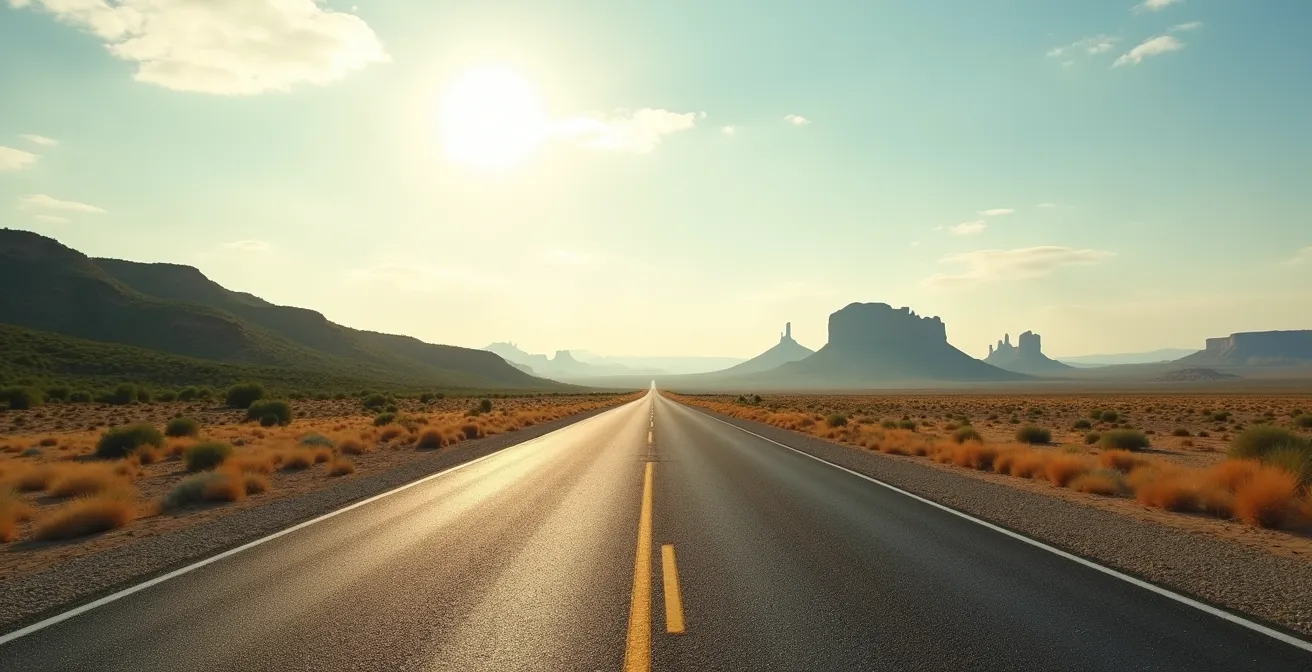
Traveling westbound, from Chicago to Santa Monica, aligns you with the classic American frontier narrative. This direction follows the path of historical migration, particularly that of the Dust Bowl-era families seeking a better life in California. This creates what one analysis calls a “Journey of Hope” narrative, where the landscape opens up and the feeling of possibility grows with each westward mile. Conversely, traveling eastbound is a counter-cultural act, a “Journey Home” that reverses the traditional story of American expansion. This can offer a more reflective, introspective experience.
The practical differences are just as stark. The East is characterized by lush greenery, rolling hills, and a high density of towns and attractions every 10-20 miles. Photography here is about capturing soft morning light filtering through humidity onto vintage diners. The West, by contrast, is a land of immense scale and dramatic, arid landscapes. It’s about sharp, high-contrast light, vast empty spaces, and dramatic shadows on rock formations during the “golden hour.” Planning must adapt accordingly; a day in Illinois might involve a dozen quick stops, while a day in Arizona could be a single, long drive through the desert. Even natural forces play a role: westbound travelers often face headwinds in the spring, while eastbound drivers get a helpful push from tailwinds.
Optimizing the search for authentic souvenirs
On a road so heavily mythologized, the line between an authentic memento and a mass-produced piece of kitsch is dangerously thin. The souvenir shops are plentiful, but many are filled with generic, imported trinkets that have no real connection to the road. To avoid this trap, the modern traveler must become a discerning collector, an “economic archaeologist” whose purchasing choices support local artists and preservationists.
A simple but powerful strategy is to engage with the vendors. As the Route 66 Authenticity Guide suggests, a few direct questions can instantly separate the real from the fake:
Ask three questions to any vendor: Who is the artist/creator? Are they local to the Route? What’s the story behind this piece?
– Route 66 Authenticity Guide, Alternative Souvenir Strategies
This approach transforms a simple transaction into a meaningful interaction. It prioritizes storytelling and local craftsmanship over a cheap price tag. An authentic souvenir is an object with a narrative—a piece of Petrified Forest wood sold by a local, a hand-thrown pottery mug from a New Mexico artisan, or a photograph bought directly from the artist who captured it.
To find these treasures, you must look beyond the obvious. Instead of just buying t-shirts, consider these options for a more authentic collection:
- Visit pioneering shops like Angel & Vilma Delgadillo’s in Seligman, where your purchase directly supports the people who saved the road.
- Seek out cookbooks from iconic local diners like the Rock Cafe in Stroud, Oklahoma, to take the flavors of the route home with you.
- Buy directly from Navajo artisans at their roadside stands in New Mexico and Arizona, ensuring the money goes to the creator.
- Commission a small piece from one of the many muralists in Pontiac, Illinois, or other towns known for their public art.
By making these conscious choices, your souvenirs become more than just objects; they become investments in the cultural ecosystem of Route 66.
Optimizing reliability for a modern drive
The romantic image of driving a vintage car down Route 66 clashes with the modern reality of remote desert stretches and limited services. While a classic convertible is tempting, reliability is the most important feature of any vehicle on this journey. Concerns about the road’s condition are common, but the good news is that a surprising 85% of the original route remains driveable in a standard passenger car. The real challenge isn’t impassable roads, but being prepared for the unexpected when you’re 50 miles from the nearest town.
Modern reliability is less about the car itself and more about the gear you carry with it. A “donut” spare tire is woefully inadequate for the long distances between service stations in the West. Likewise, a dead phone battery is not just an inconvenience but a genuine safety risk in areas with no cell service. Your vehicle and your emergency kit must be optimized for self-sufficiency, especially in the vast landscapes of Arizona, New Mexico, and California.
Before setting out, every traveler should assemble a modern emergency kit tailored to the specific challenges of Route 66. This goes far beyond a simple first-aid kit. It’s a collection of tools designed to handle common roadside issues and communication blackouts. The focus should be on tire health, power, and off-grid communication. A well-prepared traveler is a confident one, free to enjoy the isolation of the desert rather than fear it.
Your action plan: Modern Route 66 emergency kit essentials
- Assess your vehicle: Ensure you have a full-size spare tire and that your primary tires are durable Highway-Terrain (H/T) models.
- Gather power tools: Pack a portable 12V tire inflator rated for your vehicle’s tires and a minimum 20,000mAh portable power station for charging devices.
- Invest in repair gear: A professional tire plug kit with T-handle tools can fix a puncture and save you hours of waiting for a tow.
- Plan for no service: Carry a satellite messenger like a Garmin InReach Mini for emergencies in dead zones and have offline maps for the entire route pre-downloaded on your phone.
- Establish a daily habit: Perform daily tire pressure checks each morning, as desert temperature swings of 40°F or more can significantly alter pressure.
Choosing between motels and camping for economy
Accommodation is one of the biggest expenses on a Route 66 trip, and the choice between a historic motel and a campground is more than just a matter of budget—it’s a choice about the kind of experience you want. While camping seems like the obvious budget-friendly option, a true cost analysis reveals a more complex picture. The upfront investment in quality camping gear can easily reach $300-$500, and the daily time spent setting up and breaking down camp can cut into valuable exploration time.
Historic motels, while having a higher nightly rate, offer an unparalleled value in terms of cultural immersion. Staying at a place like the Blue Swallow Motel in Tucumcari, New Mexico, is not just renting a room; it’s participating in a living museum. Your $80-a-night fee is a direct investment in preservation, helping to keep the iconic neon sign lit and the 1939 motor court from falling into ruin. As the story of the Blue Swallow demonstrates, these motels survive because travelers make a conscious choice to support them.
Case Study: The Blue Swallow Motel and Economic Preservation
The Blue Swallow Motel in Tucumcari exemplifies why staying in historic motels matters beyond mere accommodation. This 1939 motor court, with its iconic neon sign, survives because travelers choose to pay slightly more for the authentic experience. Each booking directly funds preservation efforts, maintaining not just a building but a living piece of American road trip culture that would otherwise vanish.
The wisest approach for many is a hybrid strategy. By investing in a basic camping setup, you can alternate between nights under the stars in state parks and nights soaking in the neon glow of a historic motel. This allows you to save money on some nights to “splurge” on authenticity on others. This table breaks down the true costs and benefits.
| Accommodation Type | Upfront Cost | Nightly Rate | Hidden Costs | Experience Value |
|---|---|---|---|---|
| Camping | $300-500 gear investment | $15-35 campground fees | Setup time (1hr daily), security concerns, weather dependency | Nature immersion, flexibility |
| Historic Motels | None | $60-120 | None | Neon culture, local economy support, Route 66 authenticity |
| Hybrid Strategy | $150 basic camping gear | $40-70 average | Planning time | Best of both experiences |
Key takeaways
- Route 66 is not a single road but a fragmented museum; success depends on curating your itinerary by selecting high-value segments.
- Relying on a single navigation tool is a mistake. A hybrid approach combining paper maps and offline GPS is essential for tracing historic alignments.
- Your travel choices—from where you sleep to what you buy—are acts of “economic archaeology” that directly fund the preservation of the road’s culture.
Choosing the right modern American performance car for the trip
The final piece of the puzzle is the vehicle. While any reliable car can make the trip, the dream of driving Route 66 is often intertwined with the dream of doing it in an iconic American car. However, the metrics that define a great “performance car” for a racetrack are often irrelevant on the Mother Road. Here, real-world comfort, luggage space, and durability matter more than horsepower. As travel expert Nikki notes, “try to get the best car that you can afford as the comfort and amenities will be very welcome.” The modern traveler should choose a car that balances the iconic image with practical, long-haul capability.
The choice often comes down to three categories: the sleek Grand Tourer (like a Chevrolet Corvette), the brawny Muscle Car (Ford Mustang GT), or the surprisingly capable Performance Sedan (Dodge Charger). Each has a distinct personality and a unique set of compromises for a 2,400-mile journey, as this comparative table shows.
| Category | Model Example | Route 66 Pros | Route 66 Cons | Real-World MPG |
|---|---|---|---|---|
| Grand Tourer | Chevrolet Corvette | Magnetic ride comfort, prestige | Minimal luggage space, low ground clearance | 25-30 highway |
| Muscle Car | Ford Mustang GT | Iconic American image, V8 sound | Harsh ride, cramped rear seats | 23-28 highway |
| Performance Sedan | Dodge Charger Scat Pack | 4 doors, huge trunk, comfortable ride | Less sporty image, higher weight | 22-27 highway |
Ultimately, the “best” car depends on prioritizing the right metrics. Instead of 0-60 times, a savvy Route 66 traveler should build a checklist of features that genuinely impact a multi-week road trip across varied terrain.
Checklist: Performance metrics that actually matter on Route 66
- Ground clearance: Is it at least 5.5 inches to handle unpaved sections without scraping?
- Fuel tank range: Can it cover 400+ miles on a single tank to navigate remote desert stretches with confidence?
- Seat comfort: Are the seats rated for 8+ hours of driving without causing fatigue?
- Infotainment: Does it feature Apple CarPlay/Android Auto for seamless navigation flexibility?
- Cargo capacity: Does it offer at least 13 cubic feet of trunk space for two people’s gear and souvenirs?
The Route 66 of today is not the road your grandparents knew. It is something more complex, more challenging, and perhaps more rewarding. It demands more from the traveler: more research, more planning, and a more critical eye. But for those willing to engage with it on these terms—as curators, historians, and preservationists—the Mother Road still offers one of the most profound journeys into the American soul. Start sketching your own personal Route 66 exhibition today and rediscover the America that lies just off the interstate.