
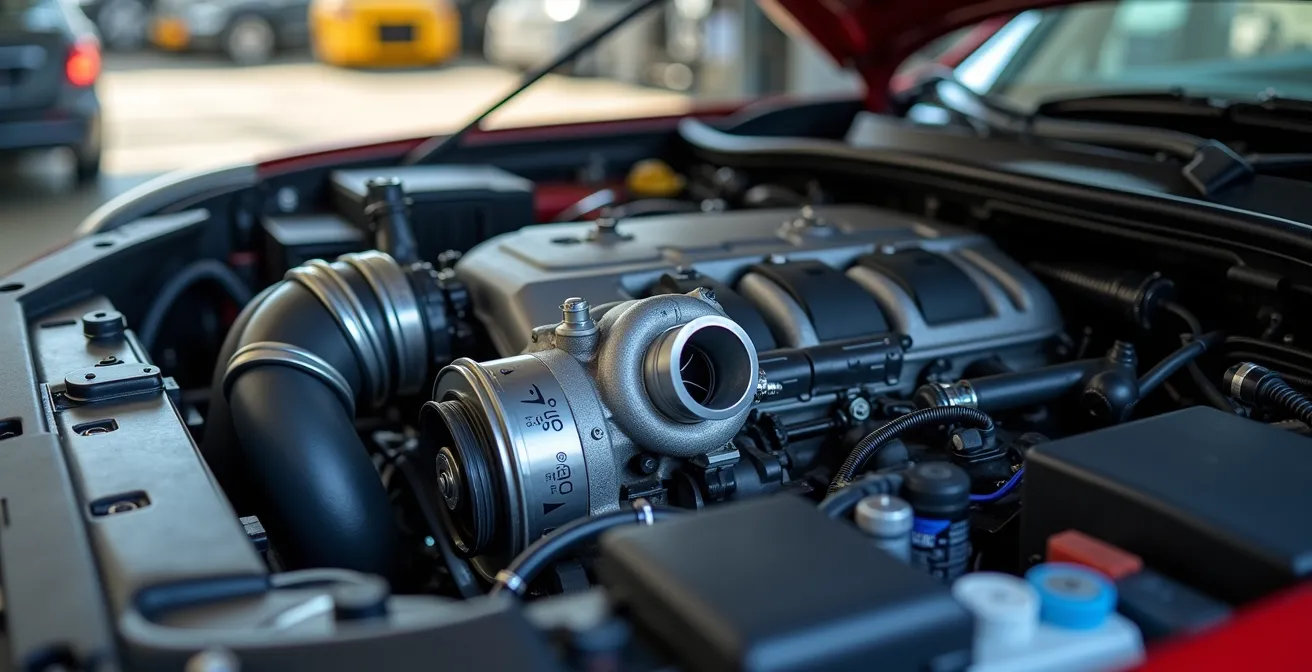
The myth that downsized turbo engines are inherently unreliable for heavy use is outdated; their longevity is determined by disciplined management of their three primary stressors.
- Engine durability hinges on controlling heat through proper oil selection and cooldown procedures to prevent thermal breakdown.
- Maintaining pressure integrity across the intake system is critical to prevent lean conditions and performance loss.
- Proactive contamination control, including modern oils to fight LSPI and carbon buildup, is non-negotiable.
Recommendation: Shift from a reactive, V8-style maintenance mindset to a proactive, data-driven approach focused on thermal monitoring and fluid quality to ensure your turbo engine’s long-term health.
For decades, the formula for a reliable truck engine was simple: big displacement, no replacement. The trusty V8, with its straightforward mechanics and predictable nature, became the gold standard for anyone needing to tow, haul, or simply depend on their vehicle day in and day out. Now, the landscape is changing. Automakers are turning to smaller, more complex downsized and turbocharged engines, like Ford’s EcoBoost V6, promising V8 power with better fuel economy. But for a traditional truck owner, this promise comes with a healthy dose of skepticism. Are these high-strung engines truly built to last under real-world stress?
The common advice often feels generic: “change the oil,” “let it warm up.” While not incorrect, these platitudes fail to address the core concerns of complexity, heat management, and the potential for astronomical repair bills. The fear is that these engines are fragile thoroughbreds, not workhorses. The conversation often gets bogged down in anecdotes of failure, rarely focusing on the specific engineering principles that dictate their longevity. This leaves many potential owners wondering if they are trading proven durability for a set of expensive, high-maintenance problems.
But what if the key to reliability isn’t about avoiding this new technology, but understanding its operational demands at a deeper, mechanical level? The long-term health of a modern Gasoline Direct Injection (GDI) turbo engine isn’t a matter of luck; it’s a direct result of meticulously managing its three core enemies: heat, pressure, and contamination. By moving beyond generic tips and embracing a proactive, diagnostic-led maintenance philosophy, you can secure the long-term durability that you demand from a truck engine.
This guide will deconstruct the essential maintenance strategies required for these powerplants. We will explore the science behind oil quality, the critical importance of thermal management, the hidden failure points in modern systems, and how to adopt a mindset that transforms a potentially complex engine into a reliable, long-term partner.
Summary: Long-Term Reliability for Downsized Turbo Engines: A V8 Owner’s Guide
- Understanding the Importance of Oil Quality
- The Mistake of Immediate Engine Shutdown
- Optimizing Intercooler Cooling
- Comparing Repair Complexity
- Planning Spark Plug Replacement
- Optimizing Fluid Management
- Understanding Active Aerodynamic Devices
- Preventing Total Engine Destruction Through Thermal Monitoring
Understanding the Importance of Oil Quality
In a naturally aspirated V8, oil is primarily a lubricant and coolant. In a modern GDI turbo engine, its role expands dramatically, becoming a crucial component in preventing catastrophic failure. The immense heat from the turbocharger and high cylinder pressures push conventional oils past their limits, leading to rapid breakdown. More importantly, these engines are uniquely susceptible to a phenomenon called Low-Speed Pre-Ignition (LSPI), where oil droplets entering the combustion chamber ignite the air-fuel mixture prematurely, causing immense pressure spikes that can damage or destroy pistons. This is a primary enemy of engine longevity.
To combat this, new oil standards have been developed. Specifically, the API SP classification was formulated to protect GDI turbo engines. According to the American Petroleum Institute specifications, these oils use a revised additive chemistry, particularly lowering calcium detergent levels, which significantly reduces the likelihood of LSPI events. Using anything less than a full synthetic oil meeting this standard is gambling with your engine’s life. As one Toyota Master Technician emphasizes, proper maintenance and continually checking oil condition is the single most important factor for maximizing engine life. On the dipstick, the oil should always appear smooth, glossy, and transparent, not dark and gritty.
Simply changing the oil isn’t enough; you must verify its condition and adjust your service intervals based on real-world data, not just the manufacturer’s optimistic schedule. This is where proactive diagnostics begin.
Your Action Plan: Implementing Used Oil Analysis
- Initial Sampling: Send an oil sample for a Used Oil Analysis (UOA) every 3,000 miles to establish a baseline for your specific engine and usage pattern.
- Key Indicator Monitoring: Monitor the report for wear metals (iron, copper, aluminum), fuel dilution percentage (critical in GDI engines), and viscosity breakdown.
- TBN Check: Ensure the Total Base Number (TBN), which measures the oil’s remaining active additives, stays above 2.0 to confirm it’s still providing protection.
- Interval Adjustment: Adjust your oil change interval based on the analysis results. If wear metals are high or TBN is low, shorten the interval.
- Set a Maximum: As a rule of thumb, establish a 5,000-mile maximum oil change interval for any turbocharged engine used for towing or heavy loads, regardless of manual guidance.
The Mistake of Immediate Engine Shutdown
One of the most ingrained habits from driving simpler, naturally aspirated engines is turning the key off the moment you park. With a turbocharged engine, especially after a hard run, towing, or climbing a grade, this can be a costly mistake. The turbocharger’s turbine can spin at over 200,000 RPM and reach temperatures exceeding 950°C (1,750°F). The engine’s oil is not just a lubricant for the turbo’s bearings; it’s the primary medium for carrying away this destructive heat.
When you shut the engine off immediately, the oil flow stops. The immense residual heat in the turbine housing soaks into the center bearing cartridge, literally cooking the stagnant oil left inside. This process, known as oil coking, turns the liquid lubricant into hard carbon deposits that clog oil passages and abrasive sludge that destroys the delicate bearings. Over time, this leads to oil starvation, bearing failure, and ultimately, a destroyed turbocharger. This is a classic example of a failure caused by a lack of mechanical sympathy.
Modern turbochargers have design features to combat this. Many now include water-cooling lines that connect to the engine’s main cooling system. These lines allow for a thermosiphon effect, where coolant continues to circulate naturally through the turbo housing even after the engine is off, pulling away a significant amount of heat. However, this system is not infallible and cannot completely eliminate heat soak under extreme conditions.
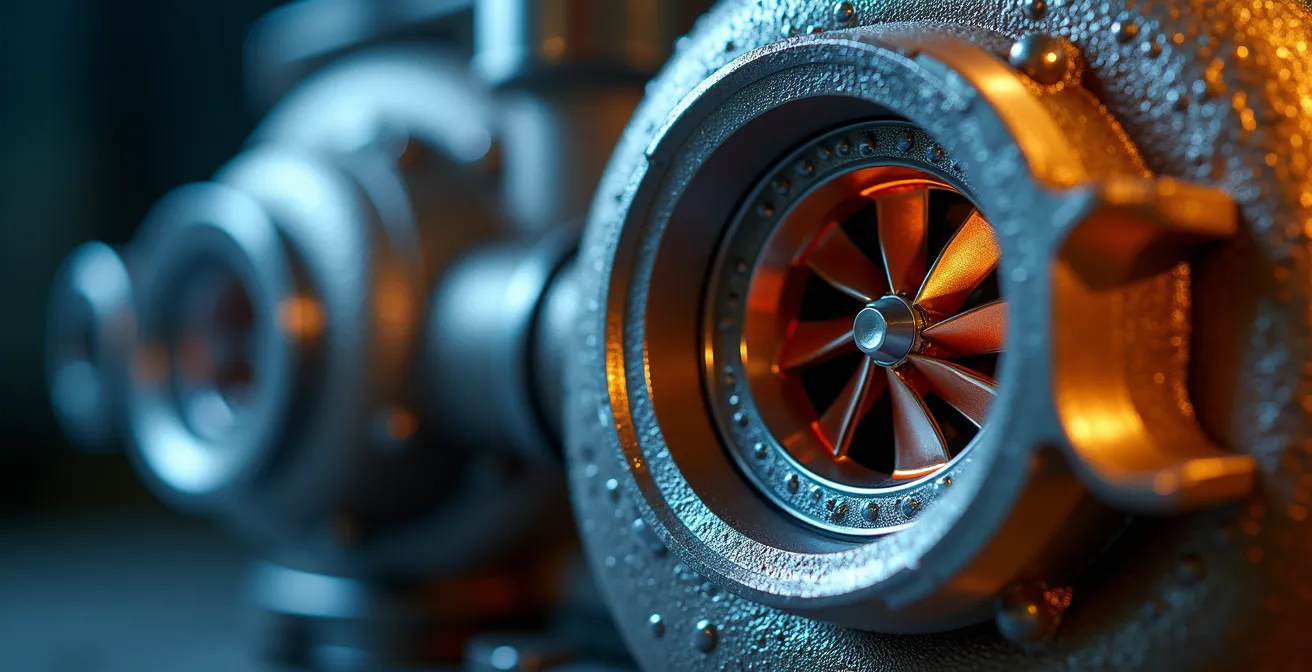
The visual above shows the intricate passages designed for oil and coolant flow within a turbo’s core. Allowing engine oil to circulate for just 30 to 60 seconds at idle before shutdown ensures this flow continues, drawing the most intense heat out of the housing and preventing the coking that leads to premature failure. It’s a small change in habit that provides a massive return in thermal management and long-term reliability.
Optimizing Intercooler Cooling
The intercooler is a component that many V8 owners have never had to think about, but on a turbo engine, its health is directly tied to engine survival. Its job is simple: to cool the compressed air coming from the turbocharger before it enters the engine. Cooler air is denser, allowing for more oxygen and thus more power. But more importantly, it’s a critical defense against engine knock or detonation. When intake air temperatures get too high, the engine’s electronic control unit (ECU) is forced to pull ignition timing and reduce power to protect itself. In a worst-case scenario, this extreme heat can contribute to pre-ignition, the same destructive force that poor quality oil can cause.
The efficiency of the intercooler can be compromised in several ways. The most common is simple blockage. Its position at the front of the vehicle makes it a magnet for bugs, leaves, and road debris, which can clog the cooling fins and drastically reduce its ability to shed heat. Furthermore, the system relies on pressure integrity. Any leaks in the boost pipes, clamps, or the intercooler itself (often in the plastic end tanks) mean the turbo has to work harder to produce the same pressure, generating even more heat and creating a vicious cycle. According to turbocharger experts at leading manufacturer Accelleron, regular inspection for debris and oily residue on couplers is a fundamental maintenance task.
A particularly dangerous condition is intercooler heat soak. This happens in low-speed, high-load situations, like towing a heavy trailer through stop-and-go traffic. With little airflow over the intercooler, the intake air temperatures can skyrocket. This exact scenario forces the ECU to take drastic measures to prevent LSPI, which can occur when pockets of the hot air-fuel mixture ignite on their own. This is not a theoretical problem; it is a known cause of catastrophic failure in modern, small-displacement GDI turbo engines.
Comparing Repair Complexity
For a traditional V8 owner, many repairs are straightforward and relatively affordable. An alternator, water pump, or starter are typically accessible and can be replaced with basic tools. This familiarity and simplicity are a huge part of the V8’s appeal. Downsized turbo engines, by their very nature, introduce a level of complexity and packaging density that fundamentally changes the repair landscape. The fear of a five-figure repair bill is not unfounded if critical components fail.
The turbocharger itself is a prime example. It’s a high-precision, finely balanced component operating in the most hostile environment in the engine bay. When it fails, repair is rarely an option. Replacement is the standard procedure, and according to industry repair cost data, the average cost can easily reach $2,000, factoring in both parts and the significant labor required to access it. This contrasts sharply with the lower cost of ancillary parts on a V8. Furthermore, other related systems add layers of complexity. GDI fuel systems run at extremely high pressures, requiring specialized tools, and intake valve carbon cleaning is a periodic maintenance item that doesn’t exist on most older port-injected V8s.
As the experts at AutoStar Heavy Duty’s technical analysis team point out when discussing commercial vehicles, the costs extend beyond the part itself. They state:
Attempting a repair on a mechanically compromised VGT unit is inherently unreliable – quality minimizes crippling downtime at $700-$880 per day.
– AutoStar Heavy Duty Technical Analysis, The True Cost to Replace a Heavy Duty Turbocharger
While a pickup truck owner may not face commercial downtime costs, the principle holds: a major failure is both expensive and debilitating. The most logical approach is to view proactive maintenance not as a cost, but as an investment to prevent these high-dollar repairs, as the following comparison illustrates.
| Maintenance Type | Frequency | Cost | Consequence if Skipped |
|---|---|---|---|
| Oil changes (synthetic) | Every 5,000 miles | $80 | Turbo failure: $2,000+ |
| Intake valve cleaning | Every 50,000 miles | $300 | Engine damage: $2,500+ |
| Boost leak inspection | Every 10,000 miles | $50 | Intercooler replacement: $800 |
| Spark plug replacement | Every 30,000 miles | $150 | Catalytic converter: $1,500 |
Planning Spark Plug Replacement
On a large-displacement, low-stress V8, spark plugs are often an afterthought, sometimes lasting 100,000 miles or more. In a high-pressure GDI turbo engine, they are a critical maintenance item with a much shorter service life. The intense pressure and heat of the combustion process place enormous demands on the spark plugs. They are not just creating a spark; they are surviving a violent, super-heated event thousands of times per minute. This environment erodes the electrodes far more quickly than in a naturally aspirated engine.
Failing to replace spark plugs on a shortened interval can have a cascading effect on other expensive components. A worn plug with an excessive gap requires higher voltage from the ignition coil to create a spark, leading to premature coil failure. More critically, a weak or inconsistent spark can lead to incomplete combustion. This unburnt fuel is then dumped into the exhaust system, where it can superheat and destroy the catalytic converter—a repair that can easily cost over $1,500. Experienced turbo owners consistently report that while a properly tuned engine isn’t significantly more difficult to maintain, the service intervals for items like oil and spark plugs are non-negotiable.
More than just a maintenance item, the spark plugs serve as a valuable diagnostic window into the engine’s health. “Reading” the plugs during a change can reveal hidden problems. Here’s what to look for:
- Healthy Plug: A light tan or grayish color on the insulator nose indicates healthy combustion and correct heat range.
- Black Soot: Dry, black carbon buildup suggests a rich air-fuel mixture, a dirty air filter, or excessive idling.
- Blistering or Melting: A white, blistered insulator or a melted electrode is a sign of extreme overheating. This indicates the plug’s heat range is too hot or there is a serious engine lean condition or cooling system problem that requires immediate attention.
– Oily Fouling: A shiny, black, oily coating points to a significant problem, such as worn piston rings or valve seals allowing oil into the combustion chamber.
Therefore, planning for spark plug replacement every 30,000 miles (or even sooner depending on tune and usage) is a cornerstone of proactive contamination control and preventative diagnostics.
Optimizing Fluid Management
A comprehensive fluid management strategy is the lifeblood of a reliable turbocharged engine. While oil gets the most attention, every fluid in the vehicle plays a heightened role due to the increased thermal and mechanical stresses. Extending fluid service intervals, a common practice on under-stressed V8s, is a recipe for failure in these more demanding applications. The goal is to move from a “lifetime fluid” myth to a “proactive replacement” reality.
Engine oil, as discussed, is paramount. Beyond using the correct API SP-rated synthetic, it’s important to understand why it degrades. According to a Kixx oil technical analysis, API SP certified oils show significant performance improvements not just in LSPI prevention but also in oxidation stability and sludge control. Oxidation occurs when oil reacts with oxygen at high temperatures, causing it to thicken and form sludge—a direct result of the heat from the turbocharger. This sludge restricts oil flow and leads to accelerated wear. This reinforces the need for shorter, 5,000-mile change intervals.
However, other fluids are equally critical to thermal management and reliability:
- Engine Coolant: The antifreeze/coolant does more than prevent freezing. It contains anti-corrosion additives that protect the entire cooling system, including the radiator, water pump, and the critical water-cooling passages in the turbocharger. These additives deplete over time. Replacing coolant every 50,000 miles or 5 years with the OEM-specified formula is essential.
- Transmission Fluid: Many modern transmissions are advertised with “lifetime” fluid. For a truck that tows or hauls, this is a dangerous fantasy. The transmission works harder to manage the engine’s torque, generating more heat. This heat breaks down the fluid, leading to poor shifting and eventual transmission failure. A drain and fill every 60,000 miles is wise insurance.
- Brake and Power Steering Fluid: Brake fluid is hygroscopic, meaning it absorbs moisture from the air, which lowers its boiling point and corrodes internal components. Power steering fluid, if the system is hydraulic, also degrades with heat and time. Flushing these systems on a regular schedule prevents failures in critical safety and control systems.
Adopting a disciplined schedule for all fluids ensures that every system in the vehicle is protected, not just the engine itself.
Key Takeaways
- The longevity of a downsized turbo engine is not a matter of chance, but of disciplined, proactive maintenance focused on managing heat, pressure, and contamination.
- Using API SP-rated full synthetic oil and shortening change intervals to a maximum of 5,000 miles is the single most effective defense against catastrophic failures like LSPI and oil coking.
- Proactive diagnostics, including Used Oil Analysis (UOA) and regular inspection of the intercooler and intake systems, are essential to catch problems before they become expensive repairs.
Understanding Active Aerodynamic Devices
One of the most overlooked aspects of modern truck design that directly impacts turbo engine reliability is the integration of active aerodynamic devices. Features like active grille shutters are primarily marketed for fuel economy. They remain closed at highway speeds to reduce aerodynamic drag and open at lower speeds or when the engine is under high load to allow air to flow through the radiator. For a V8 owner, this system might seem like an unnecessary gimmick, but for a turbo engine, its proper function is a matter of survival.
These shutters are a critical part of the vehicle’s thermal management system. A turbocharged engine running under load—such as when towing a heavy trailer up a long grade—is generating a tremendous amount of heat, both in the engine’s cooling system and in the intercooler. The ECU is programmed to open the grille shutters under these conditions to ensure maximum airflow to the radiator and intercooler, keeping temperatures in the safe operating range.
The danger lies in their failure mode. If the shutter mechanism fails or sticks in the closed position, there is often no check engine light or specific warning to the driver. The engine is slowly but surely being deprived of the cooling air it desperately needs. While cruising on a flat highway, the driver may notice nothing. But the moment the truck is put under a heavy load, the coolant and intake air temperatures will begin to climb into the red zone, leading to ECU-induced power loss at best, and severe engine overheating and damage at worst. This is a subtle but critical failure point that simply doesn’t exist on older, simpler trucks.

The image above illustrates how airflow is strategically managed in a modern vehicle. The active grille shutters are not just for efficiency; they are a dynamic gatekeeper for the engine’s cooling system. Ensuring they are clean, unobstructed, and functioning correctly during routine inspections is a crucial, though often forgotten, step in maintaining the health of a high-output turbo engine.
Preventing Total Engine Destruction Through Thermal Monitoring
The recurring theme in ensuring a downsized turbo engine’s longevity is the aggressive management of heat. While the previous sections focused on the mechanical systems that control heat, the final piece of the puzzle is proactive monitoring. Waiting for a warning light on the dashboard is a reactive approach that often means the damage has already begun. Adopting a proactive diagnostic mindset, using simple tools to monitor the engine’s vital signs, is the ultimate strategy to prevent total engine destruction.
Modern vehicles provide a wealth of data through the On-Board Diagnostics (OBD2) port. Using an inexpensive Bluetooth OBD2 scanner and a smartphone app, any owner can access the same real-time data the ECU uses. This transforms you from a passive driver into an informed operator, capable of spotting dangerous trends before they become failures. Instead of guessing, you can see exactly how your engine is performing under load. This is the pinnacle of proactive diagnostics.
The goal is to monitor a few Key Performance Indicators (KPIs) that act as an early warning system for thermal distress. Keeping an eye on these parameters, especially while towing or hauling, can give you the crucial seconds needed to back off the throttle and let the engine cool before any permanent damage occurs.
| Parameter | Healthy Range | Warning Zone | Critical Action Required |
|---|---|---|---|
| Coolant Temperature | 180-220°F | 221-240°F | Above 240°F |
| Oil Temperature | 180-230°F | 231-250°F | Above 250°F |
| Intake Air Temp (post-intercooler) | 20-40°F above ambient | 41-60°F above ambient | Above 60°F over ambient |
| Knock Retard | 0-2 degrees | 3-5 degrees | Above 5 degrees |
Ultimately, the reliability of a modern turbo engine is not in question; what is required is a change in the owner’s mindset. It demands a shift from the rugged simplicity of a V8 to the disciplined, informed approach of an aircraft pilot performing a pre-flight check. By understanding and respecting the forces of heat, pressure, and contamination, and by using modern tools to monitor them, you can ensure that your downsized engine is not just a powerful and efficient replacement for a V8, but an equally durable and long-lasting workhorse.
Adopt this proactive, data-driven maintenance philosophy today to transform your turbocharged truck into the durable, long-term asset you expect it to be.