
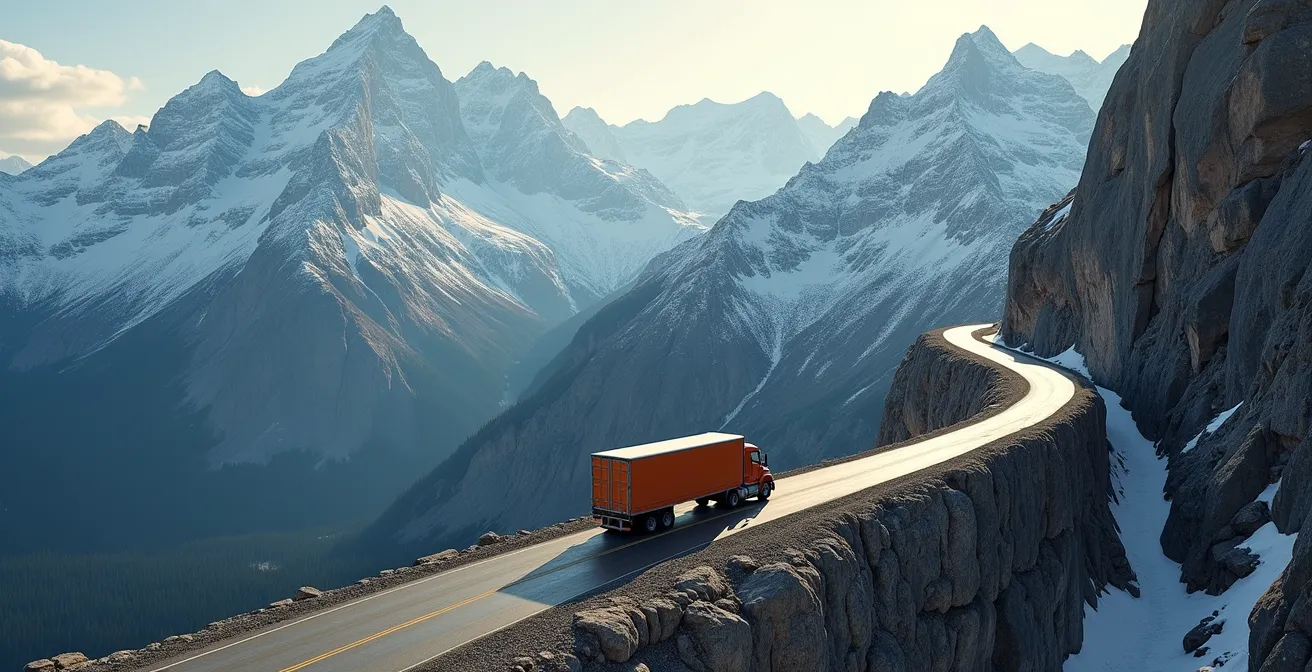
In summary:
- Mountain driving is not about rules, but about managing energy: speed (kinetic), altitude (potential), and heat (thermal).
- Your engine is your primary tool for controlling speed on descents, not your brakes. Brakes are for stopping.
- Both your vehicle and your body lose performance at high altitude; anticipate power loss and the risk of altitude sickness.
- Proper traction devices like chains are not optional; they are critical safety equipment mandated by law in many areas.
- Proactive planning, including route assessment and momentum management, is key to safety and efficiency.
For a driver accustomed to the endless flat horizons of a place like Florida, the first sight of the Rocky Mountains is awe-inspiring. That awe, however, can quickly turn to anxiety when you’re behind the wheel of a loaded vehicle, facing a 7% grade that stretches for miles. The common advice you’ve heard—”use a lower gear” or “don’t ride your brakes”—is well-intentioned but dangerously incomplete. These are merely rules, not a strategy. They tell you *what* to do, but not *why* or *how* it connects to the survival of both you and your vehicle.
The truth is that safe mountain driving has little to do with following a simple checklist. It is a dynamic skill rooted in a single, powerful concept: energy management. Every moment you are on a steep grade, you are in a battle with physics, converting massive amounts of potential energy (your altitude) into kinetic energy (your speed). If you manage this conversion improperly, that energy becomes destructive thermal energy, cooking your brakes and putting you in grave danger. This is a reality so critical that the entire commercial trucking industry is built around mastering it.
But what if you could think like those professionals? This guide will shift your perspective. We will move beyond simplistic rules and into the core physics of vehicle dynamics in mountainous terrain. We will deconstruct the processes of brake overheating, engine strain, and even the physiological effects of altitude on you, the driver. By understanding the ‘why’ behind the ‘how,’ you will learn to proactively manage your vehicle’s energy, ensuring every ascent and descent is not a gamble, but a controlled, safe, and mechanically sound operation.
To see how these principles are applied in professional-grade vehicles equipped with advanced systems, the following video provides a look into modern driver training for heavy-duty trucks. The technology may be different, but the fundamental physics of energy management remain the same.
This article is structured to build your expertise from the ground up. We will start with the fundamental physics that govern your vehicle on a grade, move to specific techniques for ascent and descent, cover critical safety equipment, and address the human factor, before tying it all together with a strategy for efficient planning.
Summary: Mastering High-Altitude Driving for Vehicle Preservation
- Understanding the Physics of Brake Overheating
- Safe Loaded Descent Method
- Comparing Chains and Snow Tires
- Preventing Altitude Sickness for the Driver
- Optimizing Engine Cooling on Ascents
- Identifying Brake Pad Glazing
- Optimizing Fuel Consumption During Altitude Changes
- Planning Efficient Commercial Routes Across Varied U.S. Terrain
Understanding the Physics of Brake Overheating
The single greatest danger in mountain driving is not the steepness of the road, but the heat generated by your brakes. The fundamental principle you must grasp is that your brakes work by converting kinetic energy (speed) into thermal energy (heat) through friction. On a flat road, this process is brief. On a long, steep descent, you are asking your brakes to dissipate an enormous and continuous amount of energy. Without proper technique, the thermal load quickly exceeds the system’s capacity.
Every brake system has a temperature limit. For commercial vehicles, federal standards test for brake fade resistance, but even these robust systems have their breaking point. Studies show that when brake components reach critical temperatures, their physical properties change. A detailed analysis of heavy vehicle brakes revealed that as temperatures climb, brake drums begin to deform. According to the findings, at just 190°C (374°F), this deformation can reduce the contact surface between the friction material and the drum, leading to a terrifying phenomenon known as brake fade.
Brake fade is a rapid loss of stopping power. As temperatures escalate, the friction coefficient of your brake pads drops, meaning they grip the rotors or drums with less and less force, even as you press harder on the pedal. Pushing past the initial fade can lead to temperatures that are truly destructive. For context, commercial vehicle safety standards test components up to a 450°F bulk drum temperature during fade tests. Exceeding these limits in the real world means you are no longer slowing down; you are simply generating more heat with diminishing returns until the brakes fail entirely.
Safe Loaded Descent Method
Since your brakes are fundamentally unsuited for continuous energy dissipation on a long descent, you must use a different tool for the job: your engine. An internal combustion engine is an air pump, and when you take your foot off the accelerator in a lower gear, it creates resistance. This “engine braking” is your primary method for controlling speed. Your brakes should be reserved for short, firm applications to make minor corrections or to stop completely. They are not for riding.
The professional technique for descending a steep grade with a heavy load is called snub braking. It is a simple, repeatable cycle designed to keep your brakes cool and effective. Here’s the non-negotiable technique:
- Select a low gear before you begin the descent—one that holds your vehicle at a safe speed without you needing to touch the brakes at all. If the vehicle still accelerates, you need an even lower gear.
- Let your speed build up by about 5 mph over your safe, target speed.
- Apply the brakes firmly and decisively to bring your speed back down to about 5 mph *below* your target speed. The application should be brief (a few seconds) but firm.
- Release the brakes completely. This allows air to flow over them, dissipating the heat you just generated.
- Repeat this cycle as needed, allowing for long periods where your brakes are disengaged and your engine is doing the work.
This method prevents the constant friction and cumulative heat buildup that leads to brake fade. It uses the brakes in short, effective bursts, giving them ample time to recover. The visual below represents the intense, localized heat that snub braking helps to manage by allowing cooling periods.
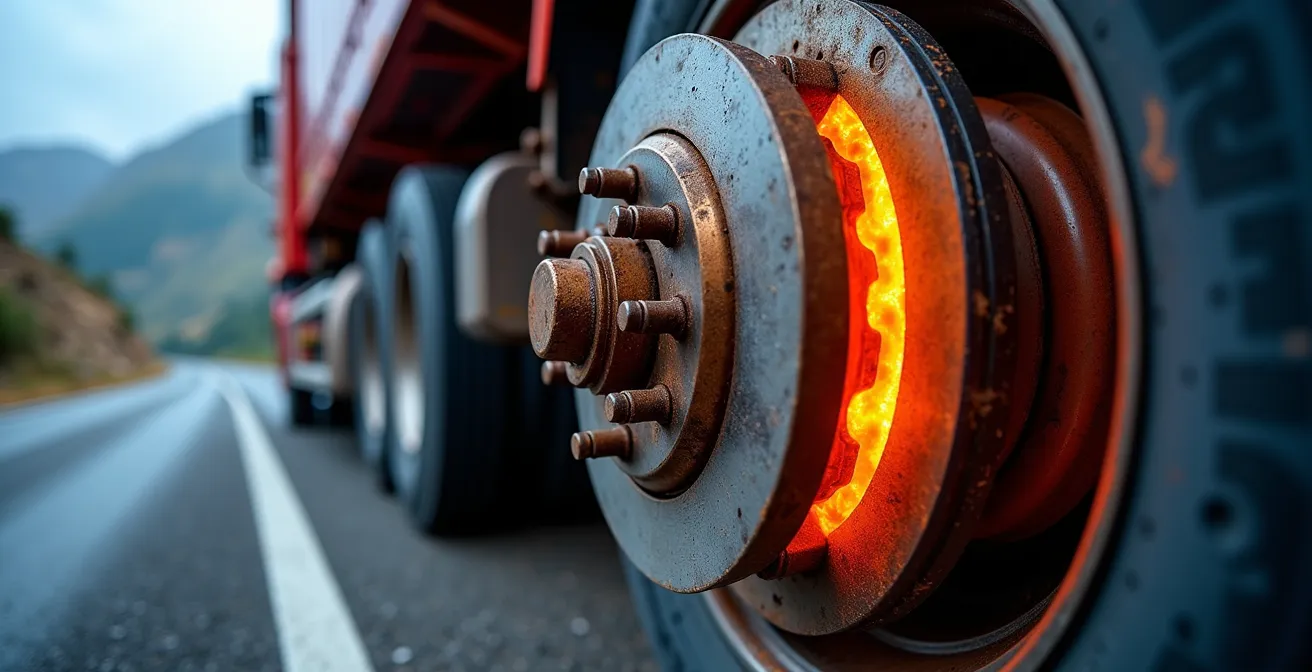
By adopting snub braking, you shift the primary thermal load from your brakes to your engine and transmission, components designed to handle sustained thermal stress far better. You are no longer a passenger holding on; you are actively managing your vehicle’s energy.
Comparing Chains and Snow Tires
Managing energy on descents is only half the battle; the other is maintaining traction, especially in the adverse weather common to high altitudes. The choice between snow tires and chains is not just a matter of preference but of physics and, often, law. Snow tires are made from a softer rubber compound that stays pliable in the cold and feature tread patterns (sipes) designed to bite into snow and ice. They provide a significant advantage over all-season tires in cold conditions.
Chains, however, are a different class of traction device. They are for severe conditions. They physically dig into packed snow and ice, providing a positive mechanical lock where a tire’s friction alone would fail. For a flatlander, it can be hard to grasp how essential these are. To understand their importance, consider the strict regulations for commercial trucks. In states like Colorado, chain laws are not suggestions; they are mandates with heavy fines for non-compliance. In fact, Colorado enforcement data shows over 1,300 chain law citations were issued during a recent winter season, often to drivers who caused major road closures.
The requirements for commercial vehicles, as shown in the table below, illustrate the level of preparation expected. While your personal vehicle may not fall under these exact rules, they serve as an expert benchmark for what severe conditions demand.
| Configuration | Chain Requirement | Alternative Devices |
|---|---|---|
| Straight Trucks | 4 tire chains on drive wheels | 4 AutoSocks, 4 cables (0.415″ dia), auto chains, sanders |
| Single Drive Axle | 4 tire chains (mandatory) | AutoSocks or auto chains only |
| Tandem Drive Axle | 4 tire chains | 4 AutoSocks, 4 cables (0.415″ dia), auto chains, sanders |
For your loaded personal vehicle, the takeaway is clear: snow tires are excellent for general winter readiness, but if you are traveling through high mountain passes during winter months, carrying a set of properly fitting chains is non-negotiable. They are your ultimate safety net when friction is gone.
Preventing Altitude Sickness for the Driver
The mechanical health of your vehicle is paramount, but it is useless if the driver is impaired. High altitude poses a direct physiological threat: Acute Mountain Sickness (AMS). Your body is accustomed to a certain oxygen level. As you ascend rapidly, the air thins, and your body may not adapt quickly enough. The symptoms are often mistaken for a flu or a hangover: headache, nausea, fatigue, and dizziness. These are not just uncomfortable; they are dangerous impairments to your ability to operate a vehicle.
The risk is not trivial. According to the Centers for Disease Control and Prevention (CDC), the danger is real for anyone ascending too quickly. In their guidelines on high-elevation travel, the CDC notes:
AMS affects 25% of all visitors sleeping at elevations >8,000 ft (≈2,450 m) in Colorado
– CDC Yellow Book, High Elevation Travel & Altitude Illness Guidelines
Driving while experiencing AMS significantly increases fatigue and the risk of a drowsy-driving crash. Your judgment is clouded, and your reaction time is slowed—a deadly combination on a winding mountain road. For a driver from sea level, the effects can be pronounced and surprisingly rapid.
Prevention is the only effective strategy. The key is acclimatization. If your itinerary involves a significant gain in elevation, plan a stop for a night at an intermediate altitude (e.g., 5,000-6,000 feet) before proceeding higher. Stay hydrated with water, avoid alcohol and heavy meals, and listen to your body. If you feel the onset of symptoms, do not push higher. Descending a few thousand feet is the most effective cure. Your trip’s schedule is less important than your life.
Optimizing Engine Cooling on Ascents
While descents tax your brakes, ascents put a heavy and sustained load on your engine and cooling system. The first thing a flatlander will notice is a significant loss of power. This is not a sign that your vehicle is broken; it is a direct consequence of physics. The air is less dense at high altitudes, meaning there are fewer oxygen molecules for your engine to burn with each combustion cycle. The result is a predictable drop in performance.
In fact, vehicle performance studies indicate an approximate 3% power loss for every 1,000 feet of altitude gained. At 10,000 feet, your engine may be producing up to 30% less power than it does at sea level. This means you will need to use more throttle for longer periods to maintain speed on a climb, which in turn generates a massive amount of heat.
Your vehicle’s cooling system—the radiator, water pump, and fan—is now working overtime. To help it cope, you must drive proactively. Manually downshifting is crucial. Don’t wait for the automatic transmission to hunt for gears. Select a lower gear that allows the engine to run at a higher, more efficient RPM. This has two benefits: it keeps the engine in its powerband and, critically, it spins the water pump and engine fan faster, increasing coolant flow and airflow through the radiator. You should also monitor your temperature gauge closely during long climbs. If you see the needle creeping up, one of the quickest ways to reduce engine load is to turn off the air conditioning, as the A/C condenser adds significant heat to the radiator.
Identifying Brake Pad Glazing
What happens if you ignore the principles of energy management and ride your brakes down a mountain pass? The immediate danger is brake fade, but even if you “get away with it,” you may have inflicted lasting damage. The extreme temperatures caused by constant friction can lead to a condition called brake pad glazing. This is a form of permanent damage that severely compromises your future braking performance.
When brake pads exceed their maximum operating temperature, the resinous materials that bind the friction material together can melt and liquefy. This molten material gets smeared across the surface of the brake pad and rotor. As it cools, it hardens into a smooth, shiny, glass-like surface. This is glazing. Instead of a rough, high-friction surface, your brake pads now have a polished, low-friction surface. This dramatically reduces their ability to stop the car, sometimes permanently.
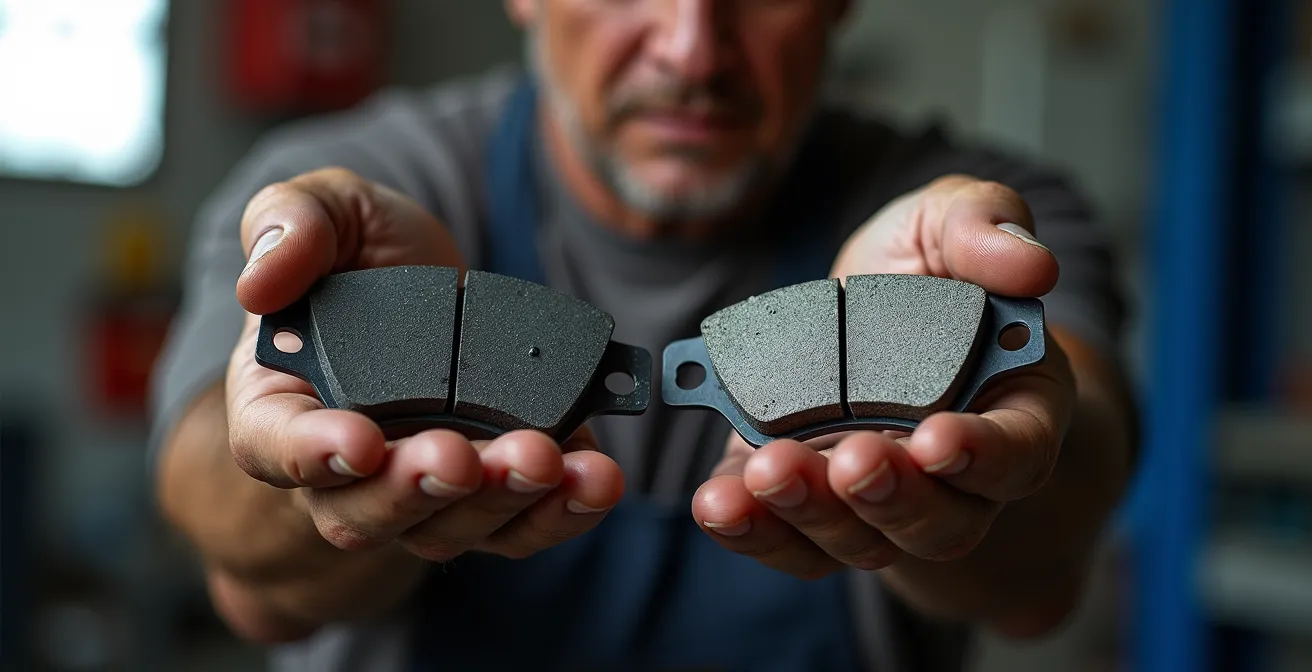
The primary symptom of glazed brakes is a noticeable reduction in braking effectiveness, often accompanied by a high-pitched squeal when you apply the pedal. You’ll find yourself having to press the brake pedal much harder to get the same stopping response you used to. In a severe case, as the case study from Bendix explains, the material left on the rotors essentially “lubricates” the surface, further reducing the friction needed to stop. The only reliable fix for severely glazed pads and rotors is to replace them. It is a costly and entirely preventable consequence of improper mountain driving technique.
Optimizing Fuel Consumption During Altitude Changes
While safety is the top priority, efficiency is also a key component of expert driving. The constant ascents and descents of mountain driving can be brutal on your fuel economy. However, by applying the principle of energy management, you can mitigate this. The key is to master momentum management—using the energy you gain from descents to help you on subsequent climbs.
Instead of braking heavily at the bottom of a hill, look ahead. If a descent is followed by an ascent, ease off the brakes (while still maintaining a safe speed with engine braking) and allow your momentum to carry you as far up the next hill as possible. This requires you to plan your speed adjustments well in advance of grade changes. Every time you use your brakes, you are converting kinetic energy into wasted heat. Every time you use momentum, you are using that same energy for productive work.
This is a technique that professional drivers, especially those in hypermiling competitions or efficiency-focused fleets, have perfected. It involves a heightened state of awareness, constantly scanning the road ahead and anticipating how to use gravity to your advantage rather than fighting it at every turn. For vehicles equipped with them, modern predictive cruise control systems automate this process, using GPS and topographical map data to optimize speed for the terrain ahead.
Action Plan: Momentum Management for Fuel Efficiency
- Anticipate Grade Changes: Plan speed adjustments well before you reach the bottom of a descent or the start of a climb.
- Use Gravity Assist: Allow momentum from descents to help propel your vehicle up the subsequent incline, minimizing throttle input.
- Maintain Smooth Inputs: Avoid aggressive acceleration and braking. Smooth, deliberate control of the accelerator is key to efficiency.
- Select the Optimal Gear: Use a gear that keeps the engine in its most efficient RPM range without laboring or revving excessively.
- Monitor Your Metrics: If your vehicle has a real-time fuel consumption display, use it as a learning tool to see how different techniques affect your efficiency.
Key takeaways
- The core of safe mountain driving is energy management: proactively controlling the conversion of altitude into speed and heat.
- Your brakes are a safety device for stopping, not a tool for controlling speed. Your engine and lower gears are your primary means of descent control.
- High altitude affects both machine and human. Anticipate engine power loss on climbs and be vigilant for the symptoms of altitude sickness in yourself and your passengers.
Planning Efficient Commercial Routes Across Varied U.S. Terrain
Mastering the individual techniques of ascent, descent, and traction is the foundation of safe mountain driving. The final layer is strategic planning. Before you even turn the key, you should have a clear understanding of the route ahead. This means more than just trusting your GPS. It involves looking at the topography of your route, identifying the locations of major mountain passes, and being aware of potential hazards and legal requirements.
For example, knowing that a route includes a pass like Colorado’s Vail Pass (elevation 10,662 ft) with its steep 7% grades should trigger a specific mental checklist: Is my vehicle’s cooling system in good shape? Do I have chains? Have I planned for acclimatization? This level of planning is standard operating procedure in the commercial trucking industry, where efficiency and safety are paramount. States with significant mountain corridors invest heavily in infrastructure to support this, with Colorado DOT data revealing over 130 chain stations statewide to help drivers comply with the law on more than 1,400 miles of highway subject to chain regulations.
For the non-commercial driver, this means using tools like Google Maps’ “Terrain” layer or specialized apps for truckers and RVers to preview elevation changes. It means checking state Department of Transportation websites for road conditions and chain law status before you depart. By planning ahead, you transform from a reactive driver, surprised by every steep grade and sharp curve, into a proactive operator who is prepared for the challenges ahead. You are no longer just driving; you are executing a well-formulated plan.
Your first drive in the mountains doesn’t have to be a trial by fire. By applying these principles of energy management, mechanical sympathy, and proactive planning, you can ensure your journey is not only safe but also enjoyable. The next logical step is to analyze your own planned route using these criteria to build a personalized travel plan.