
An Out-of-Service (OOS) violation is more than a roadside inconvenience; it’s a critical failure in a fleet’s safety and compliance system. This guide moves beyond reactive checklists to establish a proactive, systemic defense against OOS violations. By focusing on the root causes—from flawed documentation architecture and human factors to reactive maintenance—drivers and fleet managers can build a resilient operation that not only passes inspections but fundamentally enhances safety and profitability.
The sight of flashing lights in the rearview mirror is a moment of high anxiety for any commercial driver. The possibility of a DOT inspection raises the stakes, but the ultimate fear is being handed an Out-of-Service (OOS) violation. This isn’t just a ticket; it’s a complete stop to operations, a hit to your CSA score, and a significant financial blow. Many guides simply list common violations like worn tires or broken lights, advising you to “check them.” This approach treats symptoms, not the underlying disease.
The reality is that most OOS violations are not the result of a single, sudden failure but the predictable outcome of a breakdown in your operational systems. If your maintenance is purely reactive, your documentation is disorganized, or your drivers are not empowered with the right tools and training, you are systematically vulnerable. This article rejects the simple checklist in favor of a more robust framework. We will explore the root causes of compliance failures and build a systemic defense against them.
The true key to staying on the road is not just about fixing what’s broken, but about building an operation where failures are predicted and prevented. We will shift the focus from a fear of inspection to a confidence in process. This guide provides the strategic principles to build that confidence, section by section.
For those who prefer a hands-on demonstration, the following video provides a thorough walkthrough of a Class A pre-trip inspection, a critical component of any compliance strategy. It visualizes many of the key inspection points discussed in this guide.
To navigate this systemic approach effectively, this article is structured to build your defense layer by layer, from understanding the core criteria to implementing proactive maintenance strategies. The following summary outlines the key areas we will cover.
Summary: A Systematic Framework for DOT Inspection Mastery
- Understanding Out-of-Service Criteria
- The Documentation Error
- Optimizing the Pre-Trip Inspection
- Comparing Annual and Roadside Inspections
- Planning Corrective Maintenance
- Understanding Gross Vehicle Weight Rating (PTRA)
- Understanding Circadian Rhythms While Driving
- Structuring Preventive Maintenance to Reduce Downtime
Understanding Out-of-Service Criteria
An Out-of-Service (OOS) violation is the FMCSA’s most severe penalty during a roadside inspection, mandating that the vehicle or driver cease operation until the critical defect is corrected. These are not minor infractions; they represent conditions deemed to pose an imminent hazard to public safety. The most common triggers for vehicle OOS orders involve the holy trinity of mechanical failure: brake systems, tires and wheels, and lighting. For drivers, violations of Hours of Service (HOS) rules are the quickest path to being placed out of service.
Understanding these criteria is the first step in building a systemic defense. It’s not enough to know that “bad brakes” are a problem; you must understand that specific issues like an out-of-adjustment brake on 20% of a vehicle’s wheel ends or an audible air leak will trigger an immediate OOS order. The financial consequences extend far beyond the immediate repair. Violations lead to significant downtime, costly recovery services, and a direct impact on your company’s CSA (Compliance, Safety, Accountability) score, which can increase insurance premiums and reduce customer confidence.
The financial stakes are severe and escalating. According to 2024 DOT penalty updates, some record-keeping violations can result in a maximum civil penalty of up to $23,048. This figure doesn’t even account for the lost revenue from the immobilized truck. Therefore, treating OOS criteria as a high-level strategic risk, rather than a simple maintenance checklist, is essential for survival and profitability in the trucking industry.
The Documentation Error
While mechanical failures are visible, some of the most catastrophic OOS violations are silent and live only on paper or in a digital file. Documentation errors represent a systemic failure in a fleet’s operational backbone. An officer who finds a pristine truck but discovers falsified logs or missing maintenance records can still place the vehicle and driver out of service. This is because accurate documentation is the primary evidence that a carrier is operating safely and in compliance with federal regulations. It’s not just paperwork; it is the architecture of your compliance.
Common documentation errors that trigger violations include incomplete or missing Driver Vehicle Inspection Reports (DVIRs), inaccurate or falsified HOS logs, and failure to maintain comprehensive vehicle maintenance files. The transition to Electronic Logging Devices (ELDs) has reduced some errors but has also created new pitfalls, such as failing to handle unassigned driving time or improper edits to a driver’s log. These are not clerical mistakes; they are seen by regulators as potential attempts to conceal non-compliance, such as driving over hours to meet a deadline.
Building a robust documentation architecture involves more than just filling out forms. It requires integrated digital systems, automated checks and balances, and regular audits to ensure 100% accuracy. The goal is a zero-error system where compliance is a verifiable, continuously updated record, not an afterthought.

This organized data flow visualizes the ideal state: a system where information is accurate, accessible, and defensible during an inspection. The following table breaks down the severe financial penalties associated with common documentation violations, underscoring the importance of a flawless system.
| Violation Type | 2024 Fine Range | Prevention Method |
|---|---|---|
| Falsification of driver logs | $2,304-$13,000+ | ELD integration with real-time validation |
| Missing Clearinghouse queries | $6,974 | Automated query scheduling |
| Incomplete maintenance records | $1,100-$11,000 | Digital DVIR with mandatory fields |
Optimizing the Pre-Trip Inspection
The pre-trip inspection, or “ronde de sécurité,” is the single most effective tool a driver has to prevent an OOS violation. It is the first and last line of defense against mechanical failures on the road. However, its effectiveness is entirely dependent on its quality. A rushed or “pencil-whipped” inspection is worse than useless; it creates a false sense of security while leaving critical safety defects undiscovered. The goal is not merely to complete the inspection but to optimize it for maximum defect detection in a reasonable timeframe.
An effective pre-trip inspection is a systematic, repeatable process, not a casual walk-around. Experienced drivers can often perform a comprehensive DOT-level inspection efficiently, focusing on the high-risk components most likely to trigger an OOS violation. This includes checking brake pushrod travel, listening for air leaks, inspecting tire sidewalls and tread depth, verifying all required lights and reflectors are functional, and ensuring emergency equipment is present and accessible. The key is to transform the inspection from a regulatory chore into a professional habit rooted in a deep understanding of what inspectors are trained to find.
Technology can play a crucial role in this optimization. Digital DVIR apps can guide drivers through a standardized workflow, require photographic evidence of certain checks, and create an immediate, time-stamped record of the inspection. This not only ensures consistency but also provides the fleet manager with real-time visibility into the vehicle’s condition before it ever leaves the yard, creating a powerful layer of proactive mitigation.
Comparing Annual and Roadside Inspections
Not all inspections are created equal. Understanding the difference between a planned annual inspection and a random roadside inspection is crucial for developing a comprehensive compliance strategy. While they often check for similar defects, their purpose, scope, and context are fundamentally different. A fleet that prepares for both has built a truly resilient safety system.
The annual (or periodic) inspection is a planned, in-depth examination that every commercial motor vehicle must undergo. According to FMCSA regulations, this is a mandatory periodic inspection every 12 months. It covers the vehicle from top to bottom and is designed to certify its roadworthiness for the coming year. This is a proactive, scheduled event that should be viewed as an opportunity to perform a deep-dive diagnostic on the vehicle’s health and address any developing issues before they become critical.
The roadside inspection, by contrast, is a reactive, unannounced spot-check performed by law enforcement. Its primary goal is to identify and remove imminently hazardous vehicles from the road. There are several levels of roadside inspections, each with a different focus:
- Level I – North American Standard: The most comprehensive and common inspection, covering both the driver and the vehicle in detail.
- Level II – Walk-Around: A visual inspection of the driver and vehicle without the officer going underneath the truck.
- Level III – Driver-Only: Focuses exclusively on the driver’s credentials, HOS logs, and other documentation.
- Level IV – Special Inspections: A one-time examination of a particular feature, often as part of a research study or data collection effort.
- Level V – Vehicle-Only: An inspection of the vehicle without a driver present, typically conducted at a carrier’s terminal.
- Level VI – Enhanced for Radioactive: A specialized inspection for vehicles transporting certain classes of radioactive materials.
A successful compliance strategy uses the annual inspection to *prevent* the failures that a roadside inspection is designed to *catch*. A clean annual inspection report is not the end of the process; it is the baseline for a year of continuous diligence.
Planning Corrective Maintenance
When a defect is found during a pre-trip inspection or, worse, a roadside stop, the clock starts ticking. The speed and effectiveness of the maintenance response are critical. However, not all defects carry the same weight. A burnt-out clearance light is an issue to be fixed, but a cracked brake drum is a crisis. A world-class compliance program doesn’t just fix things; it has a pre-defined system for triaging defects and planning corrective maintenance based on severity.
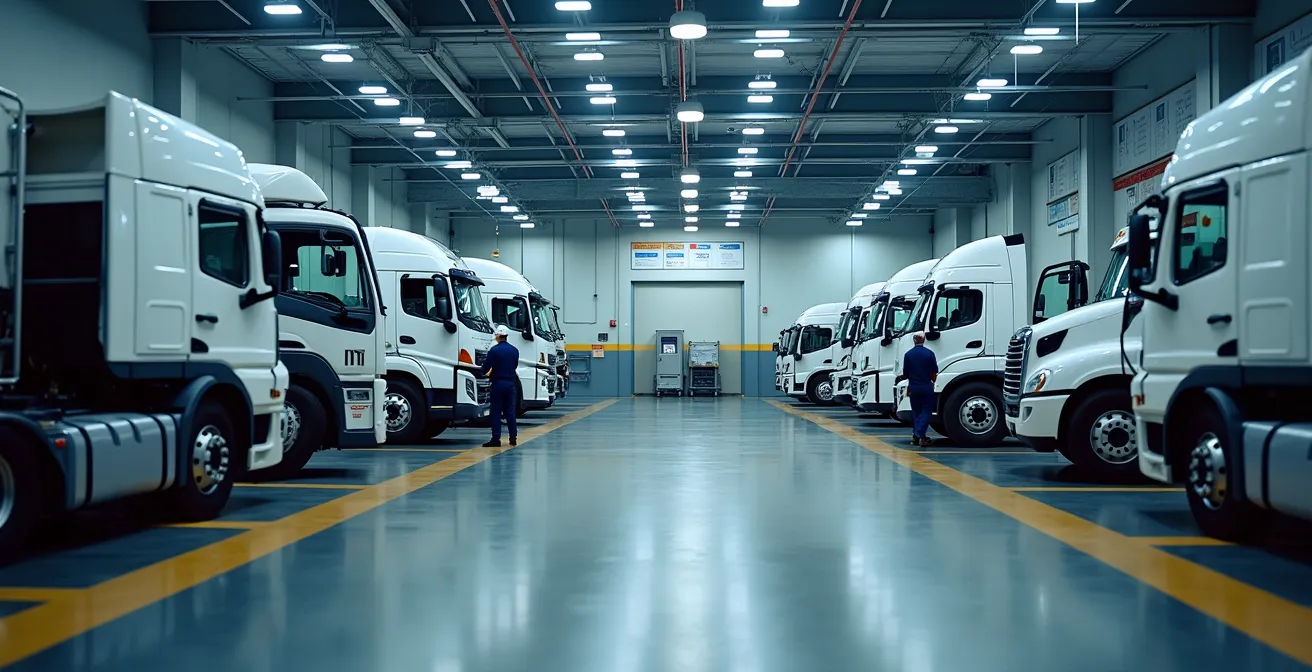
This system, often called a maintenance triage, categorizes issues into priority levels to ensure that the most critical safety defects are addressed immediately. This prevents a minor reported issue from escalating into a catastrophic failure or an OOS violation. A well-structured triage system removes ambiguity and empowers both drivers and technicians to make the right call under pressure. It provides clear guidance on whether a truck can continue its run, must return to the terminal, or must be parked immediately.

An organized maintenance facility, as shown above, is the physical manifestation of a well-planned triage system. Different bays can be dedicated to different priority levels, ensuring that a truck with a critical safety issue isn’t waiting behind one with a routine repair. The following table provides a model for how to categorize maintenance issues to ensure a rapid and appropriate response.
| Priority Level | Response Time | Example Issues | Cost Impact |
|---|---|---|---|
| Safety-Critical | Immediate/Park | Brake failure, steering defects | $5,000-$10,000+ downtime |
| Urgent | Within 24 hours | Tire wear approaching limit | $1,000-$3,000 if delayed |
| Routine | Next PM cycle | Minor fluid leaks, worn belts | $200-$500 preventive |
Understanding Gross Vehicle Weight Rating (PTRA)
Among the core tenets of vehicle compliance, few are as fundamental as weight. The Gross Vehicle Weight Rating (GVWR) is the maximum operating weight for a vehicle as specified by the manufacturer. This includes the chassis, body, engine, fuel, accessories, driver, and cargo. Exceeding the GVWR, or the individual axle weight ratings, is a serious violation that can lead to fines, OOS orders, and accelerated wear on the vehicle’s components, particularly the brakes and suspension.
Inspectors view an overweight vehicle as a significant safety risk. The vehicle’s braking system and structural components are engineered to perform up to the specified GVWR. Operating beyond that limit can compromise braking distance, increase the risk of tire failure, and cause instability, especially during emergency maneuvers. It is not merely a paperwork violation; it is a direct compromise of the vehicle’s designed safety parameters.
Compliance requires a systemic approach to load planning. It involves knowing the empty weight of the truck and trailer, understanding the weight distribution of the cargo, and using certified scales to confirm the total gross weight and individual axle weights before heading out. For fleets hauling variable loads, this process must be repeated for every dispatch. Ignoring weight compliance in favor of maximizing payload is a short-term gamble that inevitably leads to long-term costs in fines, repairs, and liability.
Understanding Circadian Rhythms While Driving
The most perfectly maintained truck is still a danger on the road if the driver behind the wheel is impaired. While much of the focus on driver fitness is on substance use, the most pervasive and insidious impairment is fatigue. Hours of Service regulations are designed to provide an opportunity for rest, but they cannot manage the quality of that rest. Understanding the impact of circadian rhythms—the body’s natural 24-hour sleep-wake cycle—is the next frontier in driver safety and compliance.
The human body is hard-wired to be less alert during certain periods, most notably the post-lunch dip (around 2-4 PM) and the deep overnight window (around 2-4 AM). During these “circadian lows,” cognitive function, reaction time, and vigilance decrease significantly, even in a driver who has had adequate sleep. A fatigued driver is more likely to make critical errors, from drifting out of their lane to failing to notice a developing mechanical issue during a pre-trip inspection. As the FMCSA notes, fatigue is a direct contributor to compliance failures. The FMCSA Safety Analysis states in its 2024 Hours of Service Compliance Report:
Driver fatigue leads to a measurable decrease in the quality and thoroughness of pre-trip inspections, creating a direct link to compliance violations.
– FMCSA Safety Analysis, 2024 Hours of Service Compliance Report
A truly proactive safety program integrates human factors into its systemic defense. This means educating drivers about sleep hygiene, scheduling routes to avoid driving during circadian lows where possible, and fostering a culture where drivers feel empowered to report fatigue without fear of punishment. It reframes fatigue not as a personal failing but as a manageable operational risk.
Your Action Plan: Building a Fatigue Risk Management System
- Self-Assessment: Implement driver fatigue self-assessment tools to be completed before each shift begins.
- Reporting Policy: Establish a clear, non-punitive fatigue reporting policy that encourages drivers to speak up when they are unfit to drive.
- Strategic Scheduling: Schedule safety-critical tasks like detailed inspections or hazardous material loading outside of the 2-4 AM circadian low periods.
- Education: Provide regular sleep hygiene and fatigue awareness education during driver safety meetings and in company communications.
- Data Monitoring: Monitor HOS and telematics data for patterns (e.g., frequent driving during low-alertness periods) that indicate heightened fatigue risk.
Key Takeaways
- OOS violations are symptoms of systemic failures in maintenance, documentation, or human factors management.
- A proactive defense focuses on preventing failures through robust systems, not just reacting to defects found during inspections.
- Documentation is a critical safety architecture, and its failure can be as severe as a mechanical breakdown.
Structuring Preventive Maintenance to Reduce Downtime
The ultimate goal of a world-class fleet operation is to move beyond corrective and even preventive maintenance and into the realm of predictive maintenance. The journey begins by shifting the entire maintenance philosophy from “fix it when it breaks” to “prevent it from ever breaking.” A structured preventive maintenance (PM) program is the foundation of this shift. It is the most powerful systemic tool for reducing downtime, controlling costs, and ensuring you pass every inspection with confidence.
A traditional PM program services vehicles based on fixed intervals of mileage or time. While this is a vast improvement over a reactive approach, modern telematics allows for a more intelligent, condition-based strategy. Instead of changing the oil every 15,000 miles, you change it when sensors indicate the oil’s viscosity has degraded. This data-driven approach ensures components are replaced based on actual wear and tear, optimizing component life without compromising safety.
This proactive stance transforms maintenance from a cost center into a strategic advantage. It reduces unexpected roadside breakdowns, which are exponentially more expensive than scheduled shop repairs. It also creates a comprehensive and defensible maintenance record that demonstrates a profound commitment to safety to both regulators and customers.
Case Study: The Shift to Condition-Based Maintenance
A fleet documented by Telematics.com made the transition from a standard mileage-based PM schedule to a condition-based system driven by telematics data. By analyzing real-time engine conditions, the company was able to extend oil change intervals significantly without increasing risk. This single systemic change resulted in savings of approximately $15,000 per vehicle annually in reduced servicing costs and increased uptime, all while maintaining or even improving overall vehicle reliability.
To transform your fleet’s safety and compliance record, the next logical step is to implement these systematic checks and maintenance protocols. Begin today by auditing your current processes against these expert benchmarks.
Frequently Asked Questions on Ensuring DOT Compliance
Is a pre-trip inspection mandatory under DOT regulations?
Yes, the FMCSA requires all commercial motor vehicle drivers to inspect their vehicles before each trip. This inspection must be documented, and the report must be signed by the driver.
What happens if drivers skip pre-trip inspections?
Failure to perform and document a pre-trip inspection is a violation in itself. More importantly, skipping inspections dramatically increases the risk of being placed out of service for a defect that would have otherwise been caught and corrected at the yard.
Can technology help streamline the inspection process?
Absolutely. Modern digital inspection apps (eDVIRs) guide drivers through a consistent and thorough process. They can require photo documentation for key components and create an instant, auditable record, effectively eliminating the problem of “pencil-whipping” and providing real-time fleet visibility.