
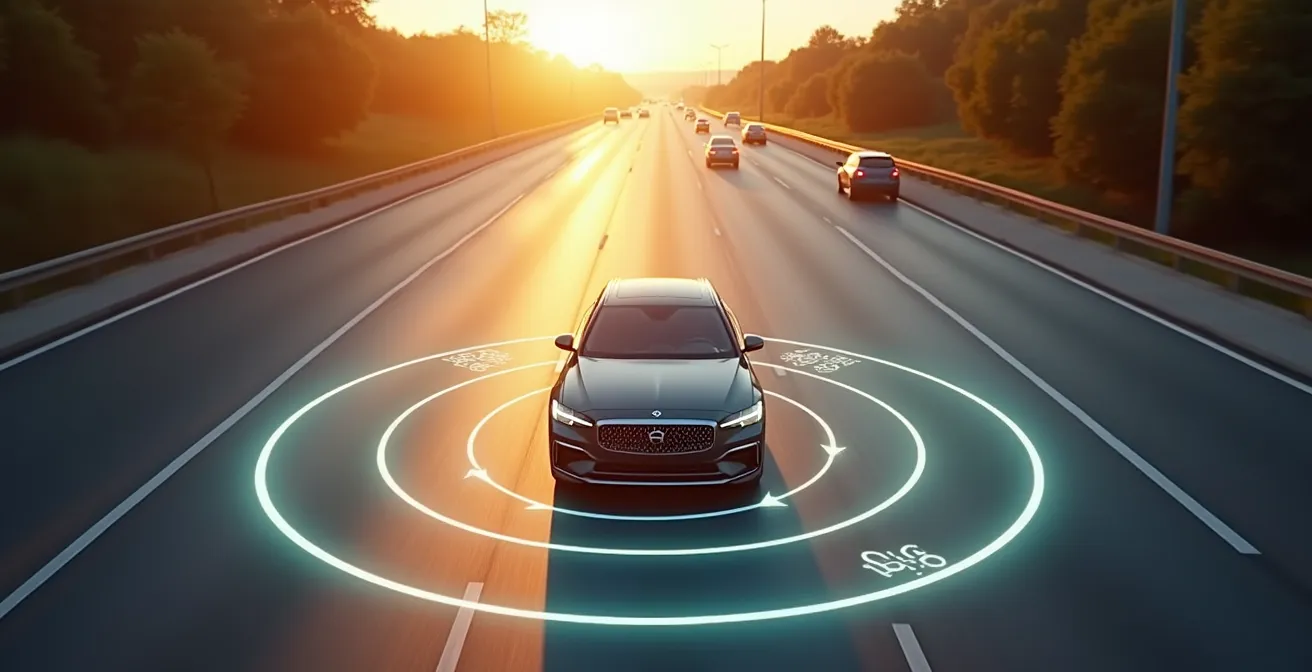
True road survival is not about following traffic laws, but mastering a mental discipline that lets you anticipate and neutralize the mistakes of other drivers before they happen.
- Proactive driving involves actively scanning 12-15 seconds ahead and running constant ‘what-if’ scenarios, turning you into a road strategist.
- Your brain’s “attentional budget” is finite; managing it is more critical than simply avoiding distractions, especially on long drives.
Recommendation: Shift your mindset from being a passive participant in traffic to an active controller of your own safety zone. This guide teaches you how.
The feeling is familiar to any new or cautious driver: a knot in the stomach when merging onto a busy highway, the spike of adrenaline when a car brakes suddenly, the pervasive sense that you are merely a passive object at the mercy of countless other drivers. Most driving advice centers on a set of rigid rules: maintain your speed, use your signals, check your blind spots. While essential, these rules only teach you how to operate your vehicle correctly; they do not teach you how to survive the unpredictable actions of others.
The common approach to safety is reactive. It waits for a threat to appear and then hopes for a quick enough response. But what if the key to genuine safety wasn’t faster reflexes, but superior prediction? What if you could learn to see the accident before it even begins to form? This is the core of proactive driving—a mental skill set that transforms you from a potential victim of circumstance into the master of your immediate environment. It’s about understanding the psychology of other drivers, the physics of your vehicle, and the geometry of the road.
This guide is not another list of traffic regulations. It is a masterclass in cognitive road strategy. We will deconstruct the mental processes that separate expert drivers from the rest. You will learn to manage your space not as a rule, but as a dynamic buffer. You will train your eyes to see what others miss. And you will develop the mental frameworks to plan for emergencies, manage fatigue, and ultimately, drive with a profound sense of control and confidence.
To help you navigate these advanced concepts, this article is structured to build your skills progressively. Below, the table of contents outlines the key mental models and practical techniques we will cover to transform your approach to driving.
Table of contents: Mastering the Road: How to Predict and Neutralize the Errors of Other Drivers
- Comprendre le coussin d’espace
- L’erreur de fixation du regard
- Optimiser la visibilité aux intersections
- Comparer la conduite proactive et réactive
- Planifier la sortie de secours
- Planifier les étapes de conduite pour éviter la fatigue
- Comprendre le temps de réaction
- Gérer les urgences routières pour garantir la sécurité des passagers
Comprendre le coussin d’espace
The most fundamental element of control on the road is space. A “space cushion” is not merely the gap in front of you; it is a 360-degree buffer zone that you actively manage. Most drivers think of following distance as a static rule, but a master driver treats it as a dynamic and non-negotiable safety asset. This cushion is your time to think, plan, and act. Without it, you are permanently in a reactive mode, vulnerable to the slightest error from another driver.
The universally taught “three-second rule” is the absolute minimum baseline for perfect conditions. To execute it properly, watch the vehicle ahead pass a fixed object like a sign or a shadow on the road, then count “one-one-thousand, two-one-thousand, three-one-thousand.” If you reach the object before finishing the count, you are too close. However, mastery lies in knowing when to expand this cushion. Every imperfect condition—rain, heavy traffic, fatigue, or a tailgater behind you—demands adding at least one additional second. When being tailgated, the most crucial adjustment is to increase your forward cushion significantly. This gives you the tailgater’s reaction time as well as your own, allowing you to brake more gently and avoid being hit from behind.
Managing your space cushion effectively also means using micro-adjustments. Instead of constantly tapping the brakes when a car cuts into your space, a proactive driver simply eases off the accelerator to re-establish the gap. This creates a smoother, safer, and more fuel-efficient driving experience. In fact, proficient space cushion management is not just a safety feature; research on commercial fleet operations demonstrates that average fuel efficiency improved by 15-20% as a direct result of smoother acceleration and braking patterns.
L’erreur de fixation du regard
Where you look is where you will go. This is an immutable law of motor control known as target fixation. In a moment of panic, an untrained driver’s eyes will lock onto the threat—the deer in the road, the swerving car—and they will inevitably steer directly into it. A master driver overcomes this instinct by training their vision to be active, not passive. This means consciously directing your gaze far down the road, toward your intended path or escape route, rather than at the immediate hazard.
This requires a structured approach to visual scanning. Instead of a random glance, a proactive driver processes the road in a hierarchy: far, mid, and near. Your primary focus should be 12 to 15 seconds ahead of your vehicle, on the horizon. This is where you identify potential strategic threats: a traffic jam forming, a truck preparing to merge, or a cloud of brake lights. The mid-ground is your tactical area, where you assess the positioning and speed of cars immediately around you. The near-ground is for immediate hazard response. By keeping your eyes moving constantly between these zones, you prevent fixation and build a complete mental picture of the traffic environment.
This illustration demonstrates the ideal visual scanning pattern, with attention distributed from the strategic horizon to the immediate tactical surroundings.
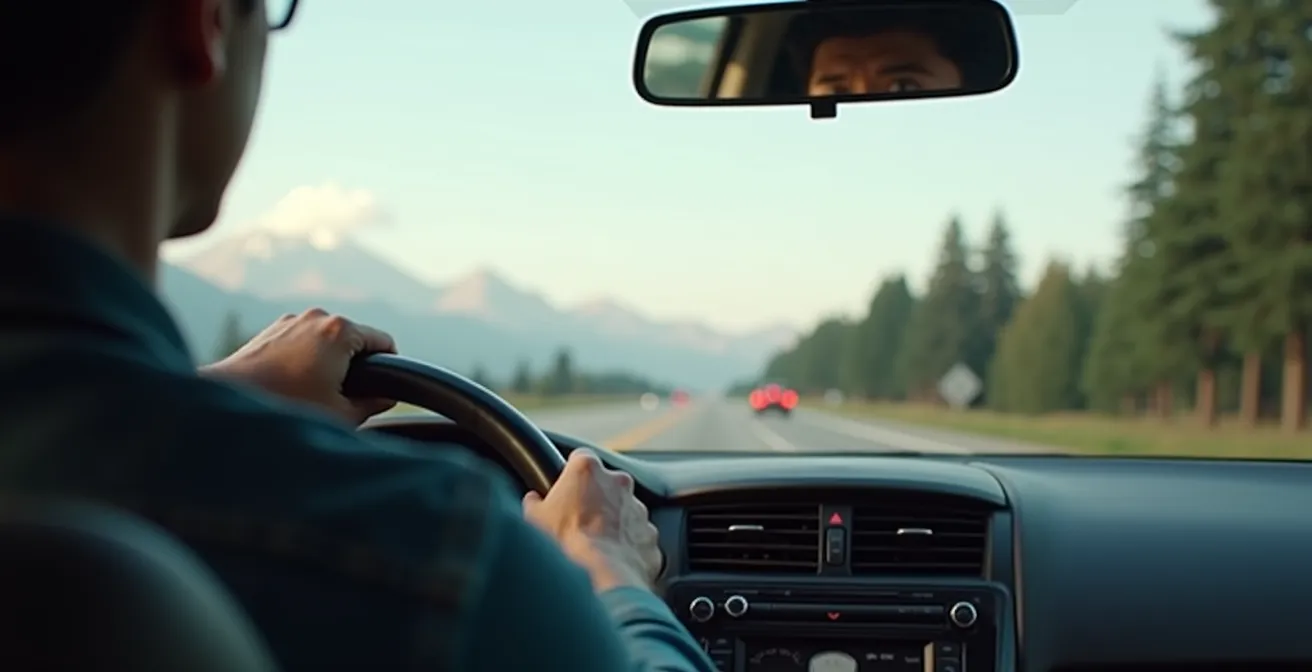
As the image shows, the driver’s focus is pulled forward, allowing peripheral vision to handle the immediate environment while the conscious mind analyzes the road far ahead. A proven method to develop this skill is “commentary driving.”
Case Study: The Commentary Driving Training Method
The Smith Space Cushion System, developed in the 1940s, introduced a revolutionary training technique called “commentary driving.” Instructors taught drivers to verbalize their entire visual process aloud: “Okay, red car ahead braking, motorcyclist on the right, clear lane to my left, green light stale.” This practice, detailed in modern courses like the SPOC3 method, forces the brain to remain actively engaged. It makes it nearly impossible to fall into target fixation, as you are continuously identifying multiple points of interest, potential hazards, and escape routes, training your mind to see the whole picture, not just a single threat.
Optimiser la visibilité aux intersections
Intersections are the most dangerous environments you will navigate. They are chaotic convergence points of vehicles, pedestrians, and cyclists, often with obstructed views. It is no surprise that 40% of all crashes occur at intersections. A master driver approaches every intersection not as a simple “stop and go” situation, but as a complex problem to be solved with a strict, repeatable protocol. The goal is to see and be seen, and to assume others will make a mistake.
The most common error at intersections is proceeding the instant a light turns green. A proactive driver never does this. Instead, they pause for one to two seconds and look left, right, and then left again. This simple pause is your defense against red-light runners, who are the cause of a significant number of severe T-bone collisions. When your view is obstructed by other vehicles or buildings, you must employ the “creeping and peeking” technique. This involves inching the car forward slowly, just enough to gain a clear line of sight around the obstruction before committing to the turn or crossing.
Establishing visibility is a two-way street. You must not only see but also make sure you are seen. This involves making deliberate eye contact with other drivers and pedestrians. A simple nod or hand gesture confirms they have seen you and understand your intentions. This act of non-verbal communication can prevent countless misunderstandings. When waiting to turn left, positioning your wheels straight until you are ready to move is a critical safety habit. If you are rear-ended while your wheels are turned, you will be pushed into oncoming traffic; if they are straight, you will be pushed forward, which is often a much safer outcome.
Comparer la conduite proactive et réactive
The difference between a safe driver and a dangerous one is not their skill with the pedals, but the quality of their thinking. Driving can be broken down into two opposing mindsets: reactive and proactive. The reactive driver operates in the present. They respond to hazards only as they appear, often with panic and abrupt maneuvers. The proactive driver, in contrast, lives in the future. They are constantly scanning, predicting, and running “what-if” scenarios to pre-plan their actions long before a hazard becomes critical.
A reactive driver’s scan is short, focused only on the car directly ahead. Their mind is passive, simply processing the immediate view. A proactive driver’s scan extends 12-15 seconds down the road, providing ample time to identify developing situations. Their mind is an active simulator, asking questions like: “What if that car pulls out without looking? What if the truck ahead loses a piece of its load? Where is my escape route?” This mental process is the foundation of situational awareness, which involves not just perceiving the environment, but comprehending its meaning and projecting future possibilities.
Because they have already considered various outcomes, the proactive driver has pre-loaded response plans. When a hazard appears, their decision is not a panic-driven reaction but the execution of a pre-determined maneuver. This dramatically reduces the time and mental load required to act, resulting in smoother, more decisive, and safer outcomes.
This comparative table breaks down the fundamental differences between these two driving philosophies, as outlined in advanced defensive driving guides.
| Aspect | Proactive Driver | Reactive Driver |
|---|---|---|
| Scanning Distance | 12-15 seconds ahead | 3-5 seconds ahead |
| Mental Process | Constantly running ‘What-If’ scenarios | Responding only to immediate threats |
| Space Management | Maintains flexible safety cushion | Minimal following distance |
| Situational Awareness | Perception, Comprehension, Projection | Perception only |
| Decision Time | Pre-loaded response plans | Panic-driven reactions |
Planifier la sortie de secours
A core tenet of proactive driving is to always have an out. An escape route is an open space—a clear adjacent lane, the shoulder of the road, a gap between cars—that you can move into to avoid a collision. The master driver maintains a constantly updated mental map of these escape options. This isn’t a one-time check; it’s a continuous process of identifying and evaluating open spaces around the vehicle at all times. You should always be able to answer the question: “If the car in front of me slams on its brakes right now, where will I go?”
This mental map is built through the “what-if” scenarios mentioned earlier. As you enter a new road segment, like a tight curve or a busy merge area, you should pre-load your primary escape plan. This plan must also factor in your vehicle’s dynamics. An SUV requires significantly more space to swerve and recover than a small sports car. Similarly, road conditions are a critical variable. A safe escape maneuver on dry pavement may be impossible on a wet or icy road, where your required stopping and maneuvering distance can increase by a factor of two to ten.
The illustration below visualizes this concept. The highlighted paths are not just empty spaces; they are pre-identified, viable escape routes that the driver has mentally cataloged.

As shown, the proactive driver sees the road as a chessboard, with multiple potential moves available at any given moment. They are not trapped in their lane; they are commanding a mobile safety zone with multiple exits. This requires a constant, conscious effort. You must train your eyes to not just look for threats, but to actively search for zones of safety. By always having an escape plan, you give yourself an alternative to collision, transforming a potential disaster into a controlled, evasive maneuver.
Planifier les étapes de conduite pour éviter la fatigue
All the proactive skills in the world are useless if the mind operating them is compromised. Driver fatigue is not just about falling asleep at the wheel; it’s a far more insidious degradation of your cognitive abilities. As you become tired, your brain’s capacity for complex thought diminishes. This is your attentional budget—a finite resource that gets depleted during a long drive. When this budget is low, your mind starts to shed non-essential tasks, and the first to go are the predictive, “what-if” functions of proactive driving.
The result is a dangerous phenomenon known as cognitive tunneling. Your visual scan narrows, your situational awareness collapses, and you become a purely reactive driver, focusing only on maintaining lane position and following the car ahead. You may be awake, but you are not truly “driving”; you are merely operating the machinery. This is the state in which predictable hazards become unavoidable emergencies because your brain has lost the ability to see them coming.
To combat this, you must plan your drives in stages, especially on long trips. A good rule is to take a 15-minute break for every two hours of driving. This is not a suggestion; it is a critical safety requirement to replenish your attentional budget. During this break, get out of the car, stretch, and focus your eyes on distant objects to combat visual fatigue. Planning your route to include these mandatory stops is as important as planning for fuel.
Research: The Attentional Budget Framework
A study published in the National Library of Medicine tracked driver performance and reaction times during extended driving sessions. The research found that driver reaction time began to increase significantly after the onset of fatigue. A key finding was that maximum reaction time was reached after 117 minutes of continuous driving. This data strongly supports the “two-hour rule,” demonstrating that cognitive performance, particularly for predictive tasks, measurably degrades after this period, leading to dangerous cognitive tunneling.
Comprendre le temps de réaction
Why is a large space cushion so non-negotiable? The answer lies in the unchangeable physics of human response. Total stopping distance is a combination of your reaction distance and your vehicle’s braking distance. While better brakes can shorten the latter, your reaction time is a complex cognitive process that is far slower than most people assume. It is not instantaneous. In fact, for many drivers, it’s a dangerously long interval.
Your total reaction time, often called Perception-Reaction Time (PRT), is made up of three distinct phases. First is Perception Time: the moment it takes for your eyes to see a hazard and your brain to recognize it as a threat. Second is Decision Time: the mental processing required to choose a course of action (e.g., brake, swerve left, swerve right). Third is Action Time: the physical time it takes for your brain’s command to travel to your foot and for your foot to move to the brake pedal. While action time is relatively quick, perception and decision time can be surprisingly long, especially if you are fatigued or distracted.
Many theoretical models use a 1.0-second reaction time, but real-world data paints a different picture. Even professional drivers are not immune to these cognitive delays. In fact, statistical analysis reveals that professional drivers’ mean reaction time is often significantly higher than the theoretical constant, underscoring that no amount of experience can defy human biology. The only way to compensate for this built-in delay is with space and time—the very cushions you create through proactive driving.
The following table, based on data from driver research institutes, breaks down the components of reaction time, showing which parts can be improved through training.
| Component | Description | Typical Duration | Can Be Improved? |
|---|---|---|---|
| Perception Time | Time to notice the hazard | 0.3-0.7 seconds | Yes – through scanning techniques |
| Decision Time | Time to choose response | 0.5-1.2 seconds | Yes – through pre-planning |
| Action Time | Physical movement time | 0.2-0.3 seconds | No – largely fixed |
| Total PRT Range | Complete response cycle | 1.0-2.2 seconds | Partially |
Key takeaways
- Mastering road safety is a mental skill based on prediction, not just a list of rules to follow.
- Your primary tools are a dynamic space cushion, active visual scanning 12-15 seconds ahead, and a constantly updated mental map of escape routes.
- Overcoming cognitive biases like target fixation and managing your “attentional budget” to prevent fatigue are as crucial as any physical maneuver.
Gérer les urgences routières pour garantir la sécurité des passagers
Even with the best proactive skills, close calls and emergencies can happen. The difference between a master driver and an average one is what happens *after* the event. For most, a near-miss is a fleeting moment of terror, quickly forgotten. For a master, it is a priceless learning opportunity. The goal is not just to survive an emergency, but to deconstruct it, understand its causes, and create a new mental rule to prevent it from ever happening again.
This requires a conscious process of debriefing. As soon as it is safe to do so, pull over and analyze the event. Ask yourself: What cues did I miss? How could my positioning have given me more options? Was I a victim of someone else’s mistake, or did my own passive driving contribute to the situation? This honest self-assessment is the crucible in which true expertise is forged. It turns a negative experience into a permanent upgrade in your mental software.
Case Study: The Strategic Emergency Stopping Decision Framework
Advanced Collision Avoidance Training programs teach a counter-intuitive but vital concept: the safest action in an emergency is not always to stop immediately. Stopping in a high-risk area—like the middle of a multi-lane highway or just over a blind crest—can create a secondary, more dangerous collision. Strategic stopping may involve continuing to drive a short distance to a safer location, like the shoulder or an exit ramp, even with a flat tire or other issue. This decision requires a deep understanding of vehicle dynamics and a calm, pre-planned response, reinforcing the idea that every action in an emergency should be a deliberate choice, not a panic reaction.
This final step—learning from your experiences—is what completes the cycle of mastery. It ensures that every mile driven makes you a safer, more competent, and more confident driver. The following checklist provides a framework for this critical debriefing process.
Your Action Plan: The Close Call Debrief Checklist
- Immediately after a near-miss, find a safe place to pull over and calm your nerves.
- Ask yourself: ‘What subtle cues did I miss that could have warned me of this situation earlier?’
- Analyze your position: ‘How could my lane choice or space cushion have been better to offer more options?’
- Establish a new rule: ‘Based on this, what will be my new personal policy for similar situations going forward?’
- Document the incident: Briefly write down or mentally rehearse what happened and what you learned to reinforce the new rule.
The journey to becoming a master driver doesn’t end here. Every trip is a training session. Use the principles in this guide not as a checklist to be memorized, but as a mental framework to be practiced. Start today by actively analyzing one traffic situation on your drive, and turn every commute into your own personal masterclass.