

A wheel alignment is not a maintenance expense; it’s the single most effective strategy for protecting your tire investment and preserving your vehicle’s systemic integrity.
- Ignoring minor misalignment creates a “geometric liability” that can slash tire life by over 25% and increase fuel consumption.
- Performing an alignment on worn suspension components is a false economy that guarantees premature tire failure.
Recommendation: Treat your next alignment as a diagnostic health check. Demand a before-and-after printout and ensure all underlying suspension issues are addressed first to secure the full value of your tires.
That sinking feeling is all too familiar for many drivers: a routine service visit reveals your relatively new tires are already worn out, with uneven, feathered edges. The diagnosis is almost always a bad wheel alignment. You’re left with a hefty bill for new tires and the alignment service itself, feeling like you’ve just thrown money away. The common advice is to simply “get an alignment with new tires,” but this superficial guidance fails to address the core of the problem. It treats alignment as a reactive chore rather than a proactive financial and safety measure.
The reality is that your vehicle’s wheels are subject to a constant battle of physical forces. Every pothole, curb, and aggressive turn conspires to push them out of their optimal orientation. But what if the key to breaking this cycle of premature wear wasn’t just about correcting the angles, but about understanding alignment as an active investment strategy? What if the alignment report itself was one of the most valuable diagnostic tools at your disposal, capable of revealing the hidden health of your entire suspension system?
This guide reframes the entire concept of wheel alignment. We will move beyond the simple definitions of camber, caster, and toe. Instead, we will explore the financial mechanics of tire wear, the critical mistake of ignoring related components, and how a precise alignment is fundamental to the function of your vehicle’s modern safety systems. By the end, you will no longer see alignment as a cost to be minimized, but as a powerful tool for managing the total cost of vehicle ownership and maximizing your tire equity.
In this comprehensive guide, we’ll deconstruct the critical aspects of wheel alignment, from the fundamental geometry to advanced considerations for modified vehicles. The following sections are designed to empower you with the expert knowledge needed to protect your investment and ensure your vehicle performs exactly as it should.
Summary: Your guide to a profitable tire investment through precise alignment
- Comprendre les angles de géométrie
- L’erreur de négliger les composants usés
- Optimiser la tenue de route
- Comparer l’alignement 2 et 4 roues
- Planifier le contrôle après impact
- Corriger la géométrie après une rehausse
- L’erreur de confiance aveugle
- Choisir la modification de suspension adaptée à l’usage réel
Comprendre les angles de géométrie
At the heart of wheel alignment are three primary angles: camber, caster, and toe. Thinking of them not as static settings but as tools for force management is crucial. Toe angle, the direction your tires point relative to the vehicle’s centerline, is the most aggressive tire-wear angle. Even a slight misalignment here forces the tire to scrub sideways as it rolls forward, effectively erasing tread with every mile. Research confirms the severe financial impact; a mere 0.17 inches of toe misalignment can reduce tire life by 25%. This is a direct hit to your tire equity.
Camber is the inward or outward tilt of the top of the tire when viewed from the front. Negative camber (tilting in) improves cornering grip but can accelerate inside shoulder wear if excessive. Caster, the forward or backward tilt of the steering axis, is primarily about stability. A correct caster angle provides good steering wheel returnability after a turn and helps the vehicle track straight on the highway. It has less impact on tire wear but a massive effect on driving feel and safety.
Understanding these angles transforms an alignment printout from a confusing sheet of numbers into a diagnostic report. It tells a story about how your car is interacting with the road and where the forces of wear are being concentrated. The goal of a proper alignment is to balance these forces, optimizing for a combination of tire longevity, handling precision, and overall safety based on the vehicle’s design and your driving needs. It is the fundamental step in managing the geometric liability that, if ignored, will inevitably consume your tire investment.
L’erreur de négliger les composants usés
One of the costliest mistakes a vehicle owner can make is authorizing an alignment without first ensuring the integrity of the suspension components. Performing an alignment on a vehicle with worn ball joints, tie rod ends, or control arm bushings is the definition of a false economy. These loose or failing parts create “slop” in the system, making it impossible for the wheels to hold the precise angles set by the alignment machine. The moment the vehicle drives off the rack, the alignment is already compromised.
This scenario creates a frustrating and expensive cycle. A perfect example is the case of Jordan, a college student whose Toyota Corolla developed a severe bald patch on a front tire just three months after an alignment. The root cause wasn’t a bad alignment job; it was the shop’s failure to identify and replace worn suspension components damaged by a pothole. The unaddressed negative camber and toe-out issues, allowed by the worn parts, quickly destroyed a new tire, costing him an extra $400. An alignment can only be as good as the components it’s built upon.
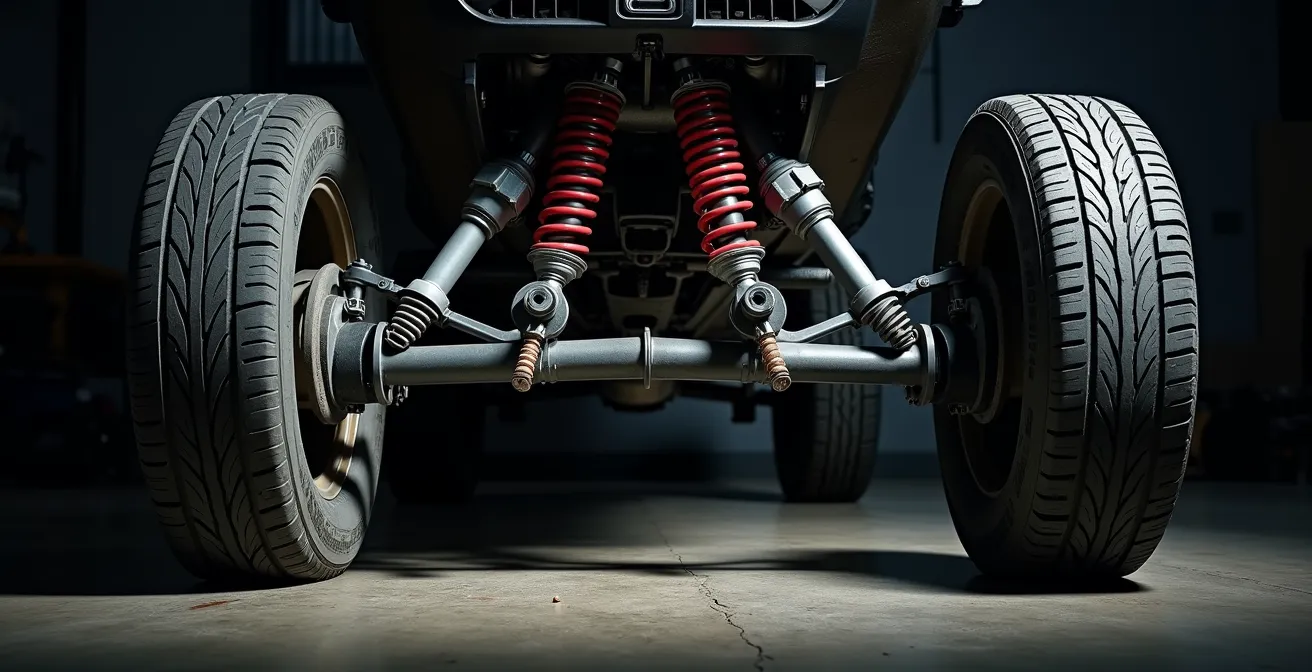
The financial logic is undeniable. As industry data shows, a necessary $300 bushing replacement effectively protects a $1,200 investment in new tires. A pre-alignment inspection is not an upsell; it is a mandatory step to guarantee the value and longevity of both the tires and the alignment service itself. Insisting on this inspection transforms you from a passive customer into an informed manager of your vehicle’s health, preventing you from paying for a service that is doomed to fail from the start.
Optimiser la tenue de route
While preserving tire life is a primary financial benefit of proper alignment, its effect on vehicle handling and safety is just as critical, especially in modern cars. A precisely aligned vehicle offers predictable, stable handling during routine driving, highway cruising, and, most importantly, emergency maneuvers. This isn’t just about “feeling” better; it’s about ensuring the vehicle’s systemic integrity. The suspension is a complex system, and alignment ensures all its parts work in harmony to keep the tire’s contact patch optimally planted on the road surface.
This synergy is now more important than ever due to the proliferation of Advanced Driver-Assistance Systems (ADAS). Features like lane-keeping assist, adaptive cruise control, and automatic emergency braking do not operate in a vacuum. They rely on a suite of sensors, with the steering angle sensor being paramount. As the Tire Discounters Technical Team points out:
Today’s vehicles are smart, really smart. That means your safety systems like lane keep assist, collision braking, and adaptive cruise control all rely on pinpoint data from your steering angle sensor
– Tire Discounters Technical Team, Tire Discounters Alignment Guide
A misaligned vehicle can have a steering wheel that is off-center when driving straight. This confuses the steering angle sensor, which may feed incorrect data to the ADAS computer. The result can be erratic lane-keeping corrections, delayed braking intervention, or even the complete deactivation of these life-saving features. A proper four-wheel alignment, which sets the steering angle correctly in relation to the vehicle’s true thrust line, is therefore not just a mechanical adjustment but a critical digital calibration essential for modern vehicle safety.
Comparer l’alignement 2 et 4 roues
The question of whether to perform a two-wheel (front-end) or four-wheel alignment is a common point of confusion. Decades ago, when most vehicles featured a solid rear axle, a front-end alignment was often sufficient. However, the landscape of automotive design has fundamentally changed. The vast majority of modern cars, SUVs, and even many trucks now use independent rear suspension, where each rear wheel can be adjusted. For these vehicles, a four-wheel alignment is not an optional upgrade; it is a mandatory procedure.
A two-wheel alignment on a modern vehicle ignores half the problem. It adjusts the front wheels relative to the vehicle’s centerline but fails to account for the direction the rear wheels are pointing. If the rear wheels are misaligned (a condition known as a bad thrust angle), the car will “dog track,” essentially trying to drive sideways down the road. The driver will be forced to hold the steering wheel at a constant angle to compensate, leading to rapid, uneven tire wear and a perpetually crooked steering wheel. As Firestone experts confirm, the majority of vehicles on the road today require a four-wheel alignment to ensure all wheels are working in concert.
The decision matrix is straightforward for any vehicle owner looking to protect their investment. A four-wheel alignment is the only way to ensure the thrust line is parallel to the vehicle’s centerline, guaranteeing a centered steering wheel and a vehicle that tracks true.
| Vehicle Type | Suspension Type | Recommended Service | Cost Difference |
|---|---|---|---|
| Modern Cars/SUVs | Independent Rear | 4-Wheel Required | +$50-75 |
| Older Trucks | Solid Rear Axle | 2-Wheel Possible* | Baseline |
| FWD Vehicles | Any | 4-Wheel Optimal | +$50-75 |
While a front-end alignment might seem cheaper initially, it’s a classic example of being penny-wise and pound-foolish on any vehicle with an adjustable rear suspension. The small upfront savings are quickly erased by the cost of replacing tires worn prematurely by an uncorrected rear-end issue.
Planifier le contrôle après impact
Road hazards like potholes and curbs are the primary enemies of a vehicle’s alignment. An impact that feels minor to the driver can be significant enough to bend a suspension component or knock an angle out of specification. The key is to move from a reactive “wait and see” approach to a proactive assessment plan. Not every jolt requires an immediate trip to the shop, but having a mental scale for impact severity can save you hundreds of dollars in tire costs.
A practical assessment scale can be used: a minor jolt (Level 1) warrants monitoring steering feel for a week. A moderate impact (Level 2) should prompt a visual tire inspection and pressure check. A hard hit that you clearly feel through the chassis (Level 3) means you should schedule an alignment check within the next hundred miles. Any impact severe enough to make the wheel hop or cause a noticeable pull (Level 4) requires immediate inspection. If you see visible damage to the wheel or tire (Level 5), the vehicle should not be driven.
Beyond preventing wear, a post-impact alignment check provides critical diagnostic value. In some cases, it can even become a financial tool. Consider the case of a customer whose post-impact alignment report showed a 0.3-degree toe misalignment and negative camber on the left front wheel. This official documentation served as irrefutable proof of damage caused by a specific road hazard. This evidence was instrumental in securing insurance coverage for both the $400 tire replacement and the alignment service, expenses that would have otherwise been entirely out-of-pocket. An alignment report transforms an invisible problem into a documented, quantifiable fact.
Corriger la géométrie après une rehausse
Modifying a vehicle’s suspension, particularly by installing a lift or leveling kit, fundamentally alters its geometry. Failing to correct this geometry is a guaranteed path to poor handling, compromised safety, and catastrophic tire wear. When you raise a vehicle with independent front suspension, the control arms swing downwards in an arc, which inherently pulls the tops of the tires inward (increasing negative camber) and alters the toe setting. Simply installing the lift kit and driving away will destroy a set of expensive off-road tires in a few thousand miles.
Correcting this requires more than a standard alignment. Depending on the height of the lift, specific hardware is necessary to bring the angles back into an acceptable range. A simple 2-inch leveling kit might only require eccentric “camber bolts,” but a more substantial 4-inch lift will often demand new adjustable control arms and a track bar to re-center the axle. This is a specialized task that goes far beyond a typical alignment job.
The financial stakes are extremely high. The cost of proper geometric correction hardware and the expert alignment that follows should be factored into the total budget of any suspension lift. Ignoring this step in an attempt to save money upfront will backfire spectacularly. In fact, industry analysis demonstrates that the total cost of ownership (TCO) for a lifted vehicle can be three times higher if the post-lift alignment is performed improperly or skipped entirely, due to the rapid destruction of tires and added strain on other components.
| Lift Type | Required Hardware | Alignment Complexity | Additional Cost |
|---|---|---|---|
| 2″ Leveling Kit | Camber bolts | Moderate | $150-250 |
| 4″ Suspension Lift | Adjustable control arms, track bar | High | $500-800 |
| 6″+ Lift | Full geometry correction kit | Expert only | $1000+ |
L’erreur de confiance aveugle
Not all alignment shops are created equal. The sophistication of modern alignment machines and the precision required for today’s vehicles mean that the skill of the technician and the quality of the equipment matter more than ever. Placing blind trust in any shop advertising “cheap alignments” can be a direct path back to the problems you’re trying to solve: premature tire wear and poor handling. An informed vehicle owner must become an active participant in the process, vetting the shop to ensure their investment is in good hands.
The first sign of a quality shop is transparency. They should have no issue discussing their equipment, its calibration schedule, and their process. A shop that defaults to a “trust us” attitude should be a red flag. The most powerful tool for accountability is the before-and-after printout. This document is your proof of service. It should clearly show the initial out-of-spec measurements in red and the final, corrected measurements in green. A shop that is unwilling or unable to provide this is not a shop you should trust with a four-figure tire investment.
Furthermore, a truly professional alignment isn’t finished when the car comes off the rack. It includes centering the steering wheel and performing a short test drive to confirm that the vehicle tracks straight and the wheel is perfectly level. This final quality control step separates the experts from the rest. To protect yourself, you need to ask the right questions before any work begins.
Your checklist: 5 questions to vet your alignment shop
- What model alignment machine do you use and when was it last calibrated?
- Do you provide a complete before-and-after printout showing all measurements?
- What is your procedure for inspecting suspension components before performing the alignment?
- Will the service include centering the steering wheel and a final test drive for verification?
- What is your warranty period on the alignment, and what does it cover?
Asking these questions demonstrates that you are an educated consumer and significantly increases the likelihood of receiving the quality service your vehicle requires.
Key takeaways
- Wheel alignment is a financial strategy, not just a repair. Correct angles directly protect the equity you have in your tires.
- Never align a vehicle with worn suspension parts. A pre-alignment inspection is mandatory to avoid wasting money on a service that won’t last.
- On modern vehicles, alignment is also a digital calibration. It is essential for the proper function of life-saving ADAS safety systems.
Choisir la modification de suspension adaptée à l’usage réel
The world of suspension modifications offers endless choices, from aggressive lowering springs for performance cars to towering lift kits for off-road trucks. However, the optimal choice is always dictated by the vehicle’s real-world use case. There is no one-size-fits-all solution, and every modification involves a trade-off. A setup designed for maximum track-day grip, with aggressive negative camber and toe-out, will provide phenomenal handling but will also significantly shorten tire life for a daily commuter. Conversely, a setup optimized purely for tire longevity and fuel economy, with zero toe and neutral camber, may feel less responsive in corners.
The key is to have an honest conversation with your technician about your priorities. Are you a high-mileage highway commuter where fuel economy and tire longevity are paramount? Or are you an enthusiast who values cornering performance above all else? This decision directly impacts the target alignment specifications. For a commercial fleet, for instance, a 30-40% increase in tire mileage from an optimized alignment translates to massive operational savings, far outweighing any perceived loss in sharp handling.
The impact on fuel economy is another critical factor often overlooked. Misalignment forces the engine to work harder to overcome the drag from scrubbing tires. As alignment experts confirm, this can lead to an up to 10% reduction in fuel efficiency. For a driver covering 15,000 miles a year, that can equate to hundreds of dollars in extra fuel costs, further eroding the return on your vehicle investment. Choosing the right suspension and alignment strategy based on your actual needs ensures you are not paying—in either tire wear or fuel costs—for a performance profile you don’t use.
Your vehicle’s alignment is the invisible foundation upon which tire life, fuel economy, and advanced safety systems are built. To stop the cycle of premature wear and unexpected costs, the next step is to treat your alignment not as a simple task, but as a comprehensive diagnostic service. Schedule a precision four-wheel alignment with a trusted shop that provides a full diagnostic printout and performs a thorough pre-inspection.