
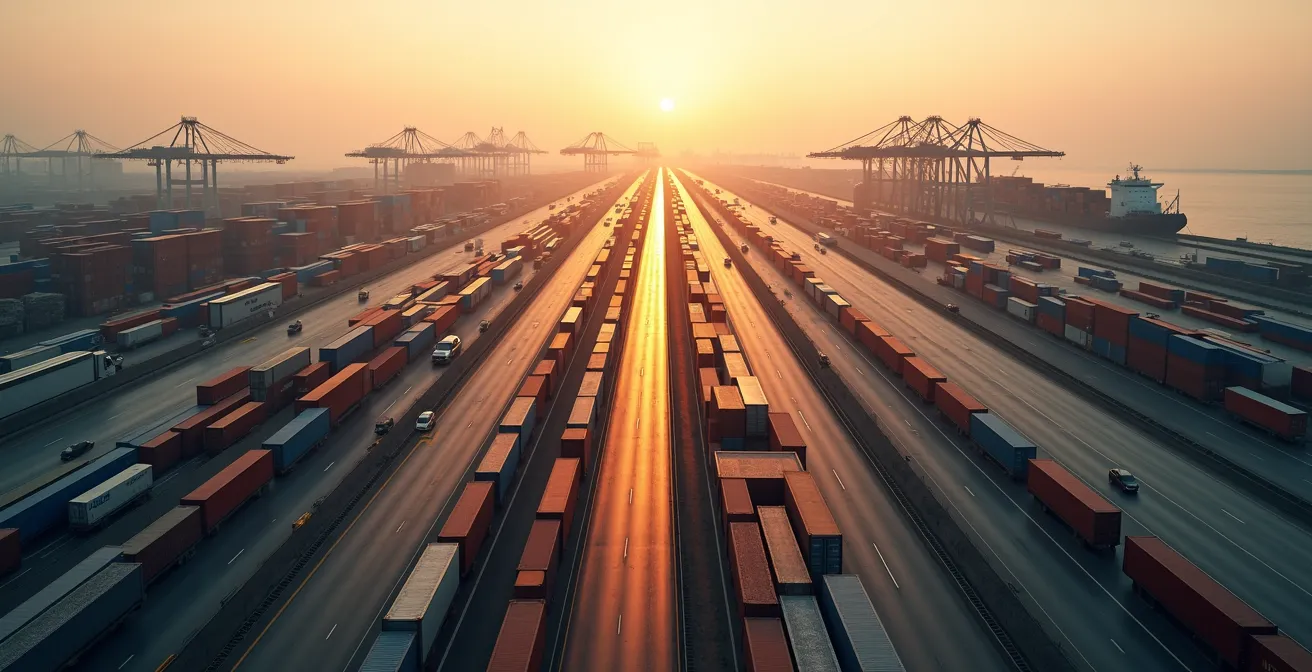
The conventional approach of simply trying to move goods faster through congested corridors is a losing battle; the real solution is to strategically re-architect your logistics flow to make the bottleneck irrelevant.
- Instead of large, centralized warehouses, leverage a network of smaller, alternative intermodal hubs and micro-fulfillment centers to decentralize operations.
- Shift from static, time-based planning to dynamic, AI-powered routing that leverages off-peak hours and real-time data to bypass congestion entirely.
Recommendation: Begin by auditing your current network for over-reliance on major congested arteries and identify opportunities for implementing decentralized, multi-modal strategies.
For any supply chain director overseeing operations along major arteries like the I-95 corridor, delays are not an anomaly; they are a constant. The traditional response has been to invest in more sophisticated tracking technology or to pressure carriers for faster transit times. These are tactical adjustments in a battle that is being lost at a strategic level. We attempt to optimize our path through the bottleneck, assuming the bottleneck itself is an unchangeable fact of life. This approach yields diminishing returns as urban density and e-commerce demands continue to escalate.
The core problem isn’t a lack of visibility or vehicle speed—it’s a fundamental flaw in network design that remains dependent on linear, centralized models. The common wisdom tells us to plan better routes or improve warehouse efficiency. But what if the warehouses are in the wrong place? What if the “best” route at 8 a.m. is a trap by 10 a.m.? The true opportunity lies not in navigating the congestion more efficiently, but in designing a system that largely avoids it. This requires a paradigm shift: we must stop thinking about optimizing a fixed path and start re-architecting a fluid logistics flow.
This guide moves beyond tactical fixes to offer a strategic framework for transforming your operations in saturated corridors. We will explore how to leverage urban space and time as assets, master the critical first and last-mile connections, and integrate technology not just for tracking, but for predictive and dynamic re-routing. By shifting focus from speed within the system to the intelligence of the system’s design, you can build a more resilient, efficient, and cost-effective supply chain.
To navigate these advanced strategies, this article is structured to build from understanding the foundational challenges to implementing integrated, multi-modal solutions. The following sections will provide a clear roadmap for re-architecting your supply chain to thrive despite congestion.
Contents: A Strategic Framework for Corridor Optimization
- Understanding the Impact of Urbanization on Freight
- Using Alternative Intermodal Hubs
- The Mistake of Time-Slot Planning in Urban Corridors
- Optimizing Loading for Short, Frequent Trips
- Planning Night Routes
- Understanding Drayage
- The Mistake of Static Routing
- Combining Rail and Road for Cost Efficiency
Understanding the Impact of Urbanization on Freight
The primary driver of gridlock in major corridors is accelerating urbanization. As cities expand, the final leg of the delivery journey becomes disproportionately complex and expensive. This isn’t just about more consumer vehicles on the road; it’s about the very structure of urban logistics. The last mile is a battleground of tight delivery windows, limited parking, and local regulations. In fact, research shows that last-mile delivery accounts for 53% of total shipping costs, a figure that highlights the immense financial pressure created by urban density. For a supply chain director, this means that even a perfectly optimized long-haul route can see its efficiency gains erased in the final few miles.
The challenge is compounded by the rise of e-commerce, which has fragmented shipments into smaller, more frequent, and time-sensitive deliveries to residential addresses. A single truck that once made a bulk delivery to a retail store is now replaced by a fleet of vans making dozens of individual stops. This operational shift dramatically increases vehicle miles traveled (VMT) within city centers, directly contributing to the congestion that delays your entire network. The traditional “hub-and-spoke” model, with large distribution centers on the outskirts of cities, becomes a source of inefficiency, forcing every package through the same congested entry and exit points.
To counter this, leading companies are rethinking the very geography of their networks. The solution is not to push harder through the urban core, but to decentralize the final fulfillment step.
Case Study: Accenture’s Micro-Fulfillment Model
An influential study by Accenture and Frontier Economics demonstrated the power of this decentralized approach. It found that using local micro-fulfillment centers (MFCs) to handle just 50% of e-commerce orders could yield massive benefits. In cities like London and Chicago, this strategy was projected to reduce delivery vehicle emissions by 16-26% and cut delivery-related traffic by 13% by 2025. For London alone, this translates to 320 million fewer miles traveled by delivery vehicles. This proves that re-architecting the physical network to bring inventory closer to the end customer is a powerful lever for mitigating urban congestion.
This data underscores a critical strategic insight: the war on congestion is won not on the highway, but in the intelligent distribution of assets within the urban environment itself. It’s about reducing the length and complexity of that costly last mile.
Using Alternative Intermodal Hubs
The conventional wisdom of relying on a few massive distribution centers located far from city centers is becoming obsolete. These large facilities create their own gravity of congestion, funneling all inbound and outbound traffic through a limited number of highway interchanges. A truly resilient strategy involves creating a distributed network of smaller, more agile alternative hubs. This approach is not about replacing the large DC, but augmenting it with a flexible layer of micro-fulfillment centers, cross-docking facilities, and even “pop-up” distribution points located in underutilized urban real estate like parking garages or repurposed retail spaces.
These alternative hubs serve a critical function: they break down bulk shipments from long-haul trucks or rail into smaller loads destined for final delivery via more efficient urban vehicles like cargo bikes or electric vans. This “flow re-architecting” stops large, inefficient trucks at the edge of the congested zone, allowing for a more nimble and less disruptive last-mile operation. By positioning inventory closer to demand clusters, you drastically reduce stem miles—the distance a delivery vehicle travels from the depot to its first delivery stop—which is a major source of cost and emissions.
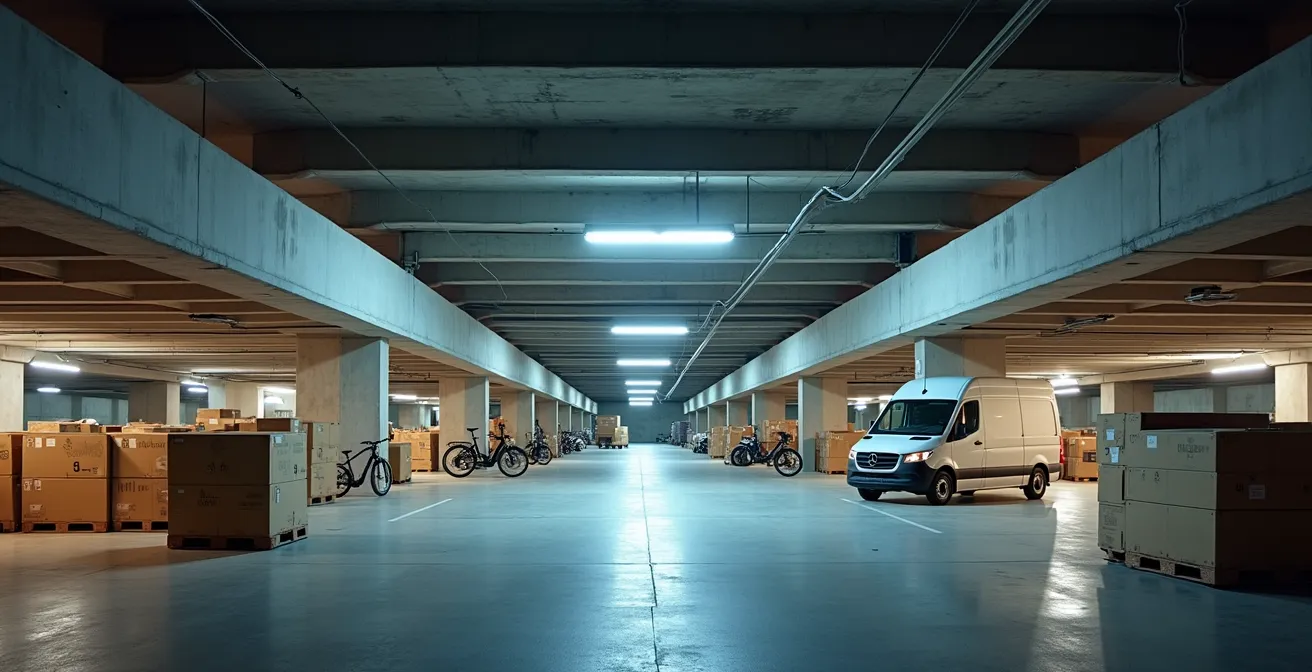
As the image illustrates, these non-traditional spaces can be transformed into highly efficient sorting and dispatching centers. The key is to see urban space not as a barrier, but as a portfolio of potential logistics assets. This requires a proactive approach to real estate and a flexible operational model that can adapt to shifting demand patterns. Establishing a network of three or four smaller hubs instead of one monolithic facility also builds crucial redundancy, ensuring that a disruption at a single point does not paralyze your entire regional operation.
Action Plan: Strategic Hub Selection Framework
- Identify Assets: Map and identify underutilized urban real estate (e.g., closed retail stores, parking structures) within a 5-10 mile radius of both major highway corridors and key last-mile delivery zones.
- Evaluate Access: Assess potential sites for multi-modal access, prioritizing proximity to cargo bike lanes, public transit connections, and secondary rail terminals, not just highway ramps.
- Design for Flow: Implement cross-docking capabilities from the outset to minimize storage time and design the facility for maximum throughput, not long-term warehousing.
- Build Redundancy: Instead of committing to one large alternative facility, establish a network of 3-4 smaller, geographically dispersed hubs to create a resilient and flexible system.
- Monitor and Adapt: Use real-time traffic and seasonal demand data to continuously monitor the performance of each hub and remain agile enough to adjust locations or operational hours as needed.
By adopting this framework, you transform your supply chain from a rigid chain into an agile, distributed network capable of absorbing shocks and navigating urban complexity with far greater efficiency.
The Mistake of Time-Slot Planning in Urban Corridors
One of the most pervasive and costly errors in urban logistics is the reliance on static time-slot planning. This involves scheduling deliveries and pickups based on historical averages or fixed appointments, a method that completely ignores the fluid, unpredictable nature of city traffic. A delivery window that seems perfectly reasonable at the planning stage can become impossible when an unforeseen accident or rush-hour surge clogs a key artery. The financial impact of this inflexibility is staggering; one analysis found that congestion cost U.S. urban areas an estimated $166 billion in 2019 through lost productivity and wasted fuel. Relying on static plans is akin to navigating a storm with a paper map instead of a live weather radar.
This rigidity creates a domino effect. A single delayed truck can miss its unloading window at a receiving dock, forcing it to wait or return later. This not only incurs detention fees but also disrupts the schedule for every subsequent delivery on its route. The driver, dispatcher, and customer are all caught in a reactive cycle of phone calls and apologies, eroding service levels and driving up operational costs. The fundamental mistake is treating time as a fixed input rather than a dynamic variable. In a saturated corridor, the “shortest” route can change minute by minute, and a plan made hours in advance is often obsolete upon departure.
The strategic alternative is a shift to dynamic, real-time route optimization. Modern transportation management systems (TMS) powered by AI and machine learning can continuously analyze live traffic data, weather conditions, and even social media alerts to adjust routes on the fly. This allows dispatchers to proactively steer drivers around emerging bottlenecks instead of reacting to them. As a case study from LogiNext Solutions shows, companies that implement advanced last-mile delivery software with this capability report significant improvements. They have seen up to a 30% reduction in delivery times and notable decreases in fuel consumption by intelligently avoiding traffic hotspots. This isn’t just better planning; it’s responsive execution.
Ultimately, overcoming the limits of time-slot planning requires a philosophical shift. You must empower your operations with technology that treats routes not as static lines on a map, but as fluid pathways that can be optimized in real time to navigate the chaos of the urban environment.
Optimizing Loading for Short, Frequent Trips
The shift to a decentralized network of smaller hubs and more frequent deliveries necessitates a complete overhaul of vehicle loading strategies. The old model of maximizing cube utilization for a long-haul trip with many stops is inefficient for the short, rapid-turnaround routes characteristic of urban logistics. In this new paradigm, the primary goal is not just to fit as much as possible into the truck, but to enable maximum speed and accuracy at the point of delivery. A poorly loaded vehicle can cost a driver precious minutes at every stop, quickly negating any time saved on the road.
The most effective strategy is “route-first” or “last-in, first-out” (LIFO) loading. This means that the packages for the last stop on a route are loaded first, at the front of the vehicle, while packages for the first stop are loaded last, right at the door. While this concept is simple, executing it effectively requires tight integration between routing software and warehouse operations. The loading plan must be a direct output of the final, optimized route, ensuring that drivers are not forced to dig through piles of boxes to find the correct parcel. This seemingly small detail dramatically reduces dwell time at each stop, allowing for more deliveries per shift and improving on-time performance.
Furthermore, optimization extends to matching the right vehicle to the right route. A dense urban route with small packages and limited parking is better served by a nimble cargo bike or electric van than a traditional step van. Analytics can help automate this vehicle-to-load matching process. Pre-kitting—grouping items for a single order or stop at the consolidation center—also plays a crucial role. This eliminates the need for secondary sorting or packaging on the street, further streamlining the final delivery process. These micro-optimizations in the loading process are what enable the broader strategic shift to a high-frequency, decentralized delivery model to succeed.
Implementing a new loading discipline requires a systematic approach:
- Route-Based Sequencing: Strictly enforce Last-In, First-Out (LIFO) loading based on the final delivery route sequence generated by your TMS.
- Vehicle Matching: Use analytics to assign the optimal vehicle type—from cargo bikes to light-duty vans—to each route based on package volume, density, and delivery environment.
- Pre-Kitting at Hub: Consolidate all items for a single order or delivery stop into a single handling unit (like a tote or bag) at the fulfillment center to eliminate on-street sorting.
- Cube and Weight Optimization: Even with LIFO, use software to plan package arrangement to maximize stability and space, ensuring a safe and efficient load.
- Document and Train: Create standardized loading pattern diagrams for common routes and use them as training tools to ensure consistency and continuous improvement among warehouse staff and drivers.
By focusing on how a vehicle is unloaded, not just how it is loaded, you can unlock significant efficiencies that are critical for success in a fast-paced urban environment.
Planning Night Routes
One of the most underutilized assets in any supply chain director’s toolkit is the 24-hour clock. While daytime hours are defined by congestion, noise regulations, and limited curb access, nighttime offers a clear path. Shifting deliveries to off-peak and overnight hours—a strategy of temporal arbitrage—is a powerful way to bypass the primary constraint of urban logistics: traffic. By operating when the rest of the city sleeps, delivery vehicles can travel across metropolitan areas in a fraction of the time, dramatically improving transit-time reliability and asset utilization. A truck that can only complete one or two cross-town runs during the day might easily complete three or four at night.
However, successful night delivery is more complex than simply changing driver shifts. The primary challenge is ensuring secure and verified receipt of goods. This requires collaboration with receiving partners and investment in the right infrastructure. Solutions range from establishing key-drop programs with trusted clients to utilizing secure 24/7 receiving hubs with smart lockers or dedicated night-shift staff. For B2B deliveries to retail stores or service locations, night operations can be a game-changer, allowing shelves to be restocked and sites to be prepared for business before employees even arrive.
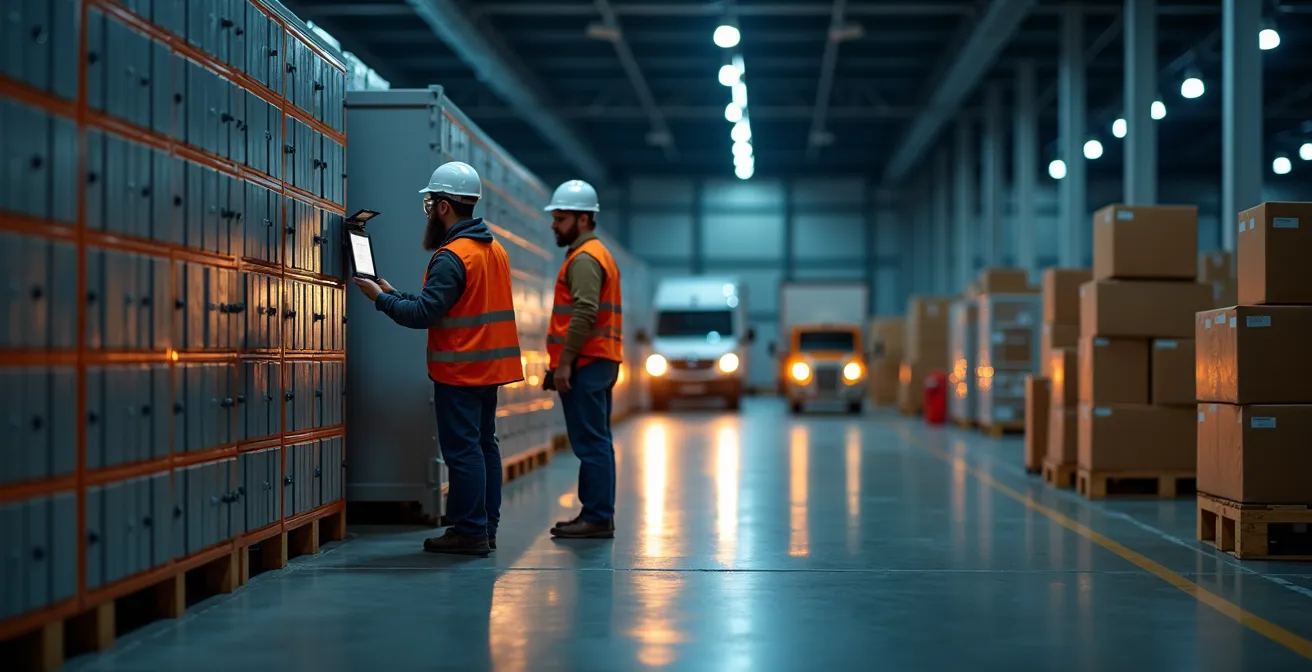
This strategy is gaining traction globally. A successful pilot program in Singapore, for instance, addressed severe port congestion by allowing barges to move between terminals at night, a previously restricted activity. According to reports on this initiative, this change helped reduce average vessel waiting times to under one day by better distributing traffic across the full 24-hour period. While focused on a port, the principle is universally applicable: distributing logistics activity over a longer timeframe smooths out the peaks that cause bottlenecks. For a corridor like the I-95, this could mean running line-haul trucks between major hubs overnight and leaving only the final, short-range deliveries for the daytime.
Implementing a night-route program requires careful planning around security, staffing, and local noise ordinances. Yet, the strategic payoff—in the form of increased speed, reliability, and asset productivity—is often more than enough to justify the investment. It transforms time from a constraint into a competitive advantage.
Understanding Drayage
For supply chains connected to ports and rail terminals, drayage is one of the most critical and often underestimated sources of congestion and cost. Drayage refers to the short-distance transport of freight containers, typically moving them from a port to a nearby rail yard, warehouse, or distribution center. While the distance is short, the process is fraught with complexity and potential for delay. A single container’s journey is dependent on vessel arrival times, terminal appointments, crane availability, and chassis supply. A breakdown at any of these points can leave a truck waiting for hours, burning fuel and wrecking schedules.
The financial consequences of inefficient drayage are severe. When containers are not picked up or returned on time, ocean carriers and terminals levy hefty fees known as detention and demurrage. These charges are meant to incentivize the rapid movement of equipment, but in a congested system, they often become an unavoidable cost of doing business. The scale of this issue is massive; the Federal Maritime Commission reported that ocean carriers collected an estimated $15.4 billion in these fees from 2020 to 2025. This is a direct tax on inefficiency that gets passed down the supply chain.
The problem is systemic. A surge in imports can quickly overwhelm a port’s capacity, creating a cascade effect. As an example, the Port of Charleston saw its congestion levels skyrocket recently, with average vessel turnaround times jumping from 1.39 days in Q1 to 3.23 days in Q2 of 2024. This 132% increase in delays at the berth means containers are unavailable for pickup, trucks miss their appointments, and the entire inland supply chain connected to that port feels the impact. Understanding drayage means recognizing it as a critical bottleneck where global and domestic supply chains collide. Optimizing your line-haul operations is futile if your containers are stuck at the port for three days.
Effective management requires deep visibility into terminal operations, strong relationships with drayage carriers, and technology that can dynamically adjust pickup schedules based on real-time container status. It also involves strategic decisions like using near-port storage yards to “peel off” containers quickly and avoid terminal holding areas.
Key Takeaways
- True optimization means re-architecting your network with alternative hubs, not just moving faster through existing traffic.
- Leverage time as an asset by shifting deliveries to off-peak and overnight hours to bypass daytime congestion.
- Replace static planning with dynamic, AI-powered routing to adapt to real-time conditions and avoid emerging bottlenecks.
The Mistake of Static Routing
The most fundamental error in modern transportation management is continuing to rely on static routing. This is the practice of planning routes based on fixed data points: addresses, standard travel times, and predetermined customer windows. It operates on the assumption that the world between point A and point B is predictable. In a saturated corridor, this assumption is not just wrong; it’s a recipe for failure. Static routing cannot account for a sudden traffic jam, a closed exit ramp, or a change in a customer’s receiving availability. It creates a rigid plan that shatters on contact with reality, leaving drivers and dispatchers in a constant state of reactive firefighting.
In contrast, dynamic route optimization uses a continuous stream of real-time data to make intelligent decisions. It is a fundamentally different approach that treats the logistics network as a living system. This is where AI and machine learning become transformative tools. As one industry analysis aptly puts it:
Predictive routing using AI to forecast traffic and delivery conditions for the entire route duration, not just at departure, helps avoid bottlenecks that don’t exist yet.
– Industry Analysis, Logistics Innovation Report
This predictive capability is the key difference. A static system might identify the shortest route based on current conditions, but a dynamic system can predict that the “shortest” route will be heavily congested in 30 minutes and proactively select a slightly longer but ultimately faster alternative. This shift from reaction to proaction saves time, fuel, and drastically improves service reliability. The performance gap between these two methodologies is not incremental; it is a step-change in efficiency.
The following comparison, based on data from technology providers like C.H. Robinson, quantifies the impact of moving from a manual, static approach to an automated, dynamic one. As the analysis of optimization tools shows, the gains are significant across every key metric.
| Metric | Static Routing | Dynamic Optimization |
|---|---|---|
| Average Cost Savings | Baseline | 8-15% Average |
| Trailer Utilization | 60-70% | 85-95% |
| Miles Traveled | Baseline | -15% Average Reduction |
| Planning Time | Manual Hours | -75% Automated |
For a supply chain director, clinging to static routing is no longer a viable option. It is an acceptance of inefficiency as a cost of doing business. The adoption of dynamic optimization technology is the single most impactful lever for unlocking new levels of performance in congested corridors.
Combining Rail and Road for Cost Efficiency
The ultimate expression of “flow re-architecting” is the strategic integration of multiple transportation modes, primarily combining the long-haul strength of rail with the last-mile flexibility of road. For freight moving over long distances along a saturated corridor—for instance, from one end of the Eastern Seaboard to the other—relying solely on trucking is often inefficient. Long-haul trucking is subject to driver hours-of-service regulations, fuel price volatility, and the very highway congestion we aim to avoid. Intermodal transport, which moves containers by rail for the majority of the journey, offers a powerful alternative.
Rail is inherently more efficient for moving large volumes of freight over long distances. A single train can carry the equivalent of over 280 trucks, resulting in significant economies of scale. This translates directly to the bottom line; according to industry experts at FourKites, shifting from over-the-road to intermodal service can cut freight spend by 10-15%. The environmental benefits are equally compelling, with the same analysis noting a potential 65% reduction in CO2 emissions compared to trucking alone. This makes intermodal a key strategy for companies focused on both fiscal and environmental sustainability goals.

The success of an intermodal strategy hinges on the efficiency of the connections at each end—the drayage operations that move containers between the rail terminal and their origin or destination. This is where the other strategies discussed in this guide converge. Using alternative hubs near rail terminals, planning night routes for drayage trucks, and employing dynamic routing to manage terminal appointments are all critical enablers. When executed well, the system is seamless: a container is drayed to a rail ramp, travels hundreds of miles by train bypassing highway traffic, and is then picked up by a truck for only a short, final-mile delivery.
This combination allows you to leverage the best of both worlds: the cost-effectiveness and sustainability of rail for the long haul, and the unparalleled flexibility of trucks for the first and last mile. It is the most robust way to build resilience and efficiency into a supply chain that must operate across congested, long-distance corridors.
To put these strategies into practice, the next logical step is to conduct a comprehensive audit of your network’s choke points and identify the most impactful opportunities for intermodal integration and decentralized fulfillment.