

In summary:
- Treat the driver and vehicle as a single, interdependent system that is under constant stress from the desert environment.
- Proactive monitoring of the vehicle’s “health” (coolant, tires, fuel) is as critical as monitoring your own hydration and condition.
- Prepare for failure. A breakdown plan, tiered survival kits, and reliable communication are not optional extras but essential components of desert travel.
- Your driving strategy must adapt to the environment, including adjusting schedules to avoid extreme heat and using specific techniques for high-altitude terrain.
The thought of driving through the vast, sun-drenched landscapes of Arizona or Nevada is the stuff of adventure dreams. But for the unprepared, that dream can quickly turn into a nightmare. The extreme heat, remote roads, and lack of cell service create an environment where a simple mechanical issue can escalate into a life-threatening situation. Most guides will tell you to check your fluids and pack extra water, and while that advice is sound, it misses the fundamental point.
True desert preparedness isn’t about a static pre-trip checklist. It’s about adopting a new mindset: viewing the driver and the vehicle as a single, interconnected survival system. The desert places immense stress on both, and a failure in one part—a dehydrated driver making poor decisions or an overheating engine—can trigger a catastrophic failure of the entire system. The key to safety isn’t just preparing your gear; it’s learning to dynamically monitor and manage the health of this combined unit throughout your journey.
This guide moves beyond generic tips to provide a strategic framework for desert travel. We will explore how to recognize the early warning signs of vehicle distress, what to do when things go wrong far from help, and how to manage critical resources like fuel and tires. By understanding the “why” behind each safety measure, you will gain the confidence and competence to navigate the desert’s beautiful but unforgiving challenges.
Summary: Preparing a Vehicle and Driver for Extreme Desert Conditions
- Identify the signs of vehicle dehydration
- Manage a breakdown in a desert dead zone
- Compare vehicle survival kits
- The fuel management error in isolated areas
- Plan driving schedules for tire safety
- Plan the emergency response
- Evaluate the necessary ground clearance
- Master high-altitude driving to preserve the mechanics
Identify the signs of vehicle dehydration
Just as a human gets dehydrated, a vehicle operating in extreme heat can suffer from its own form of “dehydration”—a critically stressed cooling system. Overheating is not a sudden event; it’s a process with clear warning signs. Your job as the system manager is to monitor these signs constantly. The most obvious indicator is your vehicle’s temperature gauge. In normal conditions, it should sit between 195-220°F (or just below the halfway mark on most gauges). If it starts creeping above that, it’s the first sign of trouble.
To properly monitor your vehicle’s health, you must engage more than just your eyes. Listen for engine ‘knocking’ or ‘pinging’ sounds, which can indicate detonation caused by excessive heat. During any stop, feel the hood of your car (carefully). If it’s intensely hot to the touch, it’s a sign your cooling system is struggling to dissipate heat. Visually inspect the coolant overflow tank for bubbling or steam, which means the coolant is boiling—a critical danger sign. According to automotive experts, overheating is the single most likely reason for a roadside breakdown in desert conditions, making this vigilance your first line of defense.

These symptoms are the vehicle’s way of telling you it’s in distress. Ignoring them is like ignoring your own thirst. If you notice any of these signs, the immediate protocol is to turn off the A/C, turn the heater on full blast to pull heat away from the engine, and find a safe place to pull over and let the system cool down completely. Proactive monitoring prevents a minor issue from becoming a trip-ending breakdown.
Manage a breakdown in a desert dead zone
The scenario every desert traveler fears is the car sputtering to a stop, surrounded by silence and with no bars on the phone. In this situation, panic is the real enemy. Survival experts advocate the S.T.O.P. method: Stop, Think, Observe, and Plan. Your vehicle is now your primary shelter and your most visible signal for help. The cardinal rule is to stay with your vehicle unless you are absolutely certain of your location and the proximity of help. A car is far easier for rescuers to spot than a person on foot.
Your first action is to make yourself visible. Use road flares, a reflective emergency sign, or even a large ‘SOS’ or ‘HELP’ message trampled into the sand or assembled from rocks nearby. If another motorist stops, use their phone to call for help but be extremely cautious about accepting a ride from a stranger. Your prepared emergency plan, which you shared with someone back home, is now your most important asset. They know your route and your “panic deadline,” the time at which they should initiate a search if they haven’t heard from you.
While waiting, your mental state is a critical survival tool. As survival experts from the city of Yucca Valley note, a positive and rational mindset is integral to survival. Keep busy by organizing your supplies, improving your shelter, and focusing on the logical steps you’ve taken. Affirm to yourself that you are prepared and that help is on the way based on the plan you put in place. This isn’t just positive thinking; it’s a strategic management of your own psychological resources in a high-stress environment.
Compare vehicle survival kits
A survival kit isn’t a one-size-fits-all item. It’s a tiered system designed for different failure scenarios. Thinking in terms of a “Grab & Go” bag, a “Vehicle Recovery” kit, and an “Extended Stay” setup allows you to organize your gear logically. The goal is to have the right tools for the specific problem at hand, whether it’s a quick hike to a ridge for a cell signal or hunkering down for a couple of days while awaiting rescue.
This tiered approach ensures you are prepared without being needlessly overloaded. A personal bag is for immediate needs if you must leave the vehicle, while the heavier recovery gear is for self-extraction. The extended stay supplies are your life-support system for a worst-case scenario. When assembling these kits, the most critical component is water. As desert survival experts emphasize, one gallon of water per person, per day is the absolute minimum for survival; for a desert trip, carrying more is always better.
A comprehensive analysis from automotive publication MotorTrend provides a clear framework for what these different kits should contain. This structure helps prioritize what is truly essential versus what is merely convenient.
| Kit Type | Essential Items | Weight | Use Case |
|---|---|---|---|
| Grab & Go Personal | Water filter, first aid, flashlight, emergency blanket | 5-10 lbs | Quick evacuation on foot |
| Vehicle Recovery | Winch, snatch straps, shovel, jack, spare parts | 50-75 lbs | Self-extraction from stuck situations |
| Extended Stay | 3.5 gal water containers, food, shelter, communications | 100+ lbs | Multi-day survival while awaiting rescue |
Building your kits around this three-tier logic transforms packing from a guessing game into a strategic preparation. You are actively planning for different levels of adversity, which is the core of responsible desert travel.
The fuel management error in isolated areas
In the desert, the distance between gas stations can be vast and unpredictable. Running out of fuel is an entirely preventable error rooted in poor resource management. The common mistake is to trust your vehicle’s highway MPG (miles per gallon) rating. Off-road conditions, particularly driving in sand or on rough trails, drastically increase fuel consumption. In fact, you can expect driving on sand to use up to 50% more fuel than normal highway driving.
The professional standard for remote travel is the “Rule of Halves.” You allocate half your tank of fuel to get to your destination and reserve the other half for the return trip. This simple rule prevents you from venturing so far that you cannot get back to your last known refueling point. To apply this rule effectively, you must have a realistic understanding of your vehicle’s off-road fuel consumption, which can only be determined by testing on similar terrain or by planning with worst-case scenario figures.
Several factors impact your fuel economy. A loaded roof rack, for example, creates significant drag and should be removed if not essential. Your driving style also plays a role; aggressive acceleration and braking burn more fuel than smooth, steady progress. Meticulous planning of your route, including all potential fuel stops and bail-out alternatives, is the only way to ensure you don’t get caught out. Fuel is a finite resource, and managing it with military precision is a hallmark of an experienced desert traveler.
Plan driving schedules for tire safety
Your tires are the only part of your vehicle in direct contact with the brutal desert terrain. Their failure is one of the most common and dangerous issues. The primary enemy of tires is heat, both from the air and, more importantly, from the road surface itself. In the desert, vehicle safety experts warn that surface temperatures can be up to 30 degrees hotter than the ambient air temperature. This extreme heat softens the rubber, increases internal pressure, and makes tires far more susceptible to blowouts from impacts or existing weaknesses.
The strategic response is to plan your driving schedule around the heat. Avoid driving during the hottest part of the day, typically between noon and 4 p.m. The cooler morning and late afternoon hours are much safer for your tires and your vehicle’s cooling system. This isn’t just about comfort; it’s a core mechanical preservation strategy.
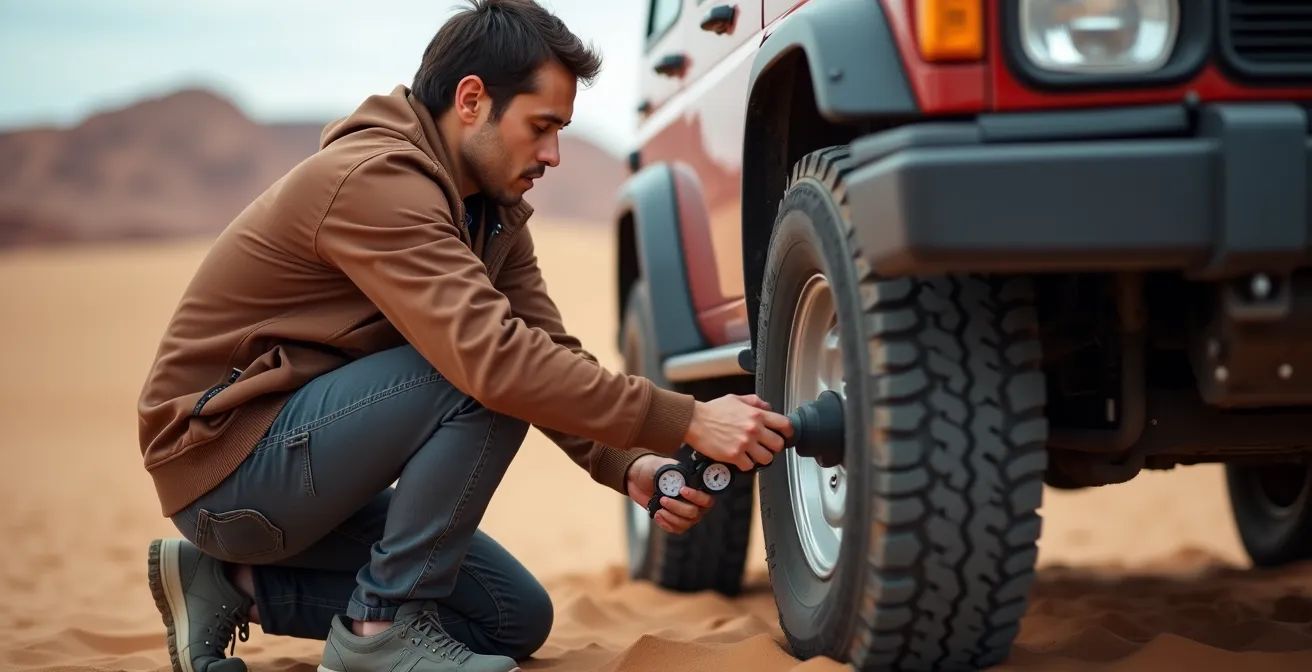
Beyond scheduling, active monitoring is key. A simple walk-around inspection at every stop can reveal potential problems before they become catastrophic failures. Check for cuts, bulges, or signs of tread separation. This constant vigilance is crucial for maintaining the integrity of your vehicle’s most vulnerable components.
Your Hourly Tire Inspection Protocol
- Stop every hour for a mandatory tire inspection walk-around.
- Feel the tire sidewalls with the back of your hand to detect excessive heat buildup.
- Check for new cuts, bulges, or signs of tread separation.
- Verify tire pressure hasn’t changed dramatically from heat expansion (if you have a gauge).
- Plan driving for the cooler morning and late afternoon hours.
Plan the emergency response
Hope is not a strategy. A detailed, written emergency plan shared with a reliable contact is your ultimate safety net. This plan is more than just telling someone, “I’m going to the desert for the weekend.” It is a formal document that provides actionable information for rescuers in a worst-case scenario. It should be treated with the seriousness of a flight plan filed by a pilot.
Your emergency plan must include several key elements. First, a detailed itinerary with your planned route, specific checkpoints, and estimated arrival times. Second, a “panic deadline”—a specific date and time when your contact should initiate the emergency plan if they have not heard from you. This eliminates ambiguity and ensures a timely response. The plan should also list your planned fuel stops, potential bail-out routes, and the GPS coordinates of any planned campsites. Finally, include crucial details about your vehicle (make, model, color, license plate), the number of passengers, any relevant medical conditions, and emergency contact information.
In a true emergency where you are incapacitated or unable to signal, this document is what will guide search and rescue teams to your location. For proactive communication, modern technology offers solutions that bypass the lack of cell service. Devices like the Spot X, a two-way satellite messenger, allow you to send texts, emails, and an SOS signal from almost anywhere in the world. Investing in such a device transforms your emergency plan from a passive safety net into an active communication line.
Evaluate the necessary ground clearance
Not all vehicles are created equal, and the desert will quickly expose the limitations of a standard street car. One of the most fundamental mechanical requirements for safe desert travel is adequate ground clearance—the distance between the lowest point of your vehicle’s undercarriage and the ground. Without enough clearance, you risk damaging critical components like the oil pan, transmission, or fuel tank on rocks, ruts, and other obstacles.
The amount of clearance you need depends on the terrain you plan to tackle. For graded dirt roads and mild trails, a stock SUV or truck might suffice. However, for more challenging landscapes, you’ll need more. Off-road experts recommend a minimum of 8 inches of ground clearance for navigating sand dunes and at least 10 or more inches for rocky trails or “boulder hopping.” This is why purpose-built off-road vehicles, with features like high ground clearance, four-wheel drive, and reinforced undercarriages, are the ideal choice for serious desert exploration.
Evaluating the terrain on your planned route and honestly assessing your vehicle’s capabilities is a critical part of your pre-trip planning. Choosing a route that exceeds your vehicle’s clearance is not an adventure; it’s a recipe for getting stranded with severe and costly damage. If your adventure plans include rugged trails, ensuring your vehicle has the necessary clearance is a non-negotiable prerequisite.
Key takeaways
- Systemic Failure: A breakdown in the desert is rarely a single event but a cascade of failures, often starting with overheating or a tire issue.
- Proactive Management: Shift from a “prepare and forget” mindset to one of constant, dynamic monitoring of both the vehicle’s gauges and the driver’s condition.
- Heat is the Enemy: Plan your driving schedule, tire checks, and engine monitoring around the primary stressor of extreme heat to preserve mechanical integrity.
Master high-altitude driving to preserve the mechanics
Many of the most spectacular desert landscapes are found at high altitudes, which introduces another significant environmental stressor: thin air. The lower air density at altitude affects both the driver and the vehicle in predictable ways. For the vehicle, it means a noticeable loss of engine power—typically a 20-30% reduction—as the engine struggles to get enough oxygen for combustion. This power loss requires a change in driving technique.
To compensate for the reduced power, you must shift to lower gears earlier than you normally would, especially on inclines. This allows the engine to operate at a higher RPM where it is more efficient. On long descents, the opposite strategy is required. You must rely exclusively on engine braking (using a lower gear to control speed) to prevent your brakes from overheating and failing, a dangerous condition known as brake fade. The combination of steep grades and high ambient temperatures puts an enormous strain on the entire system.
High altitude also exacerbates cooling system stress. If you see the temperature gauge begin to rise while climbing a steep grade, the first response is to turn off the A/C and turn the heater on full blast. This unconventional trick uses the heater core as a secondary radiator, pulling critical heat away from the engine. It’s also vital to remember that altitude affects you, the driver, causing fatigue and slower reaction times. Managing the driver-vehicle system means monitoring both your performance and the car’s.
To put these strategies into practice and ensure your vehicle is truly ready for the challenge, the logical next step is to schedule a comprehensive pre-trip inspection with a qualified mechanic who understands the demands of off-road and desert conditions.