
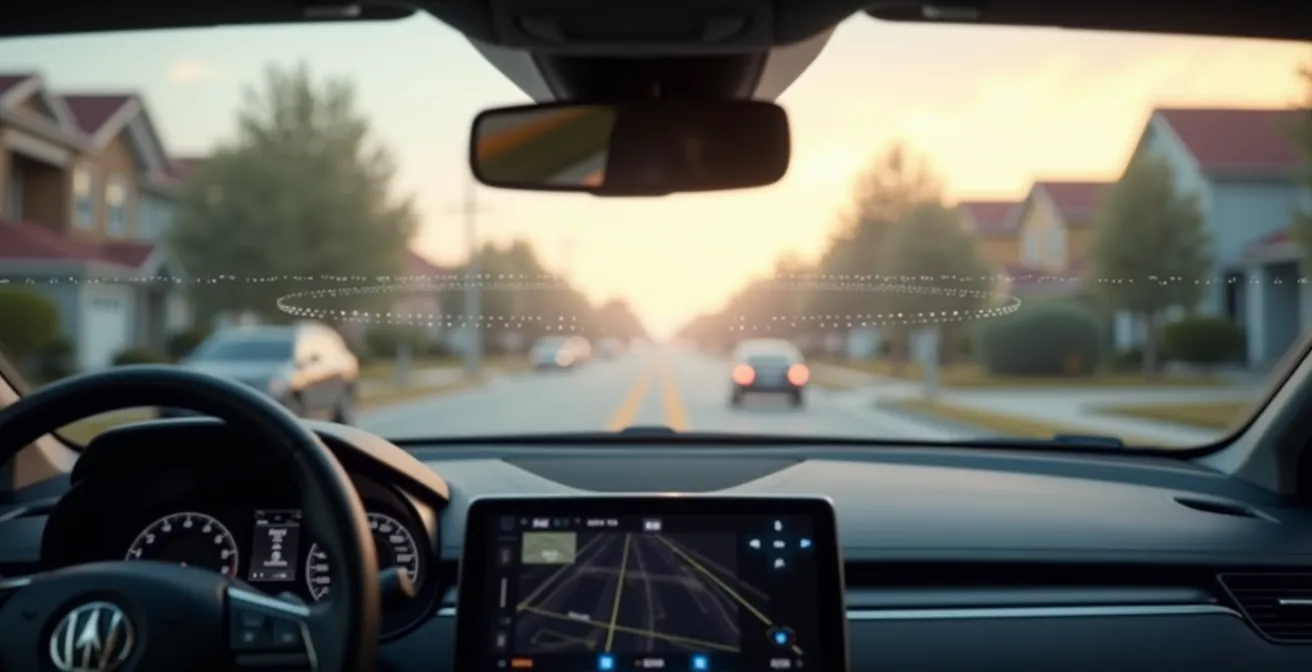
Investing in an ADAS package isn’t a simple discount; it’s an actuarial trade-off where higher repair costs can negate initial premium savings.
- Advanced Driver-Assistance Systems (ADAS) can increase repair bills by over 37%, offsetting the insurance discount you might receive.
- The true financial return comes from leveraging ADAS for usage-based insurance (telematics) to prove safe driving habits and secure deeper, personalized discounts.
Recommendation: The $2,000 package pays off only if you actively use its data for telematics discounts and choose features that demonstrably increase the vehicle’s long-term resale value.
You’re at the dealership, moments away from purchasing a new car. The salesperson presents a compelling option: a ‘$2,000 Safety and Tech’ package, complete with a suite of advanced driver-assistance systems (ADAS). The pitch is straightforward and appealing: these features make the car safer, and insurance companies reward safety with lower premiums. The common wisdom suggests you’ll easily recoup that initial investment through reduced insurance costs over the life of the vehicle. It seems like a financially sound decision, a clear win-win.
But is that the complete picture? An actuarial perspective, the very lens through which insurers view risk, reveals a more complex and nuanced reality. The direct premium discount is often just one variable in a sophisticated equation that also includes significantly higher repair costs for ADAS-equipped vehicles and the emergence of new, data-driven savings opportunities. The critical question for a discerning buyer isn’t merely “Do I get a discount?” but rather, “What is the true net financial value of this technology over the vehicle’s entire lifecycle?”
This analysis moves beyond the surface-level promise of premium reductions. We will deconstruct the cost-benefit of ADAS from an expert standpoint, examining the hidden actuarial factors that determine whether that $2,000 is a wise investment or a sunk cost. By understanding how insurers classify risk, the impact of repair cost inflation, and the power of behavioral data, you can make a decision based on a comprehensive financial model, not just a sales pitch.
This article provides a detailed breakdown of the key financial levers affected by ADAS technology. The following summary outlines the core components of this actuarial analysis to help you navigate your next vehicle purchase with confidence.
Summary: Reducing insurance premiums thanks to driving aids
- Comprendre la classification des risques
- L’erreur de coût de réparation
- Optimiser le score de conduite
- Comparer les systèmes passifs et actifs
- Planifier l’achat pour la valeur de revente
- L’erreur de sous-estimer les coûts d’assurance
- Comprendre les coûts de réparation de l’aluminium
- Maximiser la survie grâce à l’ingénierie structurelle
Understanding risk classification
Insurance pricing is fundamentally about risk classification. Actuaries group drivers and vehicles into pools based on the predicted frequency and severity of claims. Historically, this involved static data: driver age, location, driving record, and the vehicle’s crash-test ratings. The introduction of ADAS adds a dynamic layer to this model. Insurers acknowledge that vehicles equipped with features like Automatic Emergency Braking (AEB) and Blind Spot Monitoring have a lower probability of being in an accident. Consequently, these vehicles are placed in a more favorable risk category, which translates directly into premium discounts for the owner.
However, the discount is not uniform. The depth of the reduction depends on the insurer’s specific actuarial model and the sophistication of the ADAS package. A simple Forward Collision Warning (FCW) might yield a minor discount, whereas a comprehensive suite that includes active intervention systems qualifies for more significant reductions. The core concept for a buyer to grasp is the creation of a new insurability profile. Your vehicle is no longer just a model with a safety rating; it’s a dynamic asset whose risk profile can be actively managed and demonstrated through its onboard technology.
This is where the analysis deepens. Some insurers are moving beyond simply awarding a flat discount for the presence of ADAS. They are leveraging telematics to integrate with these systems, tracking real-world driving habits to offer personalized rates. This means the technology itself becomes a tool for proving you belong in the lowest-possible risk category, unlocking savings that go far beyond a simple equipment-based discount.
The repair cost mistake
The most significant financial oversight when evaluating an ADAS package is underestimating the dramatic inflation in repair costs. While these systems are highly effective at preventing accidents, they transform minor incidents that once required a simple bumper replacement or windshield fix into complex and expensive procedures. The sensors, cameras, and radar units that form the ‘eyes’ of the ADAS are often located in vulnerable areas like grilles, bumpers, and side mirrors. A minor fender-bender can now damage delicate electronics, requiring not just replacement but also precise recalibration.
This isn’t a minor increase; it’s a structural shift in repair economics. A 2023 AAA report revealed a stark reality: vehicles equipped with ADAS face, on average, 37.6% higher repair bills following a collision. This cost inflation directly counteracts the premium savings. Insurers must factor these higher potential claim payouts into their pricing models, which can dampen the very discounts they offer for the technology’s safety benefits. For the car buyer, this means a portion of your premium savings is effectively clawed back to cover the increased financial risk the insurer takes on to cover your technologically advanced vehicle.

The image above highlights the source of this expense: the specialized labor and equipment needed for calibration. After a windshield is replaced, for instance, the camera mounted behind it must be recalibrated to factory specifications to ensure systems like Lane Keep Assist function correctly. This single procedure can add hundreds of dollars to what was once a routine repair. This actuarial net value—the premium discount minus the expected increase in repair-related costs—is the number that truly matters in your financial calculation.
Optimizing your driving score
The single most powerful way to guarantee a positive financial return on an ADAS investment is to actively use it to improve your driving score through a usage-based insurance (UBI) or telematics program. These policies move beyond static risk factors and use real-world data, often collected via a smartphone app or a plug-in device, to price your premium based on how you actually drive. This is where ADAS transforms from a passive safety feature into an active tool for behavioral data monetization.
Insurers offering telematics highly value the smooth, consistent, and defensive driving patterns that ADAS promotes. Every time your Adaptive Cruise Control maintains a safe following distance or your Lane Keep Assist makes a gentle correction, you are generating data that proves you are a low-risk driver. As explained in an analysis by insurance experts, this data stream provides a new level of insight for underwriters.
Many insurers now offer telematics-based policies, where ADAS features integrate with onboard systems to track driving habits. This data allows insurers to offer personalized rates based on individual behavior, rewarding cautious drivers with lower premiums.
– Noble Quote Insurance Analysis, Car Safety Technology Guide 2024
By opting into a UBI program, you are effectively allowing the insurer to verify the risk-reducing behavior that the ADAS enables. This creates a direct feedback loop: using the systems as intended generates a favorable driving score, which in turn leads to substantial, personalized premium discounts that often far exceed the flat-rate discount for simply having the equipment. Your $2,000 investment is no longer just buying hardware; it’s buying a tool to prove your superior insurability profile.
Action plan: How to Maximize UBI Discounts with ADAS
- Consistent Use: Use Adaptive Cruise Control frequently to demonstrate maintenance of safe following distances, a key metric for insurers.
- Smooth Operation: Allow Lane Keep Assist to manage your lane positioning, showcasing smooth and stable control of the vehicle.
- Documented Prevention: Let the Automatic Emergency Braking system’s logs serve as a record of prevented incidents, a powerful testament to the system’s effectiveness.
- Monitor Feedback: Regularly check your telematics app to understand how your ADAS usage is positively impacting your driving score and adjust accordingly.
- Negotiate with Data: When your policy is up for renewal, use your documented safe driving score and ADAS usage patterns as leverage for better rates.
Comparing passive and active systems
Not all ADAS features are created equal in the eyes of an actuary. To make a smart investment, a buyer must distinguish between passive and active systems. Passive systems, like a Forward Collision Warning (FCW), provide only an alert—a beep or a flashing light—requiring the driver to take evasive action. Active systems, such as Automatic Emergency Braking (AEB), can physically intervene by applying the brakes or steering the vehicle on their own.
From an insurance perspective, active systems offer a much higher degree of risk mitigation because they reduce the element of human error. Research consistently shows that active systems are significantly more effective at preventing crashes. For example, extensive data from the Insurance Institute for Highway Safety (IIHS) demonstrates that vehicles equipped with both FCW and AEB see the most dramatic reductions in accidents and injuries. This superior performance translates directly into a higher assigned “safety credit” in actuarial models, leading to larger premium discounts.
The following table, based on IIHS research data, clearly illustrates the difference in effectiveness and the corresponding impact on insurance ratings. A vehicle with active intervention capabilities represents a much lower risk, justifying a more substantial discount.
| System Type | Crash Reduction | Injury Reduction | Insurance Impact |
|---|---|---|---|
| FCW Only (Passive) | 27% | 20% | Moderate discount |
| Low-Speed AEB (Active) | 43% | 45% | Higher discount |
| FCW + AEB (Combined) | 50% | 56% | Maximum discount |
For the buyer calculating the ROI of a $2,000 package, the lesson is clear: prioritize packages that include robust active intervention systems. A package primarily composed of passive warnings will not deliver the same level of insurance savings or safety benefits, making it a less sound financial investment. The presence of AEB, in particular, is a powerful negotiating tool when discussing premiums with an insurer.
Planning the purchase for resale value
The financial analysis of an ADAS package extends beyond immediate insurance savings. A crucial component of the total return on investment is the vehicle’s resale value. The automotive market is rapidly evolving, and safety technology is becoming a key differentiator for used car buyers. A vehicle equipped with a comprehensive and modern ADAS suite will be more attractive and command a higher price than a base model of the same year.
Think of it as future-proofing your investment. As ADAS features transition from luxury options to standard equipment, older vehicles without them will appear dated and less safe, leading to faster depreciation. By investing in the safety package now, you are aligning your vehicle with the future expectations of the market. This is particularly true for features that have become highly sought-after by consumers, such as Automatic Emergency Braking and Blind Spot Detection. These are no longer just acronyms on a spec sheet; they are tangible safety benefits that used car shoppers actively look for and are willing to pay a premium to have.
To maximize this financial benefit, it is essential to focus on the right features and to document them properly. When it comes time to sell, being able to provide the original window sticker detailing the full list of safety systems, along with service records showing proper maintenance and calibration, provides concrete proof of the vehicle’s value. This transforms the ADAS package from an expense into a tangible asset that pays dividends at the end of the ownership cycle.
- Prioritize Automatic Emergency Braking (AEB) as it is widely recognized as the most valuable single safety feature by both safety organizations and consumers.
- Include Adaptive Cruise Control (ACC), especially for vehicles that will be used for highway driving, as it is a major convenience and safety feature.
- Add Blind Spot Detection (BSD) and Rear Cross-Traffic Alert (RCTA), which provide significant confidence for urban and suburban driving.
- Keep the original window sticker and all service records to document the ADAS features and their proper maintenance for the next owner.
The mistake of underestimating insurance costs
While the prevailing logic suggests ADAS leads to lower premiums, buyers must be aware of a counterintuitive risk: in some cases, these systems can be viewed as a liability by insurers. The concern stems from a concept known as risk compensation. This is the theory that drivers, feeling protected by a technological safety net, may be inclined to take risks they would otherwise avoid, such as driving while distracted, assuming the car will intervene if something goes wrong.
This creates a complex actuarial problem. Does the risk reduction from the technology outweigh the potential for increased risk-taking behavior by the driver? Some insurers adopt a cautious stance, as noted by industry analysts.
Some insurance companies may view these technologies as a liability because they can create a false sense of security for drivers, leading them to take risks they wouldn’t otherwise take.
– TopDon Technology, The Impact Of ADAS On Car Insurance Premiums
This means a car buyer cannot simply assume their premium will drop. The final rate is a result of the insurer’s specific formula, which balances the safety benefits against the high repair costs and the potential for risk compensation. A buyer’s most powerful tool is to be proactive. Never assume a discount will be applied automatically. It is essential to shop around and speak directly with multiple insurance carriers, armed with the vehicle’s specific list of ADAS features from the window sticker, and ask precisely what discounts apply.

This proactive comparison is the only way to get a true picture of the insurance cost. One carrier might offer a substantial discount for an ADAS package, while another might offer a minimal one, effectively wiping out the financial benefit of your $2,000 investment. The key is to secure quotes and document the applied discounts before finalizing the vehicle purchase.
Understanding aluminum repair costs
The issue of repair cost inflation is further magnified when ADAS is combined with modern vehicle construction materials, particularly aluminum. Automakers are increasingly using aluminum for body panels to reduce weight and improve fuel efficiency. While effective for performance, aluminum is significantly more difficult and expensive to repair than traditional steel. It requires specialized training, dedicated tools, and a segregated repair environment to prevent cross-contamination. This drives up labor rates and the overall cost of bodywork.
When a vehicle has both an aluminum body and an ADAS suite, the costs compound. A minor collision can now necessitate not only the replacement and calibration of expensive sensors but also specialized, high-cost repairs to the aluminum panels they are mounted on. The Ford F-150, with its pioneering aluminum body and available ADAS, provides a stark case study. Repair data shows that a front-end collision on this model can lead to repair bills exceeding $14,000, a figure that reflects the dual impact of advanced materials and technology.
Even a seemingly simple repair like a windshield replacement becomes a multi-faceted expense. The glass itself may contain heating elements or acoustic layers, but the primary cost driver is the subsequent ADAS recalibration. As Car Talk research shows, ADAS sensor calibration costs range from $250 to $700, a significant surcharge on top of the windshield replacement itself. For a buyer, this means understanding that the total cost of ownership is intrinsically linked to these higher, often hidden, repair liabilities. The initial $2,000 for the safety package is just the beginning of the financial commitment.
Key takeaways
- ADAS discounts are real but are often counterbalanced by a 30-40% increase in average repair costs, a critical factor in the net financial outcome.
- The highest and most reliable financial return on an ADAS package comes from leveraging it within a telematics (UBI) program to prove safe driving habits and earn personalized discounts.
- A positive ROI depends on prioritizing active systems like AEB, which deliver the greatest safety benefits and insurance credits, and choosing features that enhance long-term resale value.
Maximizing survival through structural engineering
Ultimately, the actuarial value of ADAS is rooted in its ability to prevent crashes and, when a crash is unavoidable, to mitigate injury severity. This electronic layer of safety works in concert with the vehicle’s fundamental structural integrity. A car’s crashworthiness—its ability to protect occupants through the design of crumple zones, high-strength steel cages, and airbag systems—remains the bedrock of passenger safety. ADAS is a powerful complement to this foundation, not a replacement for it.
As the American Association of Insurance Services notes, actuaries view these systems as a complete package. The data is unequivocal: when advanced electronics are paired with robust physical engineering, the reduction in occupant injuries is profound. According to IIHS data on vehicles with both forward collision warning and automatic emergency braking, this combination results in a remarkable 64% reduction in injuries in rear-end crashes. This dramatic drop in claim severity is the ultimate goal for insurers and the most compelling argument for the technology’s value.
ADAS technologies complement traditional rating variables, such as vehicle build, in insurance ratemaking. While vehicle build characteristics like crash-test ratings and structural design provide important insights, ADAS offers a dynamic layer of risk assessment… providing an additional layer of protection beyond the inherent safety features of the vehicle itself.
– American Association of Insurance Services, Advanced Driver Assistance Systems- A Game-Changer for Auto Insurance Ratemaking
For the car buyer, this brings the analysis full circle. The $2,000 investment is not just for convenience or a simple discount. It is a purchase of a sophisticated, integrated safety system where electronics and structural engineering work together to dramatically lower the risk of injury. While the day-to-day financial return may be a complex calculation of discounts versus repair costs, the potential to avoid the physical, emotional, and financial trauma of a serious accident represents an immeasurable, and perhaps the most important, return on investment.
Therefore, when evaluating that $2,000 safety package, your final step should be a practical one. Arm yourself with the vehicle’s exact list of ADAS features and contact multiple insurers to get specific quotes. Compare not only the upfront discounts but also their approach to telematics programs to ensure your investment is optimized to work for you financially, providing both safety on the road and a positive return in your wallet.