
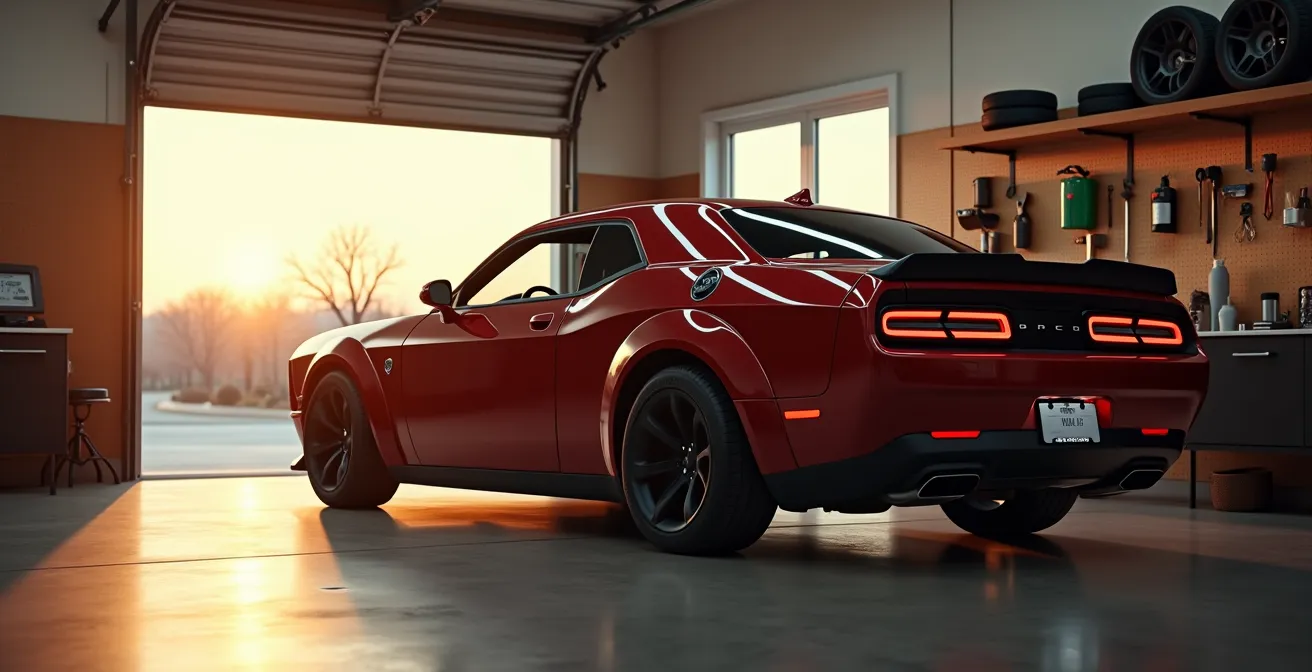
Choosing a daily-driver performance car is less about the spec sheet and more about honestly assessing its real-world compromises.
- Hidden costs, often called the “performance tax,” include significant insurance premium hikes, specialized maintenance, and rapid tire wear.
- Day-to-day practicality—such as visibility, cargo space, and winter capability—often matters more than peak horsepower for overall satisfaction.
Recommendation: Use a “Livability Audit” on your next test drive to evaluate a car beyond its raw performance numbers and ensure it fits your actual lifestyle.
The fantasy is intoxicating: the guttural rumble of a V8 as you merge onto the highway for your morning commute, the crisp shift of a performance-tuned transmission, and the knowledge that immense power is always under your right foot. For car enthusiasts with practical needs—a family, a daily commute, grocery runs—the idea of a modern American performance car like a Mustang, Camaro, or even a Corvette serving as a one-car solution is more tempting than ever. Automakers promise newfound comfort, technology, and reliability that make these cars genuinely usable every day.
Most advice stops there, offering a simple list of popular models and their horsepower figures. This approach misses the fundamental point. The challenge isn’t finding a car with enough power; it’s about decoding the unspoken compromises and hidden costs that come with it. The true measure of a daily-driven performance car isn’t its 0-60 time, but its ability to integrate into the mundane, frustrating, and unpredictable realities of everyday life without driving you insane.
But what if the key wasn’t just accepting compromise, but understanding it so deeply that you can choose the *right* set of trade-offs for your specific life? This guide provides a strategic framework to do just that. We will move beyond the spec sheets to dissect the crucial factors that determine true livability, from the financial sting of the “performance tax” to the practicalities of a winter snowstorm.
This article provides a structured approach to making a smart decision. The following sections will walk you through the essential considerations, from ergonomics and hidden costs to long-term ownership realities, equipping you to choose a car that thrills you on the weekend without becoming a burden during the week.
Summary: A Real-World Guide to Modern American Performance Cars
- Comprendre l’habitabilité réelle
- L’erreur de sous-estimer les coûts d’assurance
- Optimiser la conduite hivernale
- Comparer les transmissions automatiques et manuelles
- Planifier la revente et la dépréciation
- Identifier les compromis techniques des moteurs modernes
- Optimiser l’admission d’air
- Anticiper les erreurs d’autrui pour survivre sur la route
Comprendre l’habitabilité réelle
The first and most crucial mental shift is to look past the horsepower and focus on the “livability audit.” This is the evaluation of how the car functions in the 99% of moments you aren’t at wide-open throttle. It’s about the ease of getting in and out after a long day, the visibility when backing into a tight spot, and whether you can actually fit a week’s worth of groceries. Performance cars are notorious for prioritizing form over function, resulting in high door sills, low roofs, and gun-slit windows that can turn a simple trip to the store into a chore.
However, modern engineering has made surprising strides. The mid-engine C8 Corvette, for example, has proven itself a remarkably practical daily driver. It features not only a trunk large enough for two golf bags but also a “frunk” (front trunk) perfectly suited for grocery bags. This kind of thoughtful packaging is a key differentiator. The interior ergonomics—the placement of cup holders, the intuitiveness of the infotainment system, and the comfort of the seats in stop-and-go traffic—are the details that define daily satisfaction.
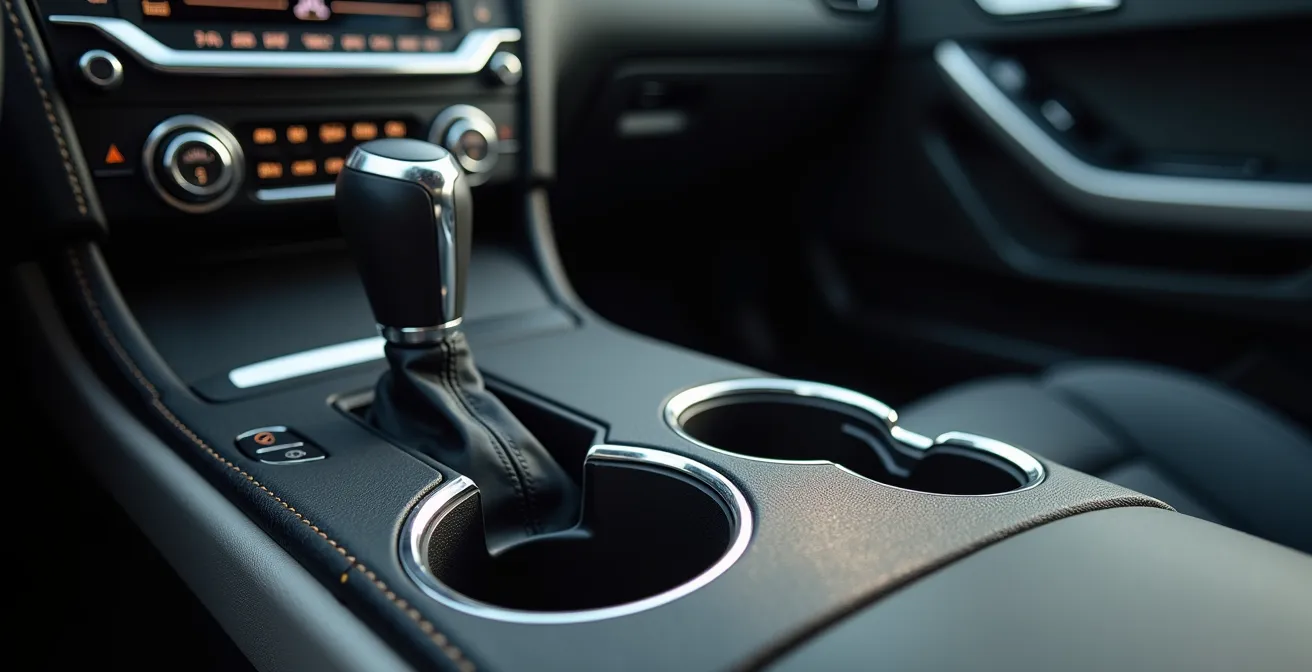
As the image above highlights, the tactile experience of the materials and the layout of daily touchpoints are paramount. You must physically interact with a car to assess its livability. A spec sheet won’t tell you if the low seating position will strain your back or if the massive blind spots of a Camaro will give you anxiety every time you change lanes. Before you fall in love with the sound, perform a rigorous audit of the silence and the stillness of daily use.
Your Livability Audit Checklist
- Trunk Capacity: Does it fit two standard carry-on suitcases or the contents of a full grocery cart?
- Rear Seat Access: If applicable, how difficult is it to install a child seat? Check for LATCH anchor accessibility.
- Ingress/Egress: Can you get in and out comfortably in a tight parking spot without being a contortionist?
- Visibility: Realistically assess blind spots using all mirrors and the backup camera. Is rear-quarter visibility adequate for highway merges?
- Daily Ergonomics: Are cup holders well-placed and usable? Is the infotainment system responsive and easy to navigate in traffic?
Ultimately, a successful daily-driven performance car is one where the ergonomic and practical compromises are ones you can happily live with, not just tolerate.
L’erreur de sous-estimer les coûts d’assurance
After the initial purchase price, the most significant and often overlooked financial burden is what can be termed the “hidden performance tax.” This is a collection of recurring costs that are substantially higher for performance vehicles, with insurance premiums being the most prominent component. Enthusiasts, captivated by a seemingly affordable sticker price on a used Mustang GT, often fail to budget for an insurance quote that can be double or even triple that of a standard sedan. Insurers see a high-horsepower, rear-wheel-drive V8 not as a weekend toy, but as a high-risk liability.
This isn’t a new phenomenon. In fact, soaring muscle car insurance costs became one of the primary factors that contributed to the segment’s decline at the beginning of the 1970s. History is repeating itself, but with more sophisticated risk analysis by insurance companies. They factor in not just the driver’s record, but the specific model’s claims history, theft rates, repair costs, and horsepower figures. A Ford Mustang GT will carry a much higher premium than a 4-cylinder EcoBoost model, even for the same driver.
This “tax” extends beyond insurance. High-compression engines often require or strongly recommend premium fuel, adding a significant cost at every fill-up. Performance tires, essential for safely deploying the car’s power, wear out much faster and cost significantly more to replace than standard all-seasons. Brakes, oil changes, and other routine maintenance items are also more expensive due to their specialized, heavy-duty nature. Forgetting to account for this cumulative financial pressure is the single biggest mistake a prospective owner can make, turning a dream car into a financial nightmare.
Before signing any papers, get multiple insurance quotes and create a realistic annual budget that includes fuel, tires, and maintenance. This figure is the true cost of ownership, not the number on the window sticker.
Optimiser la conduite hivernale
For anyone living outside the sun belt, the question of “seasonal capability” is not trivial; it’s a critical safety and usability concern. A high-torque, rear-wheel-drive car on summer performance tires is dangerously useless in snow, ice, or even just cold, damp conditions below 45°F (7°C). The tire compound becomes hard and loses its grip, making even gentle throttle application a recipe for a spin-out. Ignoring this reality is not an option. You have two primary paths: dedicating to a winter tire setup or specifically choosing a model with All-Wheel Drive (AWD).
A dedicated set of winter tires on separate wheels is the traditional and most effective solution for RWD performance cars. While it involves an initial investment and the hassle of seasonal storage and changeovers, it transforms the car’s capability, providing astonishing levels of grip and safety in harsh conditions. All-season tires, while tempting as a one-size-fits-all solution, are a significant compromise.
The following table breaks down the fundamental trade-offs, based on data regarding daily driver sports cars.
| Aspect | All-Season Tires | Dedicated Winter Tires |
|---|---|---|
| Cost | No additional tire set needed | $800-1500 for set + storage |
| Performance Trade-off | Compromised in all conditions | Optimal winter grip, summer storage needed |
| High-Torque RWD Safety | Limited traction below 45°F | Maintains grip in snow/ice |
A growing alternative is opting for a performance car with AWD. While historically rare in the American muscle segment, models like the Dodge Challenger GT offer a V6 with AWD, providing a massive boost in all-weather confidence. While it may not be a V8, it’s a car you can drive 365 days a year without anxiety. As analysis of all-weather sports cars demonstrates, having an AWD system on a powerful vehicle can make daily driving significantly less stressful when the weather turns bad.
Your choice depends on your tolerance for hassle versus your desire for V8 power. Underestimate winter at your peril; it’s the ultimate test of a performance car’s daily-driver credentials.
Comparer les transmissions automatiques et manuelles
The “manual versus automatic” debate is as old as the automobile itself, but in the context of modern performance cars, the arguments have fundamentally changed. For decades, the manual gearbox was the undisputed king for engagement and often, for outright performance. Today, that is no longer the case. Advanced multi-clutch and torque-converter automatics, often with 8, 9, or 10 speeds, can shift faster than any human, keep the engine in its optimal power band, and often deliver better acceleration figures and fuel economy.
This technical superiority is undeniable. A prime example is the Ford GT, which moved from a V8 to a smaller 3.5-liter EcoBoost V6 with a twin-turbo setup paired exclusively with an advanced automatic. The result? A blistering 10.8-second quarter-mile time and a 0-60 mph sprint in under three seconds. This showcases how modern automatics are not a compromise but an enhancement to performance. They also offer a significant advantage in the daily-driving grind of stop-and-go traffic, where constantly working a heavy performance clutch can become exhausting.
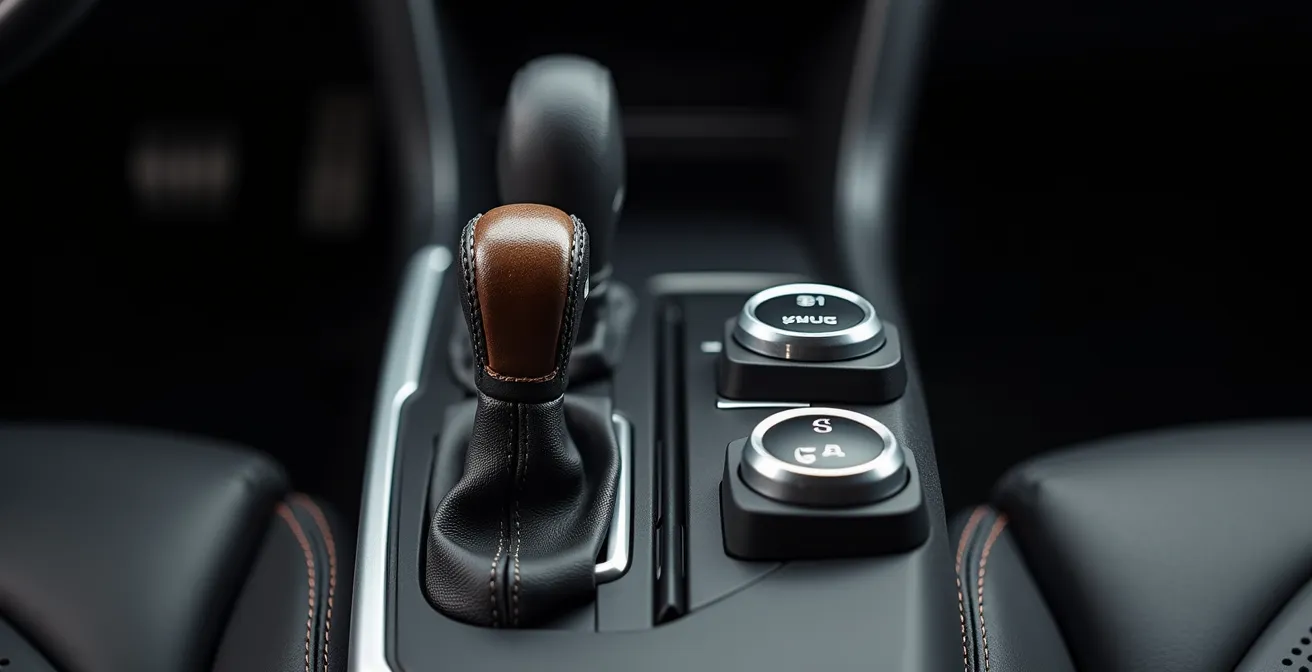
However, the choice is not purely about numbers. The manual transmission’s appeal is now almost entirely emotional and philosophical. It offers a level of mechanical connection and driver involvement that no paddle-shifter can replicate. The satisfaction of a perfectly executed heel-toe downshift or rowing through the gears on an open road is a core part of the enthusiast experience for many. It forces you to be an active participant in the act of driving. Choosing a manual today is a deliberate act—a choice to prioritize engagement over outright pace and convenience.
Your daily commute and driving style should be the deciding factor. If your drive is mostly congested city streets, an automatic will be a godsend. If you have access to open, winding roads and cherish driver involvement above all else, the manual still holds a powerful, almost anachronistic, allure.
Planifier la revente et la dépréciation
One of the smartest ways to afford a daily-driven performance car is to master the art of “depreciation arbitrage.” Performance cars, especially high-end sedans and coupes, suffer from staggering initial depreciation. The moment a new car is driven off the lot, it loses thousands in value. This is a disaster for the first owner, but a massive opportunity for the second. By targeting a car that is two to three years old, you let someone else absorb the steepest part of the value curve.
This strategy is particularly effective for American performance cars. As market analysis of used performance models reveals, depreciation makes it possible to own a high-end model for a fraction of its original cost, without sacrificing much in terms of features or performance. A three-year-old Mustang GT or Camaro SS often sells for 30-40% less than its new counterpart, while still offering the same thrilling experience and modern technology.
On the flip side, if you plan to buy new, you must think about maximizing your car’s future resale value from day one. Certain choices can make a significant difference when it’s time to sell. These decisions go beyond just mileage and condition; they involve spec’ing the car intelligently for the future enthusiast market. Some key strategies include:
- Choose ‘Hero Colors’: Iconic, model-specific colors like Ford’s Grabber Blue or Dodge’s Go Mango often command a premium on the used market over generic black, white, or silver.
- Select Key Performance Packages: Options like track packs, upgraded brakes, or adaptive suspension (e.g., MagneRide) are highly desirable and help a car retain its value.
- Document All Maintenance: Keep a meticulous record of all service, especially oil changes using high-quality synthetic oils. This builds trust with the next buyer.
- Consider Special Editions: If the initial premium for a special or limited edition is reasonable (e.g., under 15% of the base price), these models often depreciate much slower.
By either buying smartly on the depreciation curve or spec’ing your new car for future value, you can make the dream of daily-driving a performance machine far more financially sustainable.
Identifier les compromis techniques des moteurs modernes
The heart of any American performance car is its engine, and the debate between engine philosophies—primarily the traditional pushrod V8 versus the more complex Dual Overhead Cam (DOHC) V8—is often misunderstood. It’s not a simple case of old-tech versus new-tech. Both are highly advanced, but they represent different approaches to making power, each with its own set of compromises for a daily driver. The modern pushrod V8, as found in the Corvette and Camaro SS, is a marvel of engineering: compact, lightweight, and capable of producing immense low-end torque.
This design’s primary advantage is its small physical footprint and lower center of gravity, which improves handling. The simplicity also translates to proven durability and generally lower-cost maintenance. However, this design is often unfairly labeled as unsophisticated, a point passionately refuted by experts. As one analyst from Car Throttle notes, the perception is deeply flawed:
I struggle to understand why 16-valve, cam-in-block V8 engines built from aluminium, steel and titanium, operated through advanced computer control, using technologies like direct injection and variable valve timing, spinning to 7000rpm and developing 500 naturally-aspirated horsepower are somehow considered low-tech and unsophisticated next to DOHC designs. It’s a different approach to horsepower, not better or worse.
– Car Throttle, 4 Ways Top Gear Misled The World On American Performance Cars
In contrast, DOHC engines, like Ford’s “Coyote” V8, are physically larger and more complex, but they excel at breathing at high RPMs, delivering a thrilling top-end power rush. This high-revving nature can be exciting but may be less useful in daily driving than the instant, low-end grunt of a pushrod. Furthermore, the complexity of four camshafts and more moving parts can potentially lead to more expensive repairs down the line. These engines, along with modern high-compression designs, also come with implicit compromises, such as a strict requirement for premium fuel to prevent engine knock and achieve advertised power figures.
There is no single “better” engine. The choice is between the effortless, low-rpm torque of a pushrod V8 and the high-revving, symphonic character of a DOHC V8. Your preference should align with the kind of driving experience you value most day-to-day.
Optimiser l’admission d’air
For many new owners, the first temptation is to modify their car to unlock more power, and the cold air intake is one of the most popular starting points. The theory is simple: a less restrictive intake allows the engine to breathe more cold, dense air, which should result in more power. This is rooted in history; as federal emissions regulations took hold in the 1970s, manufacturers were forced to add components that choked engines and, as historical automotive analysis points out, caused horsepower numbers to plummet. The aftermarket industry boomed by offering solutions to reverse this.
However, on a modern, computer-controlled engine, the “gains” from a simple intake swap are often negligible and can sometimes come with unintended consequences. The factory airbox is the result of millions of dollars in research and development, designed to provide excellent filtration, manage air temperature, and minimize unwanted noise, all while supplying more than enough air for the stock engine’s needs. An aftermarket intake might produce a more aggressive induction sound—which can be a desirable outcome in itself—but the claimed power increases of 10-15 horsepower are often only achievable at the very peak of the RPM range, a place rarely visited in daily driving.
Before spending several hundred dollars on a polished tube and a conical filter, it’s critical to consider the real-world trade-offs. A poorly designed intake can actually hurt performance by drawing in hot air from the engine bay (a phenomenon known as heat soak), and its less-effective filter might allow harmful particulates into your engine over the long term. If you’re considering this modification, do so with your eyes open.
- Warranty Implications: While the Magnuson-Moss Act protects you, a dealer may still try to blame a modification for an unrelated engine issue, leading to a potential fight.
- Noise vs. Drone: The exciting induction roar at full throttle might become an annoying, droning noise on a long highway cruise.
- Filtration Efficiency: An oiled, high-flow filter may not protect your engine as well as the factory paper element over tens of thousands of miles.
- Documented Gains: Research independent dyno tests for your specific car model, not just the manufacturer’s marketing claims.
For a daily driver, the marginal performance benefit of an intake rarely outweighs the potential downsides in noise, filtration, and warranty headaches. The money is often better spent on high-quality tires or driver training.
Key Takeaways
- The “performance tax” is a real and significant cost, encompassing elevated insurance premiums, premium fuel requirements, and rapid tire wear.
- A personal “Livability Audit”—evaluating visibility, ergonomics, and cargo space—is more critical for daily satisfaction than reading a spec sheet.
- Depreciation can be a powerful financial tool; buying a 2-3 year old car allows you to avoid the steepest value loss and makes ownership more affordable.
Anticiper les erreurs d’autrui pour survivre sur la route
Owning a visually striking performance car introduces a social and psychological element to daily driving that owners of mundane sedans never experience. An iconic pony car like a Mustang or a vibrant C8 Corvette acts as a magnet for attention—both wanted and unwanted. You will be challenged to impromptu races at traffic lights, tailgated by aggressive drivers, and generally scrutinized more than anyone else on the road. This constant attention means you must adopt a heightened state of defensive driving, always anticipating the poor decisions of others.
This iconic status can be a double-edged sword. While it’s part of the pride of ownership, it also means you are a target. De-escalation is your most powerful tool. This means consciously avoiding eye contact with goading drivers, refusing to engage, and maintaining a steady, predictable speed. Your car’s immense power is a tool for escaping dangerous situations (like merging into fast-moving traffic), not for winning meaningless street-level ego contests. The risk of an accident, a costly ticket, or worse is simply too high.
Furthermore, the inherent design of these cars often works against you. The poor rearward visibility of a Camaro, the long hood of a Challenger, or the low seating position of a Corvette can make it difficult to see surrounding traffic. Mastering your car’s blind spots and properly setting your mirrors is not just a good habit; it’s a survival skill. You must drive as if you are invisible to others, while simultaneously being the most visible car on the road. A few key defensive strategies are non-negotiable:
- Master Your Mirrors: Adjust your side mirrors outward to eliminate blind spots, relying more on your rearview mirror for what’s directly behind you.
- Increase Following Distance: Performance cars are often “brake-checked.” Leave extra space to give yourself more time to react.
- Respect the Conditions: In wet or cold weather, traction control is your best friend. Do not get overconfident, as high torque can easily overpower the available grip.
- Install a Dash Cam: It is an inexpensive insurance policy to document the aggressive behavior of other drivers and protect you in the event of an incident.
Now that you’re equipped with this strategic framework, the next step is to apply it. Begin shortlisting cars that align with your tolerance for these compromises, and schedule test drives with your “Livability Audit” checklist in hand to make a choice that satisfies both the enthusiast and the daily driver within you.