
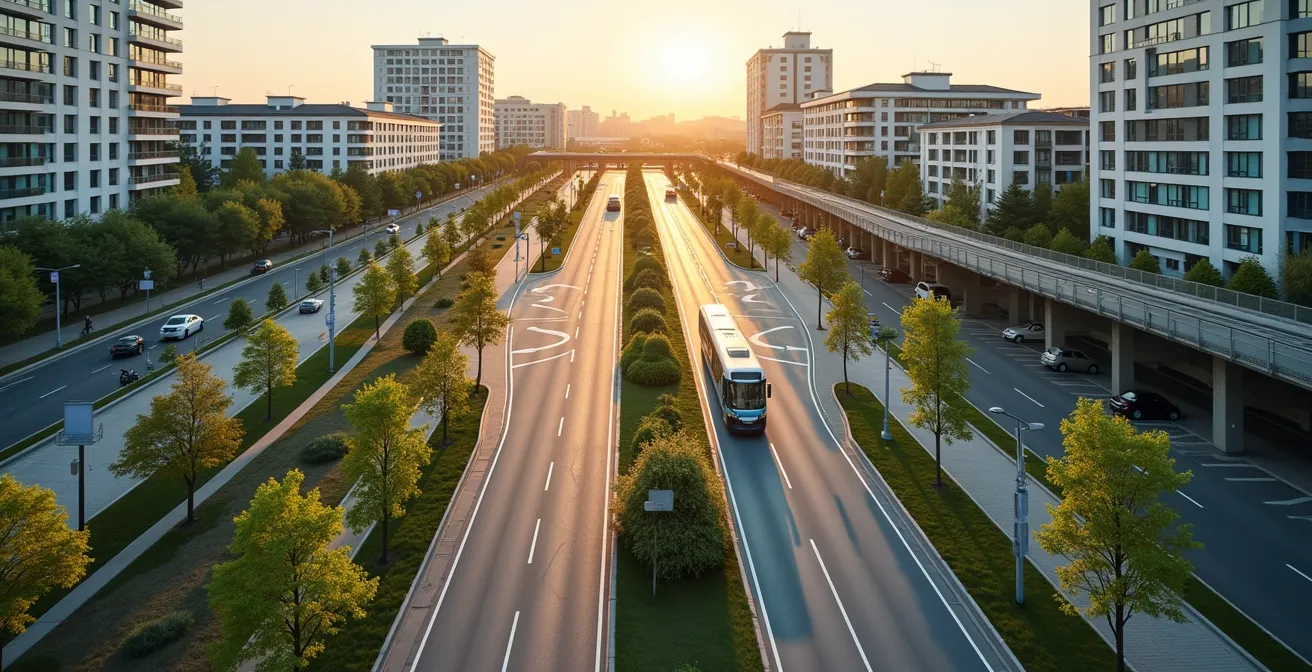
The transition to sustainable mobility is less about the vehicles we use and more about the strategic revaluation of every urban asset, from parking lots to curb space.
- This shift creates “stranded assets” like gas stations while simultaneously boosting property values in hyper-local “15-minute” neighborhoods.
- True progress lies in integrating low-tech solutions and shared systems, moving beyond the simple replacement of gas cars with electric ones.
Recommendation: Planners and investors must now prioritize proximity, access, and multimodality as the new, primary drivers of urban value and growth.
The conversation around the future of urban transport often centers on gleaming electric cars and expanded bike lanes. While important, this view misses the seismic shift happening beneath the surface. We are not just witnessing a change in how we move; we are at the beginning of a great urban rewiring, a fundamental re-engineering of city life itself. This transformation is not about replacing one technology with another, but about redefining the very concepts of distance, access, and value in our metropolitan landscapes.
For decades, urban design has been subjugated to the needs of the private automobile. This paradigm is now collapsing under its own weight, driven by environmental mandates, technological disruption, and a growing demand for more livable, human-centric spaces. For urban planners, real estate investors, and concerned citizens, understanding this transition requires looking past the vehicles and focusing on the infrastructure. The core of this revolution lies in a massive revaluation of urban assets, where the value of space is no longer determined by its ability to store cars, but by its capacity to facilitate access and foster proximity.
This article will deconstruct this complex transformation. We will explore the economic challenges posed by obsolete infrastructure, analyze the emerging real estate opportunities in “15-minute cities,” and debunk the myth that electric cars are a panacea. By navigating through policy, technology, and human behavior, we will build a comprehensive vision of the truly smart, sustainable, and connected city of tomorrow.
This in-depth analysis will guide you through the critical facets of this urban evolution. The following sections break down the challenges, opportunities, and strategic imperatives for anyone invested in the future of our cities.
Summary: The Blueprint for a New Urban Landscape
- Identifier les défis de transition
- Comprendre l’impact sur l’immobilier
- L’erreur de penser uniquement “voiture électrique”
- Optimiser l’usage partagé
- Planifier les politiques publiques
- Planifier l’électrification selon les mandats US
- Planifier les trajets multimodaux
- Naviguer dans les villes intelligentes pour gagner du temps
Identifier les défis de transition
The transition to sustainable mobility is not a seamless upgrade; it is an economic disruption with significant financial consequences. The most immediate challenge is the emergence of stranded assets: infrastructure built for a fossil-fuel-based economy that is rapidly losing its value and purpose. Globally, the value of potentially stranded fossil fuel assets is estimated at $1.4 trillion, a figure that represents a monumental risk to investors and municipalities. This isn’t a distant threat; it’s a present-day reality.
A prime example can be seen in California, where gas stations are facing an existential crisis. With zero-emission vehicles accounting for over 25% of the new car market and a full ban on new gasoline car sales set for 2035, the business model is collapsing. Many underground fuel storage tanks are nearing their mandatory retirement age, requiring huge capital investments for replacement. Station owners are now forced to question the viability of such an investment, knowing their core product is being phased out. This creates a landscape dotted with properties whose primary function is becoming obsolete, forcing a reckoning in commercial real estate.
The scale of this issue is staggering, with some research projecting that in a net-zero scenario, as much as half of the global fossil fuel assets could become stranded by 2036. For urban planners, this isn’t just about empty lots; it’s about proactively managing a wave of asset devaluation and finding visionary ways to repurpose this land for a post-car future.
Comprendre l’impact sur l’immobilier
As old assets lose value, new value is being created elsewhere. The most profound impact of sustainable mobility on real estate is the shift from a model based on car access to one based on proximity. The “15-minute city” concept, championed by cities like Paris, is the clearest expression of this new paradigm. The goal is to redesign urban space so that all essential services—jobs, shopping, healthcare, parks, and culture—are reachable within a 15-minute walk or bike ride. This is not just a lifestyle enhancement; it is a fundamental driver of real estate valuation.
In Paris, this vision is backed by substantial investment and decisive policy. According to a report on the initiative, the city has committed EUR 350 million to enhance pedestrianization and cycling infrastructure. A key measure includes removing 60,000 on-street parking spaces. By de-prioritizing car storage, the city frees up valuable public space and creates a powerful incentive for a lifestyle less dependent on private vehicles. Properties located within these well-serviced, walkable neighborhoods are seeing their desirability—and therefore their value—increase significantly. Proximity is becoming the ultimate luxury.
This process of asset revaluation is most visible in the transformation of car-centric infrastructure. Former parking garages, once essential, are now prime candidates for redevelopment into more productive uses that serve the community.
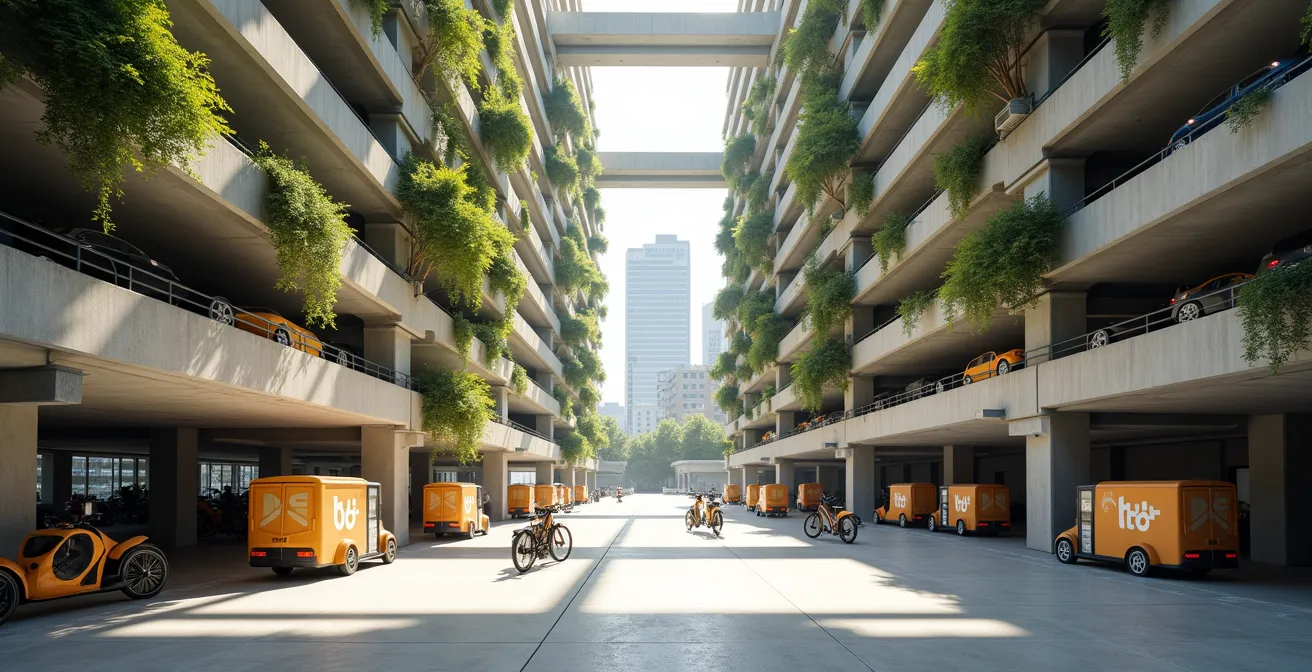
This image perfectly illustrates the potential. A structure once dedicated solely to storing idle vehicles is reborn as a dynamic hub for micro-logistics, vertical farming, and community space. For investors and developers, the ability to identify and transform such underutilized assets is becoming a key competitive advantage in the new urban economy. The question is no longer “How many parking spots are there?” but “How connected is this location to the fabric of the neighborhood?”
L’erreur de penser uniquement “voiture électrique”
A common but critical mistake in envisioning the future of cities is equating “sustainable mobility” solely with “electric cars.” While EVs are a piece of the puzzle, simply replacing millions of internal combustion engine vehicles with millions of electric ones fails to address core urban problems like congestion, the inefficient use of space, and inactive lifestyles. A truly sustainable vision requires a much broader perspective that embraces micromobility and effective, low-tech solutions.
The rise of shared e-bikes and scooters demonstrates a powerful public appetite for alternatives. For instance, a recent European mobility report shows that Barcelona’s Bicing network saw a 22% growth in e-bike ridership in a single year. These modes are not just for leisure; they are increasingly used for daily commutes, being faster and more convenient than cars for many urban trips. They require a fraction of the space for parking and movement, directly contributing to a more efficient and pleasant urban environment.
Furthermore, some of the most impactful changes have nothing to do with high-tech vehicles. Instead, they rely on thoughtful behavioral architecture—designing the city in a way that naturally encourages walking and cycling. These low-tech, high-impact interventions are often more cost-effective and create more immediate benefits for residents’ quality of life.
Action Plan: Implementing Low-Tech Urban Mobility Solutions
- Expand tree canopy coverage to create shaded, pleasant walking paths and reduce urban heat island effects.
- Install comprehensive street furniture, including benches every 100 meters, to provide rest stops for all pedestrians, especially the elderly.
- Create dedicated and protected cargo-bike lanes, separate from both regular cycling and vehicle traffic, to support last-mile logistics.
- Establish urban consolidation centers on the city periphery to coordinate last-mile deliveries and reduce truck traffic in the core.
- Design car-free “superblocks” that prioritize public squares, pedestrian zones, and community spaces over through-traffic.
This approach demonstrates that the most visionary plan isn’t always the most technologically complex. It is about creating a rich ecosystem of options where the most sustainable choice is also the easiest and most enjoyable one.
Optimiser l’usage partagé
The next layer in the urban mobility transformation is the optimization of assets through shared use. The traditional model of private car ownership is incredibly inefficient; most cars sit parked for over 95% of their lifetime, occupying valuable urban space. Shared mobility—from bike-sharing to car-sharing—directly addresses this inefficiency by allowing multiple users to access a single vehicle, dramatically increasing its utilization rate and reducing the overall number of vehicles needed.
Cities that fully embrace and electrify their shared fleets see remarkable results. Madrid’s fully-electric BiciMAD bike-share system, for example, achieved a 30% year-over-year increase in ridership, demonstrating how providing reliable, accessible, and sustainable options can shift user behavior. The key is creating an infrastructure symbiosis, where different modes work together seamlessly. This is the logic behind integrated mobility hubs, a concept masterfully executed in Singapore.
Singapore’s approach is to build its entire transport network around these hubs. The nation is expanding its rail network to place 80% of households within a 10-minute walk of a train station. These stations are not just transit stops; they are designed as nodes where commuters can effortlessly switch between the train, bus, shared bikes, or scooters. This integration makes multimodal journeys simple and intuitive, removing the friction that often discourages people from leaving their cars at home.
This human-centric approach to technology is what makes shared systems successful. It’s about the trust and ease of the transaction, creating a sense of collective ownership over the city’s mobility resources.

The success of shared mobility ultimately hinges on this seamless user experience. When accessing a bike or a car is as easy as tapping a card or a phone, the psychological barrier to giving up a private vehicle is significantly lowered. It transforms mobility from a product you own into a service you access on demand.
Planifier les politiques publiques
Technology and infrastructure alone are not enough to drive the urban mobility transition; they must be guided by clear, decisive, and well-funded public policies. Governments play the critical role of market-shaper, setting the rules of the game and providing the incentives that steer private investment and public behavior toward sustainable outcomes. After a dip during the pandemic, global surveys show public transit usage has rebounded, increasing by 10 percentage points, underscoring its foundational role in urban life and the need for continued policy support.
Different cities have adopted distinct policy approaches to achieve similar goals, offering a valuable comparative framework for planners. An analysis of major European cities reveals a variety of successful strategies, each tailored to its local context. Paris focuses on neighborhood-level transformation, Barcelona on creating car-free superblocks, Oslo on a gradual city-center car ban, and Madrid on a station-based e-bike system while banning dockless competitors.
This comparative data, drawn from analyses by firms like Deloitte, provides a clear picture of the tools available to policymakers. As detailed in a recent comparative analysis of urban mobility, these strategies combine investment with regulation to achieve tangible results.
| City | Policy Focus | Investment | Key Measure |
|---|---|---|---|
| Paris | 15-minute neighborhoods | EUR 350 million | Remove 60,000 parking spaces |
| Barcelona | Superblocks | Not specified | 31% increase in commercial activity |
| Oslo | Car-free center | Progressive since 2015 | Gradual car ban expansion |
| Madrid | Station-based sharing | 7,500 e-bikes | Banned dockless vehicles |
What these diverse approaches have in common is a clear political will to reclaim public space from the automobile and prioritize people. Effective policy is not about banning cars outright, but about making the alternatives so attractive, efficient, and well-integrated that the private car becomes the inferior choice for most urban journeys.
Planifier l’électrification selon les mandats US
Within the broader mobility transition, electrification plays a specialized and critical role, particularly in regions like the United States with strong federal and state mandates. Planning for electrification is not just a matter of installing chargers; it requires a forward-looking investment strategy that anticipates market shifts and regulatory timelines. To meet ambitious climate targets like limiting global warming to 1.5°C, it’s estimated that we must keep nearly 60% of existing oil and gas reserves in the ground. This reality is the primary driver behind mandates for vehicle electrification.
However, the pace of this transition is heavily influenced by economic expectations. It creates a self-fulfilling prophecy where the anticipation of future profits accelerates present-day investment, which in turn makes the transition more likely. As one expert from the University of Massachusetts Amherst notes, this dynamic is a powerful force in shaping the energy landscape. In a discussion on the future of fossil fuel assets, economist Gregor Semieniuk states:
If enough people expect that they’re going to be making money off this stuff, this might shape what is possible, because they will make investments based on that
– Gregor Semieniuk, University of Massachusetts Amherst
This insight is crucial for planners. By creating clear, long-term mandates for electrification, policymakers send a powerful signal to the market. This signal de-risks private investment in charging infrastructure, grid upgrades, and manufacturing capacity. For investors, this means aligning their strategies with the regulatory trajectory is not just about compliance, but about capitalizing on a predictable, policy-driven market transformation. The challenge is to build a robust charging network that is not only extensive but also intelligent, integrated with the grid to manage demand and support renewable energy sources.
Planifier les trajets multimodaux
The ultimate goal of a rewired urban mobility system is to make getting from A to B as seamless and efficient as possible, without relying on a private car. This is the promise of multimodal transport: the fluid integration of various modes—walking, biking, public transit, and shared vehicles—into a single, coherent journey. The user experience is paramount. If switching between a train and a shared bike involves multiple apps, separate payments, and uncertain availability, the system has failed.
To solve this, cities are increasingly adopting unified fare collection systems. The concept is simple but powerful: allow commuters to plan, book, and pay for their entire journey across different transport providers using a single app or a single payment card. This “Mobility as a Service” (MaaS) approach removes the biggest friction points in multimodal travel. Cities like Mexico City, Singapore, and Quito are already leading the way by expanding their unified payment platforms to encompass an ever-wider range of public and private transport options.
In Mexico City, for example, the “Tarjeta de Movilidad Integrada” (Integrated Mobility Card) allows access to the Metro, Metrobús, light rail, and even the public bike-share system. This simple integration makes a car-free lifestyle practical and convenient for millions of residents. The future of this model may even include more futuristic modes; global survey data shows that up to 40% of consumers are open to using robo-taxis once they become available, which could be another layer integrated into these MaaS platforms.
By focusing on the user’s journey rather than on individual transport modes, planners can design a system that is truly greater than the sum of its parts. It’s about creating a unified network where the transfer from one mode to another is a planned, effortless part of the trip, not a point of failure.
Key Takeaways
- The mobility shift is fundamentally an economic event, creating billions in “stranded assets” while revaluing real estate around proximity and access.
- The 15-minute city concept is the new blueprint for urban value, where walkability and hyper-local services are prized above car-centric design.
- A successful strategy must diversify beyond EVs, integrating low-tech solutions, shared systems, and seamless multimodal journeys guided by smart public policy.
Naviguer dans les villes intelligentes pour gagner du temps
As all these elements—electrification, shared use, multimodality, and responsive policy—converge, we begin to see the outline of the truly “smart city.” However, the smartest cities are not necessarily the ones with the most sensors or the fastest data networks. They are the ones that use technology to create a more human, livable, and efficient environment. Saving time is a key benefit, but the vision extends far beyond simply optimizing routes for speed.
Cities like Amsterdam and Copenhagen, recognized as leaders in eco-regulations, show that a smart city is first and foremost a green and pleasant one. The next generation of smart navigation tools will move beyond the single metric of travel time to incorporate a richer set of data that enhances well-being. Imagine a navigation app that can route you not just on the fastest path, but on the one with the best air quality, the lowest noise levels, or the most tree cover on a hot day. This is sentient navigation—a system that responds to the urban environment and the user’s holistic needs.
This future includes features like real-time safety scoring for nighttime routes, information on weather-protected transfer points during a storm, and even scenic route algorithms designed to improve mental wellbeing during a commute. Crucially, these systems must also be resilient, with built-in offline fallbacks to ensure the city remains navigable even during system failures. The goal is to use data not just to make journeys faster, but to make them safer, healthier, and more enjoyable.
This holistic approach transforms mobility from a simple logistical problem into a central pillar of public health and urban quality of life. The time saved becomes a byproduct of a system designed for human flourishing.
To fully implement this vision, planners, investors, and citizens must embrace this new paradigm. The next step is to move from understanding these principles to actively applying them in strategic planning and investment decisions.