
The secret to a perfect one-week coastal road trip isn’t driving the most famous highway end-to-end; it’s building a smarter itinerary that prioritizes experience over mileage.
- Swap linear, traffic-heavy routes for a “hub-and-spoke” model, using charming inland towns as your base.
- Budget your mental energy (“cognitive load”), not just your miles, to ensure the drive remains a pleasure, not a chore.
- Evaluate every choice through the lens of “Experience ROI” to make sure your limited time is spent on what truly matters.
Recommendation: Stop following the herd down the Pacific Coast Highway. Instead, use these strategies to design a personalized coastal journey that delivers iconic views without the iconic traffic jams.
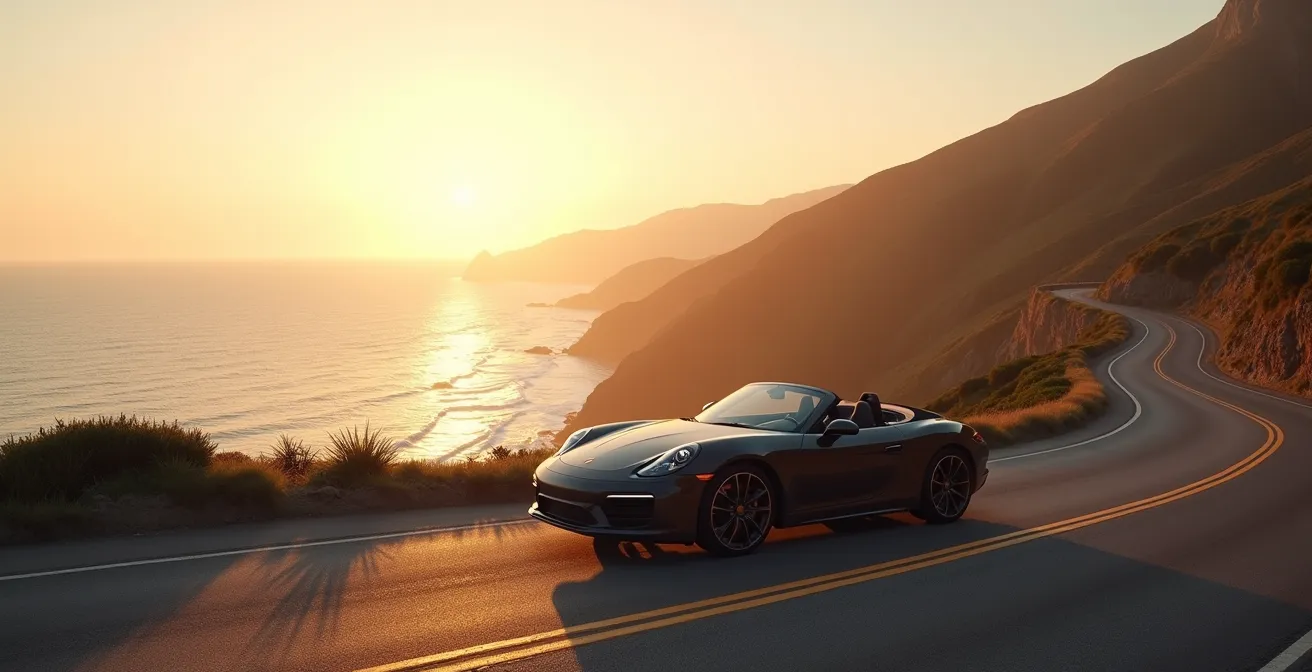
The image is seared into our collective consciousness: a convertible, top down, winding along a sun-drenched highway carved into cliffs that plunge into a sparkling blue ocean. For many, this is the quintessential American road trip. The default plan is simple: fly into San Francisco, rent a car, and drive the Pacific Coast Highway (PCH) south to Los Angeles, ticking off iconic sights along the way. It’s a journey steeped in romance and adventure, promising freedom and endless vistas.
But the reality of this dream, especially for a traveler on a tight one-week schedule, can be starkly different. The legendary PCH is also legendary for its bumper-to-bumper traffic, particularly around major cities and famous viewpoints. The drive can become a stressful, exhausting crawl rather than a liberating escape. The usual advice—book hotels in advance, see Big Sur, rent a convertible—while valid, fails to address the core problem: you’re on the same crowded path as everyone else.
What if the key to unlocking the perfect coastal road trip wasn’t about the specific highway you drive, but about the strategy you employ? This guide proposes a radical shift in thinking. Instead of blindly following a single, congested route, you will learn to think like a travel strategist. We will deconstruct the journey and rebuild it based on principles of “Experience Return on Investment” and “Cognitive Load Budgeting.” The goal is to curate a highlight reel of coastal moments, using less-traveled inland routes as smart connectors, ensuring your precious week is filled with awe, not aggravation.
This article will guide you through a new philosophy of coastal travel, from strategically avoiding tourist bottlenecks to optimizing your budget and even turning foggy days into an advantage. By the end, you’ll be equipped to design an itinerary that is truly your own—one that delivers all the beauty of the American coast with none of the burnout.
For a change of pace, and for those who appreciate a timeless classic, the following video offers a vibrant visual and musical interlude. It’s a remastered look at a cultural touchstone that has brought joy to millions online.
To help you navigate this strategic approach, we’ve broken down the key components of planning your perfect coastal journey. The following summary outlines the sections that will transform you from a simple tourist into a savvy road trip architect, ready to craft an unforgettable and efficient adventure.
Summary: A Smarter Approach to Your Coastal Drive
- Avoiding tourist traps on the Pacific Coast Highway
- Planning driving stages to avoid fatigue
- Choosing the right vehicle for the coastal route
- Optimizing the accommodation budget on the coast
- Understanding the seasonality of coastal fog
- Planning the itinerary to avoid costly tolls
- Optimizing space for passengers
- Evaluating the relevance of Route 66 for the modern traveler
Avoiding tourist traps on the Pacific Coast Highway
The term “tourist trap” on the Pacific Coast Highway doesn’t necessarily refer to the iconic sights themselves—Bixby Bridge and the Big Sur coastline are breathtaking for a reason. The real trap is the conventional wisdom that you must drive the route linearly from point A to point B, a mindset that funnels you into the same traffic flows as everyone else. The sheer scale of this phenomenon is staggering; a recent report shows that California’s coastal tourism generated a record $157.3 billion in 2024 alone. You aren’t just in a line of cars; you’re part of a massive economic engine.
To escape this trap, you must abandon the end-to-end pilgrimage. Instead, identify the 2-3 “must-see” segments of the PCH that are non-negotiable for you. Treat them as destinations, not just points on a map. For example, instead of driving the entire congested stretch from Monterey to Morro Bay, you could base yourself inland and dedicate a full day to exploring the core Big Sur section, allowing you to pull over frequently, take short hikes, and wait for the perfect photo opportunity without the pressure of a long-distance schedule.
The key is to use faster, less scenic inland highways like the 101 as strategic “jump points.” Drive the 101 to get close to a prime coastal area, then merge onto Highway 1 for the high-value scenic portion. This approach allows you to experience the absolute best of the coast while bypassing the tedious, traffic-clogged stretches in between. You’re trading quantity of miles for quality of experience, which is the first step toward a more enjoyable trip.
Planning driving stages to avoid fatigue
On a coastal road trip, not all miles are created equal. Driving 50 miles on a straight, flat desert highway is a completely different experience from driving 50 miles along the winding, cliff-hugging roads of Big Sur. The latter requires constant focus, sharp turns, and vigilance for cyclists and other vehicles, leading to significant mental exhaustion. This is the principle of “Cognitive Load Budgeting”: planning your driving day based on the mental energy required, not just the distance covered.
A common mistake is to plan a 200-mile day that includes a long, demanding coastal section, leaving the driver drained and unable to enjoy the destination. A smarter approach is to mix high-load and low-load driving. For instance, tackle a winding 2-hour coastal segment in the morning when you’re fresh, then switch to an easier inland highway for the afternoon portion of the drive. This preserves your mental energy for the experiences that matter, like exploring a town or enjoying a sunset view.
This approach also forces you to build in more frequent stops on high-load routes. These aren’t just for photo ops; they are essential “decompression stops” to reset your focus. On a route like the PCH through Big Sur, a stop every 30-45 minutes is not a delay—it’s a crucial part of the safety and enjoyment strategy. The table below illustrates how different road types place vastly different demands on a driver.
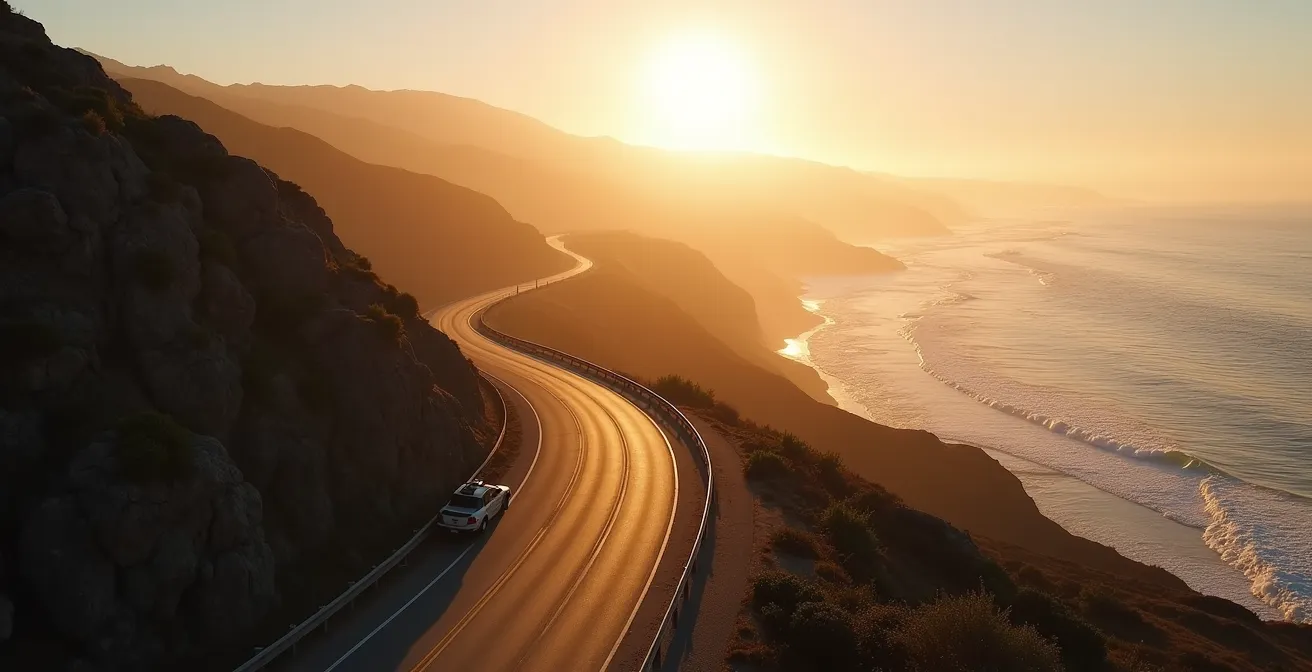
As the visual suggests, the most beautiful routes often require the most attention. By budgeting your cognitive load, you ensure that the drive itself remains a highlight of the trip, not a stressful chore to be endured between destinations. It’s a fundamental shift from “how far can we get?” to “how well can we travel?”
This table offers a clear comparison of the mental energy required for different types of roads often found on a coastal itinerary.
| Route Segment | Distance | Cognitive Load | Recommended Drive Time | Rest Stops Needed |
|---|---|---|---|---|
| Big Sur Winding Roads | 50 miles | Very High | 3-4 hours | 3-4 stops |
| Desert Highway (I-40) | 150 miles | Low | 2.5 hours | 1-2 stops |
| PCH through Malibu | 30 miles | Moderate | 1.5-2 hours | 2 stops |
| Highway 101 (straight sections) | 100 miles | Low-Moderate | 1.5 hours | 1 stop |
Choosing the right vehicle for the coastal route
The vehicle you choose is more than just transportation; it’s your mobile base of operations and a key character in the story of your trip. The classic dream, of course, is the convertible. As the experts at PCH1 Road Trip Guide note, a convertible is a fantastic choice for this journey. They advise, “The coast has stunning views and a top down lets you feel the ocean breeze and enjoy the panorama.” This romantic vision is powerful and, for some, the perfect fit.
A convertible is also a great option for driving the Pacific Coast Highway. The coast has stunning views and a top down lets you feel the ocean breeze and enjoy the panorama
– PCH1 Road Trip Guide, Pacific Coast Highway Road Trip & Travel Guide
However, a strategic traveler looks beyond the dream to consider practical realities and the specific “narrative fit” of the vehicle. Are you on a romantic getaway? The convertible is ideal. An adventure trip with hiking and kayaking? An SUV or a vehicle with a roof rack makes more sense. Prioritizing sustainability? A hybrid or EV offers a lower carbon footprint and can save significantly on fuel. The right car aligns with the kind of experience you want to have.
Beyond the narrative, there are crucial practical considerations. A sedan, for example, often offers better fuel economy on long drives and a more secure, out-of-sight trunk for valuables compared to an SUV where luggage might be visible. Before you even book, think about your total luggage, including a cooler for snacks and drinks, and any souvenirs you might pick up along the way. Your vehicle must accommodate your life on the road comfortably, not just your driving aspirations.
Your Action Plan: Vehicle Selection Checklist for Coastal Routes
- Conduct the ‘Luggage Tetris Test’: Before renting, ensure there’s ample space for all passengers, luggage, a cooler, and anticipated souvenirs. Don’t underestimate your space needs.
- Calculate True Cost: Look beyond the daily rental rate. A hybrid or EV may have a higher upfront cost but could be cheaper overall when factoring in fuel efficiency on a long trip.
- Consider ‘Narrative Fit’: What story are you telling? A convertible for romance, a 4×4 for adventure, an EV for sustainability, or a classic car for pure nostalgia. Choose the car that enhances your desired experience.
- Evaluate Multi-Modal Options: Could you park your car and use local ferries, e-bikes, or trains for specific segments? This can be a great way to experience places like the Amalfi Coast or coastal islands.
- Choose a Sedan Over an SUV for Security: If you’re carrying valuables, a sedan’s trunk is harder to break into than an SUV’s cargo area. Sedans also typically offer better fuel economy for long-distance cruising.
Optimizing the accommodation budget on the coast
Coastal real estate is among the most expensive in the world, and this premium directly translates to accommodation costs. Hotels and rentals with an ocean view come with a hefty price tag, and the demand is intense. This phenomenon isn’t unique to the US; a study of European tourism shows that in coastal regions, a staggering 51% of hotel bed capacity is concentrated along the shoreline, creating intense price pressure. The most crucial strategy to optimize your budget is to look inland.
This is the “Hub-and-Spoke” model. Instead of booking expensive, linear accommodations each night along the coast, you establish a “hub” in a charming, more affordable town 15-30 minutes inland. From this base, you take “spoke” day trips to various coastal spots. This approach has multiple benefits: you save a significant amount on lodging, you experience more authentic local culture away from the tourist crowds, and you reduce the daily hassle of packing and unpacking.
As one California native’s experience demonstrates, spontaneous booking along the coast is a recipe for disaster. They noted that their attempt to find rooms on the fly between San Francisco and Monterey “did not work out so well,” a stark reminder that planning is non-negotiable on popular routes. Securing an inland hub in advance gives you both financial savings and peace of mind. You can then “splurge” on a single, iconic coastal night if you wish, while saving substantially on the rest of the trip.

By embracing an inland hub, you trade a constant ocean view from your hotel window for a fatter wallet, less stress, and a more authentic travel experience. You can still spend all day at the beach; you just retreat to your quiet, affordable home base at night.
Understanding the seasonality of coastal fog
One of the most misunderstood elements of a California coastal trip is the marine layer, commonly known as fog. Many travelers envision non-stop sunshine, only to be met with thick, gray skies, especially during the morning hours. The fog is most prevalent from late spring through early summer, a period so predictable in Southern California it’s been nicknamed “June Gloom.” San Francisco is famous for its fog year-round, and as you head north along the coast, cooler temperatures and rain become more common even in the afternoon.
Rather than seeing fog as a trip-ruiner, the strategic traveler sees it as a scheduling tool. The fog is typically thickest along the immediate coastline in the mornings and often burns off by early afternoon. This natural rhythm provides a clear template for planning your day: embrace the “reverse day” strategy. Explore inland areas in the morning—charming towns, wineries, or redwood groves just a few miles from the coast—where the sun is more likely to be shining. Save your prime coastal driving and beach time for the afternoon when the marine layer has lifted, revealing the spectacular views you came for.

Furthermore, fog can be a tremendous creative advantage for photographers. It creates ethereal, moody shots that sunny-day tourists will never capture. A foggy morning can transform a bustling harbor into a mysterious, quiet scene or lend a mystical atmosphere to a redwood forest. By understanding the patterns of the marine layer, you don’t just avoid disappointment; you unlock a different kind of beauty and a more efficient way to structure your precious vacation days.
Planning the itinerary to avoid costly tolls
While navigating a coastal route, you’ll inevitably encounter tolls. A knee-jerk reaction might be to avoid them all to save money, but a savvy traveler evaluates them based on “Experience ROI.” Some tolls are essentially tickets to an exclusive, unforgettable experience, while others are simply time-savers with little scenic value. The Golden Gate Bridge toll, for example, offers an exceptionally high ROI; crossing it is an iconic, memorable part of any San Francisco visit. Similarly, the fee for the 17-Mile Drive in Pebble Beach grants access to a uniquely manicured and beautiful stretch of coastline you can’t see otherwise.
In contrast, paying for express lanes on a highway like I-95 on the East Coast offers a low Experience ROI. You’re paying to bypass traffic, not to see something beautiful. In these cases, it’s purely a transactional decision: is the time you save worth the money? Often, on a leisurely road trip, it’s not.
A major hidden cost, however, comes from rental car toll transponders. Rental companies often charge a daily “convenience fee” of $15-$25 for the transponder, *even on days you don’t use a toll road*. This can add over $100 to a week-long trip for no reason. The smart move is to decline the rental company’s device. Instead, use apps like Waze or Google Maps to preview toll costs and, for regions with frequent tolls, register your rental car’s license plate on a “Pay-by-Plate” website beforehand. This allows you to pay tolls directly without any exorbitant administrative fees.
Optimizing space for passengers
A week-long road trip in a confined space can test even the strongest relationships. The key to harmony is to transform passengers from passive cargo into active, contributing members of the crew. As one road trip expert puts it, you must “Transform passengers from passive cargo into active contributors to the trip’s success by defining clear roles and responsibilities.” This philosophy is the foundation of a well-organized and peaceful journey.
Transform passengers from passive cargo into active contributors to the trip’s success by defining clear roles and responsibilities
– Road Trip Planning Expert, Ultimate East Coast Road Trip Guide
A highly effective method is the “Zone Control System.” This isn’t just about keeping the car tidy; it’s about giving each person ownership and purpose. By establishing clear roles and spaces, you minimize conflict over everything from charging ports to music choices. It turns the shared space of the car into a collaborative cockpit rather than a battleground for legroom and luggage.
Implementing this system can be broken down into a few key actions:
- Establish ‘Zones of Control’: Assign each person a specific domain. The driver focuses on the road. The front passenger is the “Digital Co-Pilot,” in charge of navigation, music, and researching lunch spots or points of interest. Backseat passengers have their “comfort zone” and can be in charge of snack distribution.
- Implement the ‘Go-Bag’ System: Each person has a small bag with their daily essentials (sunglasses, book, headphones, water). The main luggage stays in the trunk, keeping the cabin clutter-free and organized.
- Assign a Charging Station: Designate specific ports or a power bank for each person’s devices. This simple step prevents the “my phone is at 2%!” panic and ensures the navigation device never dies.
- Schedule ‘Decompression Stops’: Plan short, 15-minute breaks where the explicit goal is for everyone to get out and walk in different directions. It’s a quick reset button for moods and prevents cabin fever.
Key Takeaways
- The best trip is built on a smart itinerary, not just by following one famous highway.
- Budget for your mental energy (“cognitive load”), not just your miles, to keep the drive enjoyable.
- Use affordable inland towns as a “hub” for coastal day trips to save money and reduce stress.
Evaluating the relevance of Route 66 for the modern traveler
When dreaming of an American road trip, another name often comes to mind: Route 66. The “Mother Road” is an icon of nostalgic Americana, a symbol of freedom and westward expansion. But for the modern, time-crunched traveler seeking scenic bang-for-buck, how does it stack up against a coastal itinerary? The answer lies in understanding the fundamental nature of each journey. Coastal and marine tourism is a global powerhouse, representing approximately 50% of all tourism worldwide, valued at an incredible $4.6 trillion.
This economic reality translates into a key metric for the traveler: Experience Density. Coastal routes, by their very nature, offer a high density of dramatic, ever-changing scenery. The view shifts from sandy beaches to rocky cliffs to charming harbor towns, often within a single hour of driving. Route 66, while historically significant, offers a much lower experience density. It traverses vast, often empty stretches of the American interior. The nostalgic motels and quirky roadside attractions are highlights, but they are islands in a sea of long, monotonous driving.
For a traveler with only one week, a coastal route provides a far greater “Experience ROI.” The infrastructure is generally better maintained, accommodation options are more abundant, and the “Instagram-ability” factor is consistently high. While Route 66 is a fantastic journey for those with more time and a specific interest in mid-century history, it simply cannot compete with the sheer, concentrated scenic power of a well-planned coastal drive. The following table breaks down the key differences.
| Factor | Route 66 | Pacific Coast Highway |
|---|---|---|
| Nostalgia Value | Very High – Historic significance | Moderate – Natural beauty focus |
| Instagram-ability | Moderate – Vintage Americana | Very High – Dramatic coastlines |
| Infrastructure Quality | Variable – Many bypassed sections | Good – Well-maintained scenic route |
| Accommodation Options | Limited – Rural stretches | Abundant – Coastal towns |
| Experience Density | Low – Long empty stretches | High – Continuous scenic views |
| Cost per Mile | Lower – Inland prices | Higher – Coastal premium |
Ultimately, the choice depends on your goal. If you seek a journey into American history, Route 66 is your path. If you seek a journey filled with breathtaking, continuous natural beauty on a tight schedule, the coast is, and remains, the undisputed champion.
Now that you’re armed with a new strategic framework, you can move beyond the one-size-fits-all road trip. Start designing your personalized coastal itinerary today, and trade the predictable traffic jams for unforgettable, tailor-made memories.