
Every product you touch, every package delivered to your doorstep, and every ingredient in your favorite meal has traveled through an intricate web of transportation and logistics operations. This vast industry serves as the circulatory system of the global economy, moving approximately 11 billion tons of freight annually and employing millions of professionals worldwide. Yet for many, the mechanisms behind this complex ecosystem remain a mystery.
Understanding transportation and logistics isn’t just valuable for industry professionals—it empowers consumers, entrepreneurs, and business leaders to make informed decisions about shipping, sourcing, and operational efficiency. This comprehensive resource will walk you through the fundamental concepts, operational modes, technological innovations, and current challenges shaping this dynamic field, providing you with the knowledge to navigate this essential industry with confidence.
At its core, transportation and logistics represents the strategic planning, implementation, and control of the movement and storage of goods, services, and information from point of origin to point of consumption. Think of it as orchestrating a symphony where vehicles, warehouses, technology systems, and human expertise must work in perfect harmony to deliver value.
The industry encompasses several interconnected components that work together seamlessly:
The economic impact cannot be overstated. Logistics costs typically represent between 8-15% of a product’s final price, making efficiency improvements in this sector directly beneficial to both businesses and consumers. For developing economies, reliable transportation infrastructure serves as a catalyst for trade, job creation, and market access.
Selecting the appropriate transportation mode requires balancing speed, cost, capacity, and reliability based on specific shipment characteristics. Each mode offers distinct advantages that make it ideal for particular scenarios.
Trucking remains the most versatile option, handling approximately 70% of domestic freight in many developed nations. Its strength lies in door-to-door service and the ability to reach locations inaccessible to other modes. Small businesses particularly benefit from less-than-truckload (LTL) services that consolidate multiple shipments, making road transport economical even for smaller volumes.
Road transport excels for time-sensitive deliveries within regional distances, typically under 500 miles, where the flexibility to adjust routes and schedules outweighs the higher per-mile costs compared to rail or sea.
Ocean freight moves roughly 90% of international trade by volume, making it the backbone of globalization. Container ships can carry thousands of twenty-foot equivalent units (TEUs), achieving economies of scale impossible with other modes. A single large vessel can transport the equivalent of a train stretching 44 miles long.
While transit times are measured in weeks rather than days, the cost per ton-mile remains unbeatable for non-perishable goods, raw materials, and manufactured products where timing is less critical than price optimization.
When urgency justifies premium pricing, air transportation delivers. Pharmaceuticals, electronics, fashion items, and perishable goods frequently travel by air to minimize inventory holding costs and meet tight deadlines. Though air freight accounts for less than 1% of global shipment volume, it represents approximately 35% of trade value.
The calculation is straightforward: if product obsolescence costs or lost sales from stockouts exceed the transportation premium, air freight becomes the economically rational choice.
Rail transportation offers a middle ground, combining lower costs than trucking with better speed than ocean shipping for continental distances. Intermodal transportation—seamlessly transferring containers between ships, trains, and trucks—has revolutionized logistics by optimizing each mode’s strengths throughout the journey.
A typical cross-country shipment might travel by truck to a rail terminal, move efficiently across the continent by train, then complete the final miles by truck again, reducing costs by 20-30% compared to road-only options.
Transportation represents just one link in the broader supply chain—the entire network of suppliers, manufacturers, warehouses, distributors, and retailers that collaborate to deliver products to end customers. Mastering this interconnected system separates thriving businesses from struggling ones.
Modern warehouses function as sophisticated coordination hubs rather than simple storage facilities. Strategic placement near transportation intersections or major markets minimizes overall delivery times and costs. Inside, systematic processes ensure accuracy and efficiency:
High-performing facilities utilize slotting optimization—placing fast-moving items in easily accessible locations—to reduce the walking distance that comprises up to 50% of warehouse labor time.
Balancing inventory levels represents one of logistics’ most challenging puzzles. Excess stock ties up capital and incurs storage costs, while insufficient inventory risks stockouts and lost sales. The just-in-time philosophy, pioneered in automotive manufacturing, aims to receive goods only as needed for production or sale, minimizing holding costs.
However, recent supply chain disruptions have prompted many organizations to reconsider pure just-in-time approaches, adopting hybrid strategies that maintain strategic safety stock for critical items while optimizing inventory turnover for others.
The final leg of delivery—from distribution center to customer—accounts for approximately 53% of total shipping costs despite representing the shortest distance. Urban congestion, failed delivery attempts, and the expectation for increasingly narrow delivery windows create persistent challenges.
Innovative solutions include micro-fulfillment centers positioned within urban areas, delivery lockers that eliminate failed attempts, and route optimization software that can reduce delivery distances by 10-30% through intelligent sequencing.
Digital transformation has revolutionized logistics operations, creating visibility and efficiency previously unimaginable. Understanding these technological tools helps both providers and customers optimize their operations.
Real-time tracking systems using GPS, RFID tags, and IoT sensors provide unprecedented shipment visibility. Customers can monitor their freight’s location and condition, while logistics providers gain data to optimize routes, predict delivery times more accurately, and proactively address delays.
This transparency builds trust and enables better planning. A retailer receiving real-time updates about an inbound shipment can prepare receiving dock resources and notify customers about product availability with confidence.
Warehouse automation has progressed from simple conveyor belts to sophisticated robotic systems. Autonomous mobile robots navigate facilities, transporting goods to human workers who remain stationary, eliminating unproductive walking time. Automated storage and retrieval systems maximize vertical space utilization while accelerating picking operations.
These technologies don’t necessarily eliminate jobs but rather shift human workers toward higher-value activities like quality control, exception handling, and system oversight while machines handle repetitive physical tasks.
Predictive analytics examines historical patterns to forecast demand fluctuations, enabling proactive inventory positioning. Machine learning algorithms continuously optimize routing decisions based on weather, traffic patterns, and historical delivery success rates. The result is smarter networks that self-improve over time.
A practical application: analyzing delivery data might reveal that certain neighborhoods have higher success rates for morning deliveries while others favor afternoon windows, allowing dynamic route planning that increases first-attempt delivery success.
The transportation and logistics landscape continues evolving in response to technological advances, regulatory changes, and shifting customer expectations. Awareness of these dynamics helps stakeholders prepare for what’s ahead.
Pressure to reduce the industry’s carbon footprint grows from both regulators and consumers. Transportation accounts for a significant portion of global greenhouse gas emissions, prompting exploration of electric vehicles for short-haul deliveries, alternative fuels for long-haul trucking, and route optimization to minimize empty miles.
Forward-thinking companies view sustainability not merely as compliance but as competitive advantage, attracting environmentally conscious customers and partners while potentially reducing fuel costs through efficiency improvements.
Many regions face persistent shortages of qualified truck drivers, warehouse workers, and logistics professionals. The physically demanding nature of some roles, combined with demographic shifts, creates ongoing recruitment challenges. Solutions include improved compensation, career development pathways, and continued automation to reduce physically intensive tasks.
The industry increasingly requires workers who combine traditional logistics knowledge with technological proficiency, creating opportunities for those willing to develop hybrid skill sets.
Navigating customs regulations, safety standards, and trade agreements adds complexity to international logistics. Documentation errors can result in costly delays, while compliance failures may trigger penalties. Successful freight forwarding requires expertise in regulations across multiple jurisdictions.
Trade policies continue shifting, requiring logistics providers to maintain flexibility in routing and sourcing strategies to adapt quickly to changing tariffs, trade agreements, and geopolitical considerations.
Transportation and logistics may operate largely behind the scenes, but its influence on product availability, pricing, and economic vitality is undeniable. Whether you’re launching an e-commerce venture, optimizing your company’s distribution network, or simply curious about how goods reach your doorstep, understanding these fundamental concepts empowers better decisions. The industry’s continued evolution through technology, sustainability initiatives, and operational innovations ensures it remains a dynamic field rich with opportunities for learning and professional growth.

Investing in new delivery technology is not enough to slash last-mile costs; true efficiency comes from using it to dismantle the rigid, static operational models that cause failures. Success lies in creating a dynamic system that optimizes routes, inventory density,…
Read more
Predictive analytics transforms fleet operations from a cost center into a margin-expansion engine by shifting decisions from reactive to probabilistic. It moves beyond simple monitoring to provide the financial leverage needed to lower insurance premiums, optimize capital expenditure on assets,…
Read more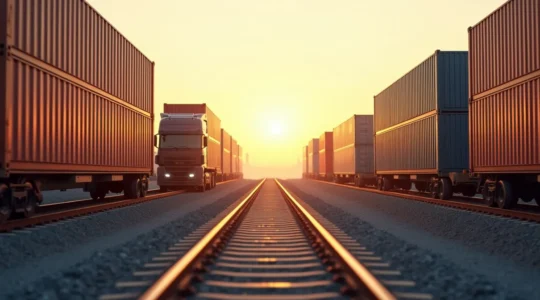
Intermodal’s promise of 10-15% savings is only the beginning; true cost mastery lies in controlling hidden operational variables that determine your real-world ROI. Mitigate rail-specific risks like harmonic vibration through advanced blocking and bracing, not just standard packing. Strategically choose…
Read more
Total logistics visibility isn’t about more tracking; it’s about eliminating operational risk by creating a predictive digital nervous system. Manual data entry introduces unacceptable integrity risks in high-value supply chains. True digitalization transforms dispatchers from reactive problem-solvers into proactive ‘Logistics…
Read more
True driver endurance isn’t about fighting fatigue with stimulants; it’s about engineering your body’s performance like a high-precision machine. Your body’s internal clock (circadian rhythm) dictates peak and low energy periods, which you can manage, not just endure. Strategic nutrition…
Read more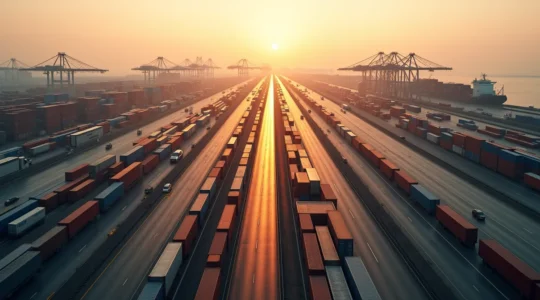
The conventional approach of simply trying to move goods faster through congested corridors is a losing battle; the real solution is to strategically re-architect your logistics flow to make the bottleneck irrelevant. Instead of large, centralized warehouses, leverage a network…
Read more
The efficiency of your fleet is dictated less by traffic and more by the hidden ‘geometric friction’ of the highways themselves. Subtle design elements like vertical grade and interchange spacing directly impact fuel burn and travel time predictability. Toll roads…
Read more
Effective route planning isn’t about avoiding obstacles; it’s about mastering the physics of the terrain and the science of weather to turn liabilities into predictable, manageable variables. The shortest route is often a “false economy,” increasing total costs through higher…
Read more